sogood
Well-Known Member
As the title suggests, I embarked upon one particular job which developed into something entirely different, as follows.
I took my boat out at the end of the season with the intention of scraping the hull and antifouling it. It had never been antifouled and was the original gelcoat, which I had been hoping to preserve. I launched her for the first time last year with a view to seeing how she might or might not be affected by growth etc. I thought that because she is moored in brackish water the growth might not be too bad. How wrong I was!
Tiny barnacles soon took hold, at times clogging up the water intake on the leg, but not before I discovered it, so no harm done. Just ensuring to keep it clear. The rest of the hull developed such a build up as to seriously affect performance, feeling as though I was dragging my anchor.
Alongside this, I noticed the boat was listing at times and further investigation showed that she was taking on water. The bilge pump was handling this and the fact that my mooring drains dry at low tide helped, as any water onboard would drain back out when she was sitting on the dry.
But it got worse and needed investigation, so after pulling her out and taking her home, a closer look showed the exhaust bellows had come adrift. The reason for this was serious corrosion on the bellows flanges on both ends of the gimble housing. The corrosion was mostly on the lower edges and the bellows pulled away easily, not helped by the fact that I have to leave my boat moored with the leg fully raised, to clear the bottom on low tide.
I found this to be a not uncommon problem with some "fixes" available, but I opted for a replacement and found a very good, clean, freshwater used replacement gimble on ebay. So, while awaiting delivery, I decided to look into the transom, as the engine and outdrive had to be removed anyway. I cut away the inner glass and some battery shelves at either side of the inner transom and found what remained of my transom. A mostly soft, mushy remnant of what once used to be. Looking ahead, I cut away the rear section of the cap that runs across the top of the transom, to facilitate fitting the new transom. I wanted to fit it in one complete section, rather than building it up in sections.
Now, after much cutting, scraping, grinding etc. I'm almost ready to start installing the new transom. I have both 3/4" marine ply transom boards cut and each have been given a coat of resin to help seal them up. All my glass is cut also and I'm just waiting for some better weather to start rebuilding it.
To cut the new transom boards, I used an 8x4 sheet of 3mm hardboard, hung on the outside of the transom, onto which I then marked out the shape of the transom. This was then reduced in size accordingly, to allow for the fact that the transom dimensions are smaller on the inside. New transom boards ahve been dry fitted and I'm very happy with the result. I alsso routed off the inside edge of the first board, to allow it to sit snug, compensating for the irregular inner edge of the transom/sides/hull. While I'm at it, I'll also be replacing sections of the stringers where they meet the transom and I'll be looking into the engine mounts, as the mounting bolts came out with little or no effort. I thought they were just a bit loose, but found that they wouldn't tighten up at all and just kept turning when I tried to do so! As for the barnacles, they are gone. I have scraped and cleaned the hull right back to spotlessly clean and it's ready for primer and antifoul. This required some inventive approaches, as the boat sits on a bunked trailer and I had to support the boat, one side at a time and drop the bunks to allow access for cleaning. I'll have to take a similar approach when painting.
I also found some corrosion on the lower mounting holes on the exhaust "Y" pipe, but this has been addressed. This "Y" pipe was missing one of it's four mounting bolts and the bottom two were so loose as to be easily removed by hand! Another bullet dodged.
A little side job was the salvaging of my recently renewed starter motor. This had been submerged during one or more of the water ingress occasions. I removed the starter and left it sitting in a bucket of fresh, soapy water for a few day, just to flush it out and clean away any possible salt build up. Then I pressure hosed it, dismantled it and cleaned and lubed all the relevant moving parts. I left the various parts sitting on a shelf in the immersion/hot press and when I was happy that it was fully dried out, I cleaned it up and re-assembled it and am happy to say its functioning perfectly. So at least I've saved that much.
I'll post further updates as I progress, but I'm working against time as my next work/tour season is due to kick off around March 8th. Fingers crossed for better weather. I can only post one picture here so I'll show you the corrosion to the gimble housing where the exhaust bellows attaches. The corrosion was the same at either end of the bellows.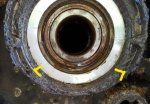
In the meantime, my replacement gimble housing arrived and it's perfect!
I took my boat out at the end of the season with the intention of scraping the hull and antifouling it. It had never been antifouled and was the original gelcoat, which I had been hoping to preserve. I launched her for the first time last year with a view to seeing how she might or might not be affected by growth etc. I thought that because she is moored in brackish water the growth might not be too bad. How wrong I was!
Tiny barnacles soon took hold, at times clogging up the water intake on the leg, but not before I discovered it, so no harm done. Just ensuring to keep it clear. The rest of the hull developed such a build up as to seriously affect performance, feeling as though I was dragging my anchor.
Alongside this, I noticed the boat was listing at times and further investigation showed that she was taking on water. The bilge pump was handling this and the fact that my mooring drains dry at low tide helped, as any water onboard would drain back out when she was sitting on the dry.
But it got worse and needed investigation, so after pulling her out and taking her home, a closer look showed the exhaust bellows had come adrift. The reason for this was serious corrosion on the bellows flanges on both ends of the gimble housing. The corrosion was mostly on the lower edges and the bellows pulled away easily, not helped by the fact that I have to leave my boat moored with the leg fully raised, to clear the bottom on low tide.
I found this to be a not uncommon problem with some "fixes" available, but I opted for a replacement and found a very good, clean, freshwater used replacement gimble on ebay. So, while awaiting delivery, I decided to look into the transom, as the engine and outdrive had to be removed anyway. I cut away the inner glass and some battery shelves at either side of the inner transom and found what remained of my transom. A mostly soft, mushy remnant of what once used to be. Looking ahead, I cut away the rear section of the cap that runs across the top of the transom, to facilitate fitting the new transom. I wanted to fit it in one complete section, rather than building it up in sections.
Now, after much cutting, scraping, grinding etc. I'm almost ready to start installing the new transom. I have both 3/4" marine ply transom boards cut and each have been given a coat of resin to help seal them up. All my glass is cut also and I'm just waiting for some better weather to start rebuilding it.
To cut the new transom boards, I used an 8x4 sheet of 3mm hardboard, hung on the outside of the transom, onto which I then marked out the shape of the transom. This was then reduced in size accordingly, to allow for the fact that the transom dimensions are smaller on the inside. New transom boards ahve been dry fitted and I'm very happy with the result. I alsso routed off the inside edge of the first board, to allow it to sit snug, compensating for the irregular inner edge of the transom/sides/hull. While I'm at it, I'll also be replacing sections of the stringers where they meet the transom and I'll be looking into the engine mounts, as the mounting bolts came out with little or no effort. I thought they were just a bit loose, but found that they wouldn't tighten up at all and just kept turning when I tried to do so! As for the barnacles, they are gone. I have scraped and cleaned the hull right back to spotlessly clean and it's ready for primer and antifoul. This required some inventive approaches, as the boat sits on a bunked trailer and I had to support the boat, one side at a time and drop the bunks to allow access for cleaning. I'll have to take a similar approach when painting.
I also found some corrosion on the lower mounting holes on the exhaust "Y" pipe, but this has been addressed. This "Y" pipe was missing one of it's four mounting bolts and the bottom two were so loose as to be easily removed by hand! Another bullet dodged.
A little side job was the salvaging of my recently renewed starter motor. This had been submerged during one or more of the water ingress occasions. I removed the starter and left it sitting in a bucket of fresh, soapy water for a few day, just to flush it out and clean away any possible salt build up. Then I pressure hosed it, dismantled it and cleaned and lubed all the relevant moving parts. I left the various parts sitting on a shelf in the immersion/hot press and when I was happy that it was fully dried out, I cleaned it up and re-assembled it and am happy to say its functioning perfectly. So at least I've saved that much.
I'll post further updates as I progress, but I'm working against time as my next work/tour season is due to kick off around March 8th. Fingers crossed for better weather. I can only post one picture here so I'll show you the corrosion to the gimble housing where the exhaust bellows attaches. The corrosion was the same at either end of the bellows.
In the meantime, my replacement gimble housing arrived and it's perfect!


 I was being flippant, but in your shoes I can understand you being grumpy. If you have different barnacles in Ireland to us in Wales you may indeed get away with Trilux. It is the common choice so something must be said for it. I'd have thought the photo spoke volumes but in case you missed it not a single barnacle on the transom.