A rare anchor thread......

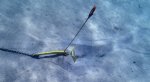
Here are the results of my morning swim a couple of days ago, armed with my new Tough camera, same as noelex' I think.

The anchorage is on the north side of Amorgos. It is known for having a hard bottom, indeed the wiki pilot advises not to use a CQR. We attempted five times to set our Rocna, Jill reversing the boat while I watched the anchor with mask and snorkel. Eventually we settled for a poor situation as the wind was very light. There were four boats in the anchorage by morning, all on different anchors with mixed results.

1. German boat, anchor type unknown to me, looks like some sort of forged Danforth type. Perfectly set.
02a3a222913f7b24824a6f1004df2b2e_zps38867ec0.jpg

2. People we know, Bugel anchor. We watched them attempt a couple of times but clearly successful
5dd3b9412254878a5d4ace486489d00f_zps406d4c27.jpg

3. Our Rocna. The Captain Elias pilot says holding is OK if your anchor catches a clump of weed(!). This is it.
92d1f8a03cf15e708b76a856abad07a4_zps0f7948b1.jpg

4. Delta. They seemed a little slapdash in their anchoring, although they did reverse it in.
1858bf2343a68f65e1ab0e661186a6af_zps5377c3c6.jpg


Quite a surprising result to me. We are thinking of buying a sacrificial rebar grapnel from a fisherman chandlery for any future anchorages like this one.
 
Thanks for the photos.
The unknown anchor is a Jambo. I have only seen a few, but it does well in weed. It does not have a big blade area and the thick shank will reduce deep penetration, so I suspect it will struggle in softer substrates, but I have no evidence to back that up. As you say it did very well on this occasion. Here is a couple of photos I have taken of the Jambo out of the water to give you some idea of the design.

Available in SS and Galvanised. Very sexy in SS :), almost a rival for the Ultra.

The Rocna does not look very good at all. When you part the weed it tends to look even worse. Is there rock under the sand? Any idea what is in the top left of the photo is it rock or a bit of debris, or something else?
The Delta is also poor. The Bugel looks good, but may be a copy.

The Delta looks spookily like one a saw recently. Perhaps yellow Deltas with red flat float ropes are in fashion :)
 

Attachments

  • image.jpg
    image.jpg
    93.7 KB · Views: 0
Last edited:
Interesting images:

Are we sure the yellow model is a genuine Delta. We spent a month of last summer in the Med and I noted many painted anchors. Commonly these were Bugel copies and they might simply have been painted because they were not galvanised, or galvanised poorly. We also noted that many people on yachts were on holiday and had little idea about anchors or anchoring. They deployed their anchor, chilled white wine in hand, until it reached the seabed, dropped a bit more chain and then went aft to join the party. It is not surprising that some anchors are seen lying on their side (particularly in a hard seabed) they are not set in the first place. On many yachts we saw there was a tendency, as everywhere else in the world, to have undersized anchor gear - whereas Noelex has a monster of a Mantus, nearly 60kgs on a large, but not that large, a yacht. Anchor tests need to compare like with like, same weight, same setting procedure - any other evidence are simply nice pictures and very dangerous to make comparisons, for example comparing a 60kg Mantus with a 15kg CQR!

But Vyv is correct in that the best, or better, anchor is one that performs in a cross section of seabeds but there has been an emphasis on hard seabeds in many anchor tests - in fact Mantus had a series of videos illustrating how their anchor was the only one to set at all (in their chosen seabed) and it was most unusual to have an anchor test where neither Ronca nor Supreme would set. In fact it is difficult to find an anchor test where a variety of anchors were directly compared with a soft mud or soft sand seabed. Fortress I think did some testing in mud in the 90's and PS had an article on anchors in soft mud - but the rest of testing is commonly harder sands. Many of the seabeds round the UK are soft, most of the estuarine anchorages on Australia's east cost, most of Tasmania's Rivers, Port Davey, Macquarrie Harbour and Port Phillip Bay at Melbounre are soft mud - so the Fortress tests will be of considerable interest here. Looking at Noelex rather large portfolio of images none of the anchors are well set, they all show protruding shanks and/or roll bars - which might be set but not well set. The suggestion is the images are all a hard seabed. It will be interesting when he eventually moves to very soft sand or soft mud or heavy weed.

No anchor is going to be perfect in every seabed, which is why if you have a twin bow roller then the idea of 2 different anchor styles is sensible. Most of us have only one bow roller but having an alloy anchor does allow easy deployment of a second. But we want an anchor that works optimally in as many of the seabeds one uses but if anchor tests only look at hard bottoms (which is where a CQR and Delta struggle) this might have resulted in anchors that are actually not very good in soft seabeds - we have been blinded by the results. But to discard convex because the Delta, now almost 40 years old and CQR coming on for 80 years old do not work is frankly ludicrous (and only a complete idiot or someone of limited knowledge would suggest that because a CQR does not work then no convex will work) - there have been developments since which do work in harder substrates.

Jonathan
 
Last edited:
To illustrate lack of anchoring knowledge - the yellow delta type in Vyvs post above - note the way in which the Swivel is attached. Vyv has a lovely series of images on his website as to why this is wrong. If they knew about anchoring they would not have a swivel ready to distort.

Jonathan
 
To illustrate lack of anchoring knowledge - the yellow delta type in Vyvs post above - note the way in which the Swivel is attached. Vyv has a lovely series of images on his website as to why this is wrong. If they knew about anchoring they would not have a swivel ready to distort.

Jonathan

I cannot speak for the German boat but the other three are all long term British cruisers. The yellow anchor is a Delta. Quite common to paint anchors, initially because they rust. My Delta was painted silver quite a few years ago but has been used only rarely since. I painted my Rocna white this year, again due to rusting of both flukes and shank, but have found the colour a significant bonus in spotting where the anchor is lying. I can see it clearly at the end of 30 metres of chain.

It was also interesting to see that all four of us had some sort of strop or buoy attached to the head of the anchor. Speaks volumes for experience when anchoring problems occur. All Sunsail anchors used to have a length of floating line attached, don't know whether that is the case now.

I agree your comments about the swivel. The bending at the jaws could be a big problem, although a Kong of that size does give some leeway on strength. Our swivel free season is proving interesting. Have anchored close to 100 times and the anchor has come up inverted twice. The shackle has jammed a couple of times between the forestay and bow roller shank due to it being the opposite way around now, previously the eye of the shackle went through the larger link chain between anchor and swivel. Jill seems to have got the hang of turning the anchor over quite easily so we will probably continue with just a shackle. (To clarify, Jill does the anchoring rather than helming as she does not enjoy close quarter boat manoeuvring, not because I like ordering her about!)

Is 'Bugel copy' a misnomer? I understood that due to a misunderstanding on the designer's part the plans were never copyrighted. Anyone can make one from the original drawings, the main production ones being by WASI.
 
Hi Vyv,

Interesting comment from you on your success, so far, in removing the swivel. It is also interesting that this introduced another problem, the shackle jamming. It will be useful if at the end of the season you can summarise what you did, found. I do recall you had found, as we better noticed after you made mention, that the windlass seemed to induce chain twist - I assume this is still the case - so how do you get rid of it? We find that it must untwist on retrieval as we have never had the tangle you described in your chain locker.

Again maybe strops and/or buoys are a Med thing - very unusual here.

Of the Bugel - in our month's sojourn last year in the Med we saw very few genuine (or stainless) Bugels - and some of these might have been copies. But we saw lots of different styles, including one with 2 toes - a bit like that Jambo (which we also saw) but fixed fluke and roll bar. We actually saw one Jambo with an integrated swivel in the shank. Many of these steel (non stainless Bugels) were painted and rusty and a surprising number had bent shanks. My deduction was that there was a lot of backyard Bugel production - their very popularity suggested they were either very cheap (though never saw one for sale in a chandler) and/or did work well But painted anchors were quite common in the Med but I think ours is the only painted one I have seen here in Oz (painted so as to be able to see it and it shows up better on images) and we have painted our Excel, Spade, Fortress.

I noted your comment 'that no-one who buys a new gen anchor goes back to the older style' - but we noticed very few new gen anchors on yachts - the anchor makers have a huge market still to address! But presumably the many owners of the CQRs, Delta's, Bugels (in the east Med) and Brittanys (in the west Med) are happy (or in blissful ignorance) - or they would have chenged.

Jonathan
 
These are my latest photos of a Wasi (or what I would call genuine) Bugel. (Maybe "original" might be more correct.)

The boat was Med-moored in softer sand than is typical for this area. Churned up by the repeated anchoring.
I did not see the drop, so I don't know how skilfully the drop was carried out, or how much force they put on the anchor etc.


This is the result:
5-6m @ 5:1
It has set rapidly in only a metre or so. The anchor still has a significant list of about 30 degrees. The underside of the fluke is still reasonably exposed, as well as a small amount of the top. Nevertheless, it has achieved a 'just acceptable' set. It is difficult to tell from this sort of appearance what would happen with a bit more force on the anchor so it is difficult to come to firm conclusions. Would it rotate level and bury more?
Some extra wind would be helpful in judging the anchor's performance better.


imagejpg1_zpsf4eae6c9.jpg


imagejpg2_zpsa419ad1a.jpg
 
Last edited:
These are great images but they have no reference point. There is no 'standard'. To be useful the anchors need to be defined by size and we need to know how a common standard, or maybe 2 or 3 standards - set the same way in the same seabed would perform. Its a 'just acceptable set' - but how does this compare with a CQR, Brittany, Rocna of the same size (or sized for the same vessel) in the same seabed, set the same way? For all we know all the other anchors would not set as well, or they might set better. We in fact do not know how it was set - maybe the owner is sufficiently confident he is happy as it is (based on not having dragged previously). There are certainly lots of Bugels around in the eastern Med - they are not all surely bought because they are pretty (genuine and made from stainless) or cheap (made in a backyard).

What is interesting is that despite lots of gorgeous images, taken at great expense of time, of CQRs set appalingly reports of yachts being lost through CQRs dragging are actually quite rare. I personally find this most odd, having had, copy, CQRs drag sufficient often we bought another anchor, so why if they set so badly are they so common - and used by long term cruisers?

To me the images are superb but they raise many more questions than they answer and to be able to conclude anything about anchor performance would be 'challenging'.

Jonathan
 
Vyv, I appreciate the input. Soft mud is very common here across the pond in bays, lakes, and rivers. It is certainly possible that in addition to soft mud, the CQR might also perform better in difficult bottoms such as grass, weeds, and rocks where the roll bars of the new generation anchors could very well impede penetration, so the advantage of the roll bar anchors might be limited to only harder soils such as clay and sand.

While I agree with your assessment that no one goes back to a CQR after using a new generation anchor, it also seems common that few switchers purchase a new generation anchor that is the same weight as their CQR.....they typically size up to a much heavier new generation model, so by that alone, they should experience a notable performance improvement.

What a good point, Brian.
On looking at the recommendations for new generation anchors, they all boat, using length/weight, ask you to have a heavier one than CQR, Delta (or Fortress).

From this I have to conclude that, like the Emperor with his clothes, the protagonists may have missed a point.

Before his untimely death, I had many e-mail discussions with Alain Poiraud and his most telling point, in support of "new generation" anchors was INCREASED FLUKE area.
I look forward to your final findings - though I don't own one I'm sure that in terms of holding power/weight the Fortress will top the lot.
 
Like Vyv's idea (and many others it appears) of painting the anchor to increase visibility. Although the water in Scotland can sometimes be gin clear it is too too damm cold for any sub surface investigation !

As regards swivels, in all the years with our CQR and now with the Rocna we have never used one - just a good quality shackle so what are the disadvantages or potential pitfalls of not having one ?

Also, as we have some anchor experts contributing to this thread a quick off topic question please;

The galvanising on the tip of our Rocna has worn away leaving a rusty tip, other than that it is in fairly good nick - what is the best option for treating it ? (apols once again for o/t but such an opportunity for good advice does not come around often :))
 
Last edited:
What a good point, Brian.
On looking at the recommendations for new generation anchors, they all boat, using length/weight, ask you to have a heavier one than CQR, Delta (or Fortress).

From this I have to conclude that, like the Emperor with his clothes, the protagonists may have missed a point.

Before his untimely death, I had many e-mail discussions with Alain Poiraud and his most telling point, in support of "new generation" anchors was INCREASED FLUKE area

I shared e-mail discussions with Alain of Spade as well and he was quite the character. He was very proud of his product and rightly so, and he certainly had a strong opinion about competitive brands. We engaged in some heated "my anchor is better than your anchor" type debates, but they were always respectful, and I thought highly of him as a pioneer in anchor design.

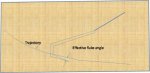
In regards to increased fluke area, it is also vitally important that an anchor has an aggressive downward trajectory as it is being pulling into a sea bottom. During our soft mud bottom testing, the crew were stunned when one of the most recent new generation models, which had a massive surface area advantage over the other models, never really engaged the bottom.

When I shared the results and images of this anchor with Bob Taylor, a retired US Navy anchor design & soil mechanics expert, who is consulting for us on this project, he said it was obvious that the "effective fluke angle" of this anchor was minimal in soft mud, and in turn, so was the resistance it created.

His words: It’s not all about fluke area, it is how the anchor presents itself during penetration to cause soil bearing failure.

By the way, I would like to post an image to illustrate this, but I am at my maximum KB capacity for images. Does anyone know how to delete old images to free up space?

Thanks,
Brian
 
Last edited:
Go to "settings" (top right just below the adds)

Then "miscellaneous" and "attachments" on the left hand side.

Check the boxes on the photos you want to delete and select delete.

(Or host them on an external site light photobucket)
 
Thanks Noelex. For whatever reason, I have tried (3) web browsers and was only able to see the check off box a couple of times and then delete just an image or two, but I was able to squeeze the one below in, which is for the point I made above.
 

Attachments

  • image008.jpg
    image008.jpg
    20.1 KB · Views: 0
I shared e-mail discussions with Alain of Spade as well and he was quite the character. He was very proud of his product and rightly so, and he certainly had a strong opinion about competitive brands. We engaged in some heated "my anchor is better than your anchor" type debates, but they were always respectful, and I thought highly of him as a pioneer in anchor design.

In regards to increased fluke area, it is also vitally important that an anchor has an aggressive downward trajectory as it is being pulling into a sea bottom. During our soft mud bottom testing, the crew were stunned when one of the most recent new generation models, which had a massive surface area advantage over the other models, never really engaged the bottom.

When I shared the results and images of this anchor with Bob Taylor, a retired US Navy anchor design & soil mechanics expert, who is consulting for us on this project, he said it was obvious that the "effective fluke angle" of this anchor was minimal in soft mud, and in turn, so was the resistance it created.

His words: It’s not all about fluke area, it is how the anchor presents itself during penetration to cause soil bearing failure.

By the way, I would like to post an image to illustrate this, but I am at my maximum KB capacity for images. Does anyone know how to delete old images to free up space?

Thanks,
Brian

"one of most recent new gen" etc. must be Mantus.

But in any case, I did observe this phenomenon with my previous anchor, a 55kg (121 pounds) Rocna, which just did not set in soft mud. I would have to use my kedge instead (a large Fortress), which with the "mud palms" would grab soft mud instantaneously and hold.

I do not have this problem with my present main bower, a 100 pound Spade. Maybe it's the "effective angle of presentation", or maybe its the lead ballast and sharp fluke. Whatever it is, it works.

"New gen" anchors are truly a great leap forward, but they are not all the same, and they are not all without any weaknesses.
 
The galvanising on the tip of our Rocna has worn away leaving a rusty tip, other than that it is in fairly good nick - what is the best option for treating it ? (apols once again for o/t but such an opportunity for good advice does not come around often :))

I am not aware that there is any satisfactory treatment for worn galvanising on the toe of the anchor. It happens to all anchors, except alloy, and the speed of wear is a function of steel chemistry and how it was galvansied. If you are using the anchor regularly having a raw steel toe is not disadvantageous, it will not corrode anyway and any corrosion would be superficial and wear of in use. If you =decommission' the yacht for winter then the obvious solution is to clean and paint the toe (with an anticorrosive) when you put the yacht to bed. This will wear off very quickly when you come to use the anchor next season. Some people do regalvanise their anchors but if its only the toe I would not bother, wait till you start to see rust on the shank and then go for the regalvansing. If you have an original Rocna with the HT shank then they were reputed to have poor gal on the shank (its a function of the steel chemistry and the gal process) and the shank might go more quickly that the 'rest' of the fluke.

But the issue you have is not a function of it being a Rocna - all galvansied steel toes wear off the gal.

Of swivels - to me simply another connector and another item to go wrong. Many people who use swivels comment that when they lift their anchor it rotates as it comes up - which suggests that the swivel does not 'undo' any twists - but this is anecdotal. If you were to anchor in one place for a long time and the location was tidal then your yacht might turn, and turn the same way, and introduce twist and in such a situation I can see that a swivel might be useful (note the anecdotal comment) but for normal anchoring I simply do not see any reason to use one - the twists will fall out as the anchor lifts from the seabed. it seems to be to be another piece of very clever marketing and preying on fear. Most swivels are connected incorrectly, as per the yellow Delta - which appears to negate any advantage as the fork is not designed to take a side load (and the anchor shank is not designed to be lengthened). I have seen how a swivel has bent the end of a shank, have seen bent swivels and swivels with bent forks (I think Vyv's website has an image of the latter) The barrel part of the swivel is totally hidden from the owners view and it is impossible to see how the 'shank' of the swivel is performing. I might be wrong (as common) but swivels seem to be a recent phenomena - I do not recall them being quite so common 20 years or more ago, We do not use a swivel.

Jonathan


Jonathan
 
The Bugel I showed in post #47 has changed in response to some wind pressure.

We have had little wind (perhaps 15 knots), but Med-moored there is a bit more pressure on the anchor with any crosswind. This together with soft substrate and relatively small fluke area of the Bugel has been enough to set the anchor better.

The fluke is now further dug in and the list is down to 20 degrees. Reassuringly it has done this better set with minimal movement backwards. Anyway it is now a good set. It is well buried. I would prefer to see less list, but this is decreasing as it buries. (The Bugel is a bit more prone to mantaining a list at a stage in the set when newer roll bar anchor anchors would have levelled out)

Notice how rapidly the drag marks are filling in. They are barely visible. This will only happen in softer substrate.

imagejpg1_zps89d6169f.jpg


imagejpg1_zps5966e945.jpg
 
I am not aware that there is any satisfactory treatment for worn galvanising on the toe of the anchor. It happens to all anchors, except alloy, and the speed of wear is a function of steel chemistry and how it was galvansied. If you are using the anchor regularly having a raw steel toe is not disadvantageous, it will not corrode anyway and any corrosion would be superficial and wear of in use. If you =decommission' the yacht for winter then the obvious solution is to clean and paint the toe (with an anticorrosive) when you put the yacht to bed. This will wear off very quickly when you come to use the anchor next season. Some people do regalvanise their anchors but if its only the toe I would not bother, wait till you start to see rust on the shank and then go for the regalvansing. If you have an original Rocna with the HT shank then they were reputed to have poor gal on the shank (its a function of the steel chemistry and the gal process) and the shank might go more quickly that the 'rest' of the fluke.

But the issue you have is not a function of it being a Rocna - all galvansied steel toes wear off the gal.

Of swivels - to me simply another connector and another item to go wrong. Many people who use swivels comment that when they lift their anchor it rotates as it comes up - which suggests that the swivel does not 'undo' any twists - but this is anecdotal. If you were to anchor in one place for a long time and the location was tidal then your yacht might turn, and turn the same way, and introduce twist and in such a situation I can see that a swivel might be useful (note the anecdotal comment) but for normal anchoring I simply do not see any reason to use one - the twists will fall out as the anchor lifts from the seabed. it seems to be to be another piece of very clever marketing and preying on fear. Most swivels are connected incorrectly, as per the yellow Delta - which appears to negate any advantage as the fork is not designed to take a side load (and the anchor shank is not designed to be lengthened). I have seen how a swivel has bent the end of a shank, have seen bent swivels and swivels with bent forks (I think Vyv's website has an image of the latter) The barrel part of the swivel is totally hidden from the owners view and it is impossible to see how the 'shank' of the swivel is performing. I might be wrong (as common) but swivels seem to be a recent phenomena - I do not recall them being quite so common 20 years or more ago, We do not use a swivel.

Jonathan


Jonathan

Galvanising wear - surely it shows the anchor is doing its job and digging in, on my CQR, within 80 deployments, an area 20mm x 4mm had been stripped off the front edge 100mm from the point. On the other hand all the galvanising flaked off the back of the stern kedge Delta after 3 seasons.

I tried a swivel for 2 years - it made no significant difference to how many times the anchor was correctly presented on recovery. Apart from being another "fail-point" it seriously changes the weight distribution of an anchor - in the wrong direction. On a CQR, which is only just tip-down, it was a definite disadvantage.

I believe Vyv Cox is doing some experiments on wit/without swivels.
 
The Bugel I showed in post #47 has changed in response to some wind pressure.

We have had little wind (perhaps 15 knots), but Med-moored there is a bit more pressure on the anchor with any crosswind. This together with soft substrate and relatively small fluke area of the Bugel has been enough to set the anchor better.

The fluke is now further dug in and the list is down to 20 degrees. Reassuringly it has done this better set with minimal movement backwards. Anyway it is now a good set. It is well buried. I would prefer to see less list, but this is decreasing as it buries. (The Bugel is a bit more prone to mantaining a list at a stage in the set when newer roll bar anchor anchors would have levelled out)

Notice how rapidly the drag marks are filling in. They are barely visible. This will only happen in softer substrate.

Cannot post new photos at present. We anchored yesterday and could see that the Rocna was well bedded, easily done when it is painted white. By the time I swam over it about an hour later we had swung through about 270 degrees and the anchor looked very much like your Bugel shot. The wind was never strong enough yesterday to bed it more deeply so it continued to look about the same.

We know that after a good blow it will bed quite deeply and symmetrically. This after a day and night of F6 a few years ago.
IMG_0052.jpg
 
Galvanising wear - surely it shows the anchor is doing its job and digging in, on my CQR, within 80 deployments, an area 20mm x 4mm had been stripped off the front edge 100mm from the point. On the other hand all the galvanising flaked off the back of the stern kedge Delta after 3 seasons.

.

If galvansing flakes off an object then that is more likely to occur as a result of poor galvansing (commonly poor preperation/cleaning). Galvansing should wear off not flake.

But if you look at different anchors the wear of galvanising does give some indication as to how an anchor works. On our Excel the wear is at and on top of the toe and in the bulge under the toe. The toe wears because it engages first and the underside wears as it is part of the development of compression. Compression also develops at the rear of the fluke, where it upturns (in the same way I'd expect to see wear (not flaking) on a Delta. I'd guess a Kobra might wear the same way. A Rocna tends to wear in a vaguely similar manner - at the toe and at the upturn at the heel of the fluke where the seabed is compressed between roll bar and fluke. A Supreme with no compression point only wears at the toe. Spade seem to wear at the toe, underneath where that large bulge is and to a much lesser extent at the rear of the fluke. I do not see enough genuine Bruce to comment - and the few I see are very old and generally rusty. Anchors also wear at the shackle point of the shank - as on modern anchors this part of the anchor is dragged below the seabed simultaneous with the toe engaging. Obviously with time all anchors will wear all over - but most wear will occur at the toe and wherever the compression point is (if it has one).

Jonathan
 
Top