A Lesson in Physical Chemistry

Did you remember to account for the difference in atmospheric pressure on either side caused by the height difference :)

:D No, I suspect I got the conversion to mm wrong by a factor of 10 as half my mind was on the stove too. Also left in a dividing 2 for the half gate height, not correct for the difference calculation. Poor show all round. :(
 
Last edited:
I agree on the 490 N/m^2, but I think this would be balanced by a drop of 50mm. 50kg/m^2 / 1025kg/m^3 = 49 mm

The difference in density is 2.5%, so difference in surface height (from the equilibrium height) will be in the same ratio. 2000mm * 0.025 = 50mm

Thanks - see above! :redface-new:
 
σt = (ρ - 1000) kg m−3 when p = -g ρ z(TDS=[(A-B) * 1000]/mL)


Yeah!!! b..dy right too !!!

Has it occurred to anyone that the gates might be knackered & the lock keeper just gave the Op that waffle to stop him complaining,
 
Last edited:
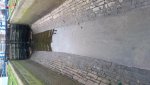
This doesn't add anything to the technical discussion, but just out of interest, a picture taken during the upgrade. Couldn't see my 'phone though.
20180112_154544.jpg
Oops, sorry, don't know how to rotate it.
 
Last edited:
σt = (ρ - 1000) kg m−3 when p = -g ρ z(TDS=[(A-B) * 1000]/mL)


Yeah!!! b..dy right too !!!

Has it occurred to anyone that the gates might be knackered & the lock keeper just gave the Op that waffle to stop him complaining,

The gates are fairly new, two years old perhaps? No complaining from me, well at least not until I was asked to help open the gate! The lock keeper and his pal had veins bulging in their necks trying to get the thing to move initially.
 
The gates are fairly new, two years old perhaps? No complaining from me, well at least not until I was asked to help open the gate! The lock keeper and his pal had veins bulging in their necks trying to get the thing to move initially.

My photo was taken on January 12th 2018, so just 1 year old.
 
Last edited:
Good to see that the nondescript shed on Newlyn Pierhead has gained Grade 11 Listed Building status, presumably for services to chart datum?

As I understand it, the relationship between Newlyn and chart datum is complex and fairly remote. Chart depths are usually plotted relative to local Lowest Astronomic Tide. Newlyn came to fame by providing the datum for the Ordnance Survey. As I recall, , the datum was defined as Mean Low Water Ordinzry Spring Tide at Newlyn. Apologies to the late John Le Mare, my Geography teacher in 1961, if I got that wrong.

Peter.
 
As I understand it, the relationship between Newlyn and chart datum is complex and fairly remote. Chart depths are usually plotted relative to local Lowest Astronomic Tide. Newlyn came to fame by providing the datum for the Ordnance Survey. As I recall, , the datum was defined as Mean Low Water Ordinzry Spring Tide at Newlyn. Apologies to the late John Le Mare, my Geography teacher in 1961, if I got that wrong.

Peter.

Mean sea level I think. Used to be Liverpool Dock. Old Victorian London surveys show Liverpool as the datum which I've always found surprising. Not really relevant to floaty things unconnected with land.
 
Mean sea level I think. Used to be Liverpool Dock. Old Victorian London surveys show Liverpool as the datum which I've always found surprising. Not really relevant to floaty things unconnected with land.

Ah, quite right. Mean sea level for the OS and MLWOST was LAT's predecessor as chart datum. Liverpool did precede Newlyn for the OS datum, but that was before Mr Le Mare's time, let alone mine. I was interested to read that tide gauges at Liverpool, Newlyn and our own Felixstowe were considered for Ordnance datum. The Newlyn gauge won as the most directly attached to the wofld by solid rock - seems fair enough.

Peter.
 
... The Newlyn gauge won as the most directly attached to the wofld by solid rock - seems fair enough. ...

That, and because it was nearer the edge of the continental shelf and more representative of the deep ocean, rather than the shallow waters of the North /Irish Seas, so having fewer large storm surges – and was better maintained, by a scientific organisation.
 
Top