A cruise from Gravesend to Kingston

Ah that's interesting.

PLA Broadness upper barge roads does come up on the list of visitor moorings as does Barking barge roads but Jetty roads is not included.


Jetty roads which I believe is the buoys opposite the entrance to the docks and the old Gallions point marina is a busy commercial site. Looking at the myshiptracking 24hr replay there were 5 separate interactions there all involving tugs and one was at 1.30 in the morning.

I hear mention of Jetty roads quite regularly on London VTS referring to pickup and drop off of gravel barges.

Worth checking with the PLA I think.

PLA list of visitor moorings (need to be discussed with PLA in advance):

Visitor moorings on the tidal Thames - Boating on the Thames
 
Last edited:
I am aware one has to get permission from the PLA to use them, but that’s just a phone call.
I normally run from Teddington to the Medway in one, and before anyone suggests it, no I don’t want to use one of the London Marinas.

Leaving Teddington before HW to get through Richmond Weir as soon as it opens to avoid using the lock, with a 6 knot cruising speed, the tide turns against me in Gallions Reach. It’s not a problem, one just stays out of the main stream and gives the old girl a few more RPM, but always having a back-up plan and looking at all alternatives, either anchoring or using a mooring bouy and having a siesta until the tide changes, is an interesting alternative to keep in mind.

Sorry to have accidentally hijacked the original post ?
 
It sounds to me that with regard to fuel you may be worrying about a problem which you might not have. Is there a clear run from the filler to the tank?

I defimitely have some form of problem - as i mentioned earlier just off the Goodwin sands the filters got clogged up, even switching to the secondary one, and ended up being towed to Ramsgate by the lifeboat. Admittedly the crossing was a F3/4 so there would have been much movement.

Sadly the filler to the tank is a compact S shape.

In case of the former you can carefully, so as not to stir the fuel up, drop a hose or better still a rigid pipe directly into the tank, all the way to the bottom. Do it gently, then pump some fuel out into a container to see if it’s clear and clean. Ideally you want at least a 2 litre bottle full, maybe an old water bottle, leave it to settle overnight and have a look.

There is a drainage pipe at the bottom, so I can drain some off to test - but it will just tell me what I know.
 
I am aware one has to get permission from the PLA to use them, but that’s just a phone call.
I normally run from Teddington to the Medway in one, and before anyone suggests it, no I don’t want to use one of the London Marinas.

Leaving Teddington before HW to get through Richmond Weir as soon as it opens to avoid using the lock, with a 6 knot cruising speed, the tide turns against me in Gallions Reach. It’s not a problem, one just stays out of the main stream and gives the old girl a few more RPM, but always having a back-up plan and looking at all alternatives, either anchoring or using a mooring bouy and having a siesta until the tide changes, is an interesting alternative to keep in mind.

Sorry to have accidentally hijacked the original post ?
No hijacking here - just a discussion on the return trip which I'll have to do at some point!

What is the draught of your vessel? Mine max's at 1.5M
 
Might suggest , from personal experience of bying a launch from upperr thames then running it down to Gillingham; for the cost / work of fitting new good condition n clean tanks its a no brainer to rely upon an unknown tank for sediment , rust , water ,foul fuel , its risking far to much ; the new tank would not need to be of similar size to the old tank , just ample for your intended journey , even allowing for topping up enroute ; The rough waters encountered in the Thames lower reaches can be very rough ; Far rougher that upper Medway would be .

A new smaller tank will always become of great use if in the future the Old tank had neen cleaned then put into use and sediment etc becomes apparent

Best wishes on you journey , might suggest that you stop over at say Gravesnd , Pool of London, Westminster , and take in the sights alaong the way
 
I think a beer keg would be quite an interesting option for a day tank. You can get the valve off easily then it's pretty straightforward to arrange fuel flow and return. Add a ticker pump to make it all work.

Obviously depends on engine size and if you want to punch tides but 50 litres of pure clean fuel could be quite interesting in a lot of situations.

Or a stainless lorry fuel tank but that could get quite costly.

It's likely that with the vessel static the upper part of the main fuel tank would be clean so you could transfer across via an 8mm copper pipe with a pump and valve. No need to have the beer keg fillable from the shore side. Just a plug with 3 tubes in it and a vent.

This all sounds straightforward but probably not as simple as it looks.

I did wonder about using a large rubber bung and arranging the in and out pipes vertically but not sure if the bung would stay in place and/or how to make sure it does.

Ratchet straps.
 
Last edited:
Apologies for hijacking the thread. I have been doing some digging a bit behind the scenes into the plans of Gravesham council to sell the pier and the pontoon to Thames Clippers, who are starting a new service from there later in the year. (links below).

I am interested (as a slow narrowboater) in ensuring that the pontoons remain available for people who may want to stop there en route to the Medway (or possibly, in 2023, the Chelmer ...). Does anyone on this thread know anything about this?

https://news.gravesham.gov.uk/home/news/cabinet-agrees-to-sell-town-pier-to-riverboat-operator
https://www.kentonline.co.uk/gravesend/news/rapid-river-boats-likely-as-council-agrees-to-sell-off-pie-260140/
 
Seems a bit odd for the clippers to be interested.

Maybe there is commuter traffic available but it seems a bit unlikely.

I don't like the Uber branding. Black band on boat not good.

They have the money though and it's true that the Gravesend pier needs some work.
 
[QUOTE=" I am interested (as a slow narrowboater) in ensuring that the pontoons remain available for people who may want to stop there en route to the Medway (or possibly, in 2023, the Chelmer ...). Does anyone on this thread know anything about [/QUOTE]

I am with you, but sadly, I suspect that fast public transport into the city will win the day. Not least because unlike us leisure boaters, Thames Clippers will put money into maintaining the pier.
 
I think a beer keg would be quite an interesting option for a day tank. You can get the valve off easily then it's pretty straightforward to arrange fuel flow and return. Add a ticker pump to make it all work.

Obviously depends on engine size and if you want to punch tides but 50 litres of pure clean fuel could be quite interesting in a lot of situations.

Or a stainless lorry fuel tank but that could get quite costly.

It's likely that with the vessel static the upper part of the main fuel tank would be clean so you could transfer across via an 8mm copper pipe with a pump and valve. No need to have the beer keg fillable from the shore side. Just a plug with 3 tubes in it and a vent.

This all sounds straightforward but probably not as simple as it looks.

I did wonder about using a large rubber bung and arranging the in and out pipes vertically but not sure if the bung would stay in place and/or how to make sure it does.

Ratchet straps.

Might also suggest that fitting a smaller short range fuel tank would mean that given the oportunity one could transfer and filter the fuel from the main tanks into the short range tank ; so simplyfying the Draining and Transfering fuel from the main tanks . as the drained off fuel need not have to be emoved from the vessel then returned back on board again .
 
That's an interesting option I had not thought of before.

An intermediate day tank with its own pre-filters.

This idea I do like a lot. So IF the filters get blocked you still have the 50 litres of clean diesel to keep you running.

Much better than a totally separate system.

Nice.
 
That's an interesting option I had not thought of before.

An intermediate day tank with its own pre-filters.

This idea I do like a lot. So IF the filters get blocked you still have the 50 litres of clean diesel to keep you running.

Much better than a totally separate system.

Nice.
You still have to careful about how long you store it. Especially with modern fuels. Easy to fit and forget.

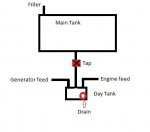
I have a Pedro which has a day tank, which is only about 1 cubic foot, and is gravity fed from the main tank. The day tank is the lowest part of the system and has a drain point at the bottom of it, the three fuel feeds, one for the main engine, one for the heater, and one for the generator, all come out of the top of the day tank and are fitted with taps. Essentially the day tank, at the lowest point, becomes a trap for water and crud. The fuel supply for the main engine comes out of the top of the day tank and goes through a racor prefilter before getting to the engine mounted fine filter.
 
Interesting approach but it appears from the description that you are drawing fuel from the dirtiest part of the system.

I suppose with quality filters and a decent drain off setup it probably works quite well.
 
The system is designed so that any mess in the bottom of the main tank will find its way to the lower day tank eventually which is easily drained and cleaned.

One simply opens the day tank drain once a year to see what comes out.

At the first sign of any problems, not that I’ve ever had any, one closes the tap between the main tank and the day tank, and then drains the day tank. As the drain is at the bottom any water or crud in the fuel is removed. As the day tank is small all it takes to drain it is an old ice cream container or such like. The fuel feed into the day tank can easily be removed and used to flush the tank if necessary. Turn the feed tap back on and you have a day tank full of clean fuel, which then passes through pre and fine filters in the normal way.
 
The system is designed so that any mess in the bottom of the main tank will find its way to the lower day tank eventually which is easily drained and cleaned.

One simply opens the day tank drain once a year to see what comes out.

At the first sign of any problems, not that I’ve ever had any, one closes the tap between the main tank and the day tank, and then drains the day tank. As the drain is at the bottom any water or crud in the fuel is removed. As the day tank is small all it takes to drain it is an old ice cream container or such like. The fuel feed into the day tank can easily be removed and used to flush the tank if necessary. Turn the feed tap back on and you have a day tank full of clean fuel, which then passes through pre and fine filters in the normal way.

Hi Mr M; having read through your method of having a supplimentary fuel tank ; if I understand it properly you have set up a Fuel system that its draining the Main Comprimised tank whilst voyaging , into the Sumlimentary tank : and if /when running the Engine shows signs of faultering you know that comprimised fuel has entered the Sumplimentary tank ; so you then bleed , clean out the suplimentary tank .

Sounds a bit dodgy to me , as your system is introducing debrie/ muck intentionally into the otherwise clean tank , whilst drawing from that tank ; maybe easy to drain off at end of season , but thought that priority should be to keep the Clean tank , err , clean and so not introducing dirty fuel whilst actually running boat .

Maybe ok on a docile River with plenty /abundance river banks to make for in an emergency , but out at sea or Estuaries seems a bit foolhardy . there are no stopping ;resting places ; as the Poster found out

But just maybe I misunderstood your systm ?
 
Hi, Capt’
You understood it perfectly, it’s a system fitted to the boat and many others by the builders, not by myself.

I think the thing we are missing is everyone assumes the tank contains water or crud of some sort. The whole purpose of the system is to ensure the tank is free from any such.

As any water/crud will always sink to the bottom, regular checking/draining of the day tank, even just once a year should be sufficient to ensure that the fuel is clean.

This is an extra cleaning step in addition to the fuel filters and is a precaution I would take before heading out to the wavy bit. A precaution which wouldn’t be available to me if the small day tank was not there.

Our original poster might not of had a problem if he were able to easily drain off any dirty fuel from the bottom of the tank pre voyage.
 
Last edited:
Top