A Celestial Navigation Question

[70521]

Well-Known Member
Joined
31 Aug 2011
Messages
22,412
Visit site
I am getting back up to speed with Celestial Navigation and am using David Burch's book Celestial Navigation: A Complete Home Study Course, and have found it the best book so far on the subject.

But I am stumped on his concept of "True Lat", page 41, having worked your lat from a sun sight then take your DR-Lat and then sum or difference to give you your "True Lat". This is not a step I've seen before and as your DR-Lat is a reference point of your choosing I am just a tad confused.

Does anybody know why he suggests this?
 
I have never hear of or read his book.
The convention I used.

I prefer the term observed latitude. Or just The Latitude. Rather than True Latitude.

Truthfully I don’t actually observe the Latitude. I calculate the latitude. From my sextant angle. By applying the declination of the sun.

The sext altitude is the angle I read straight of the sextant.
By applying the index error. And dip.
I get my observed altitude
From if you use the total correction which includes the semi diameter and a few other things like refraction and parallax
You get what is known as the true altitude.
By subtracting the True Altitude from 90 I get the True Zenith Distance.

By applying the Declination to the True Zenith Distance.

It follows what you get is the True latitude.

Sextant Altitude.
Index Error
Apparent Altitude
Dip
Observed Altitude
Total correction
True Altitude
90 - True Alt.
True Zenith Distance.
+ or - Dec
True Latitude

Even though I might prefer to call it an observed latitude. I shouldn’t. Like I said I derived my Latitude from my True Altitude.

The True Latitude is the Latitude derived from your observation of the altitude of the sun using a sextant.

The DR latitude, quite simply the the latitude of your DR for noon. Derived by running a previous position along a course and distance.

If I was doing a noon site.
I would take a sight in the morning pererably when the sun was close to due east. Using a DR position.
From this I would compare the angle of the sun calculated from my DR position with the angle I observed to derive an intercept.
Which would give me a distance along a calculated azimuth to my observed position line.

By plotting or preferably by calculation I would determine a position by latitude and longitude through which my position line passes. Known as an intercept terminal point. Or position. It’s just a position through which the position line passes.

By simple time speed and distance. I get a distance run to noon.

By applying this to the intercept terminal point by plotting or preferably calculation you determine a noon DR. Through which the position line having been run to noon now passes.

From this I would calculate or determine two things.

I would use my DR longitude to pre calculate the approximate time of apparent noon.

I would use my DR Latitude to pre cacluate the altitude of the sun at apparent noon. Which I could preset on my sextant to make life easy.

A few minutes before noon go and start taking the observation. adjust the sextant so the sun lower limb is on the horizon.
Keep observing until it stops rising or increasing.

Use this sextant angle to determine the observed or true latitude as above.

if You now plot your true latitude.

Your noon position is where the position line you ran up to noon crosses the True latitude.

This will give you an observed noon position at apparent noon. Or if you prefer. A true position.

Hope this helps
 
Last edited:
I am getting back up to speed with Celestial Navigation and am using David Burch's book Celestial Navigation: A Complete Home Study Course, and have found it the best book so far on the subject.

But I am stumped on his concept of "True Lat", page 41, having worked your lat from a sun sight then take your DR-Lat and then sum or difference to give you your "True Lat". This is not a step I've seen before and as your DR-Lat is a reference point of your choosing I am just a tad confused.

Does anybody know why he suggests this?
Can you post a copy, most of us don't have his book.
 
A noon sight for Latitude is as Uricane Jack describes above. It sounds like there is some confusion with the 'Intercept' method, using two sights to give two position lines that you plot on a piece of paper. I think the old almanac and tables method would give you a position delta from your DR, both Lat and Long. More modern almanacs use the AP 'Assumed position' concept to eliminate annoying decimals. If you use a software almanac and tables, the AP is not needed, as computers don't mind decimal places!
 
As others have posted, I’m also unfamiliar with the D Burch text. I do have his “Modern Marine Weather” book, though, and find it unnecessarily complex, confusing and often contradictory.

More info, Sandy, would probably help?
 
As others have posted, I’m also unfamiliar with the D Burch text. I do have his “Modern Marine Weather” book, though, and find it unnecessarily complex, confusing and often contradictory.

More info, Sandy, would probably help?
Not a lot to add really,

The calcs from Ho to a lat are as I expect, then at the bottom of his table he adds this comment about taking the DR-Lat and +/- the results of your calculations to give you this new "True Latitude. Makes no logical sense to me.

He has a YouTube Chanel, he does ramble a bit, but I'll try and message him through there.
 
For the avoidance of doubt, are you referring to a Latitude from sun Meridian Passage?

A quick sketch shows that there are 3 alternative equations for calculating Latitude, depending upon

1a. When Lat & Dec are “same” and Lat > Dec
1b. When Lat & Dec are “same” and Lat < Dec
2. When Lat & Dec are “contrary”

I’ve not watched his YouTube but as I said above his weather book rambles a lot ?
 
For the avoidance of doubt, are you referring to a Latitude from sun Meridian Passage?

A quick sketch shows that there are 3 alternative equations for calculating Latitude, depending upon

1a. When Lat & Dec are “same” and Lat > Dec
1b. When Lat & Dec are “same” and Lat < Dec
2. When Lat & Dec are “contrary”

I’ve not watched his YouTube but as I said above his weather book rambles a lot ?
None of those David, it appears from nowhere at the end of the calcs! I've dropped Starpath an email asking for clarification.

Being an engineer I like calculations clearly set out :)
 
Just need to check something from my original post. May come back with revised post.

OK, just checked course material I wrote many years ago when a lecturer preparing candidates for MCA deck officer exams.


Latitude = Zenith Distance +/- Declination = ZX +/- Dec

Latitude and Declination same name: Latitude = ZX + Dec

Latitude and declination have different names: Latitude = ZX - Dec


The above works as long as you know which hemisphere you are in. Simply correct the sextant altitude, subtract from 90, and apply the declination.
The sextant altitude will have observational errors, but is the best data that you have. There is no need for further complications.
 
Last edited:
There's also the case where latitude is less than declination and they have the same name. Then, Lat = Dec -ZK

You can work out which hemisphere you're in, too.

If the Sun bears south from your position and dec is north, Lat is north. If the sun bears south from your position and dec is south, Lat is south. use Lat = ZX + Dec

If the Sun bears north from your position, dec is north and ZX > dec, Lat is north. If the sun bears south from your position, dec is south and ZX > dec, lat is south.
Use Lat = ZX -Dec

If the sun bears north from your position, dec is north and ZX < dec, Lat is north. If the sun bears south from your position, dec is south and ZX < dec, Lat is south.
Use Lat = Dec - ZX
 
Thanks guys

I'll need to try an photograph or scan the page, this additional line is just thrown in at the end of the calculations after working out the Dec of the sun!
 
The latitude that comes out the back end of a MerAlt is your Observed latitude.

It may also be your True latitude at the time you took the sight but the odds are that it is not... personal error , abnormal refraction, rounding errors etc etc will see to that.....

I suspect a slip of the quill......
 
I think Frank has it.
Looking at the OP I wonder if there was a typo - Alt or Lat
My reasoning
There are only a few Nav terms that include “True” and In celestial nav True Alt is the first that comes to mind in sight reduction because it is the altitude derived from the corrected sextant sun sight.
The “True” Zenith Distance is another that is combined with Declination to give Latitude most notably used with the noon sight to give an uncomplicated observer’s latitude calculation.
But the sun doesn’t always shine when we want it to so when a single sight is all that is on offer navigators select a convenient Chosen Position (CP) near their DR. This enables them to read whole degree entries of HA and Dec from which they can derive a Tabulated Altitude (Tab Alt) and thence an intercept on the sun’s bearing line from the CP for that sight.
In the above situation the DR position is only used to select the CP but is only an estimate of position derived from course, speed and distance.
DR can not be used for much else until at least a second sight or visual position line is available to establish a fix or help inform more accurate chart based navigation.
 
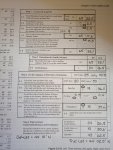
IMG_20200208_104756_3.jpg

Finally got a picture of the confusion.

I can see what he has done now. Converted the lat from 43 62.5 to 44 02.5!
 
Last edited:
It is actually quite clever. one degree = 60 mins. Just like decimal it makes the calculation simpler when you are subtracting. I have been working in a purely decimal universe for so long I missed it.

Don't get me going about pants and trousers!
 
Top