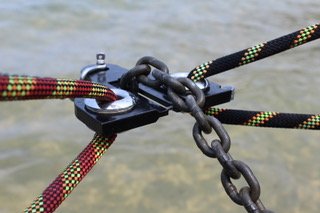
4x4 LFR for snatch recovery of vehicle - marine application of the LFR, no mention of anchors :)

Just reiterating....... One has to remember that the rings are LOW not NO friction and the friction becomes an issue under tension - which you mention.

I recall you said you might try anodising - as with galvanising do not have sharp edges,, round everything off. Any sharp edges become a source for chipping and corrosion gets under the anodising. Carabiners have sharp edges at the hinge and gate. Rings can be tactile.
 
Just reiterating....... One has to remember that the rings are LOW not NO friction and the friction becomes an issue under tension - which you mention.

I recall you said you might try anodizing - as with galvanising do not have sharp edges,, round everything off. Any sharp edges become a source for chipping and corrosion gets under the anodizing. Carabiners have sharp edges at the hinge and gate. Rings can be tactile.

All of the anodizing failures on the climbing carabiners have resulted from bearing at high load on a sharp steel edge. The alloy under the contact point probably deformed a little, causing the brittle oxide layer to crack. Really, outside the realm of what an LFR or block should expereince. I've never had an anodizing failure on an LFR in a normal service. I suppose it could wear through, but I haven't seen it.

Desert climbers will wear through the anodizing, particularly the top anchor of a climb. The ropes get sand embedded in the fibers, and then they lower off, allowing 50-150 feet of abrasive rope slide across with a 180 degree rope under a 170-pound load. Then they do it over and over and over. The carabiner is often left in place, so other climbers do the same thing for months or years until it gets scary. Like sawing a limb with a cable saw.

Nothing to do with sailing use.

6eea91e0-745a-4bf7-b3e1-7623e293421e_CRW_6011_1_0e44bebd-ad9f-45ef-9afd-16483b4712d6.jpg
 
I agree with your and Thinwater’s comments (post #27) that raw 7075 corrodes in the marine environment (like mad ! ). I was always surprised by your use and endorsement of the aluminium Anchor Right Excel anchor which has a raw uncoated and non anodised 7075 shank. This is not an anchor thread, nevertheless it shows manufacturers don't always choose ideal materials.
You are correct the is not an anchor thread but you have chosen to high light a specific anchor - and I'll take opportunity, not to criticise, but to follow your lead

In theory, practice and theory should be the same, the reality is they are often different - sometimes, or often, because some unknown facet has not been included.

The 7075 shank of the Anchor Right aluminium Excel is retained in a boxed slot and is further retained with a stainless bolt. I don't know but guess the fluke is made from the 5083 alloy and the lead ballast is in a sealed 'void' in the toe, sealed by welding a plate to close the box. In our usage the shank was attached to the rode, a HT alloy G80 chain (since then I have moved subsequent to G100 chan) with alloy G80 shackle (from either Crosby, Peerless, Yoke or Campbell). Maybe the combination of metals and alloys - protects the shank

Our 7075 shank on our Anchor Right No 4 aluminium Excel lasted 10 years and looked to have at least another 10 years life if not 40 years. There are no reports of catastrophic (nor non catestrophic) failures, in fact there are no failures of which you and I can report. For anyone with a programme of weight reduction for their yacht I would strongly recommend, and have no doubts, suggesting using an Anchor Right Aluminium Excel and/or a Viking Odin. Two very different, in design and materials, anchors but both offer weight reduction without compromising anchor performance. The alternatives, using any other 'conventiona'l steel anchor does not cut the mustard and the aluminium options Spade or Fortress demand too many important compromises.

Based on your theory it should be a pile of dust - in practice it looks almost unused and is, by choice or chance, perfect for the role for which it was designed, lightweight, develops hold comparable to its steel sibling, fits on most bow rollers and is available off the shelf in N Am, UK. Australia and NZ - and unlike almost every other anchor has not a single report of failure.

Your constant criticism of the alloy Excel lacks any substance, contradicts the evidence and increasingly looks like trolling.

Jonathan
 
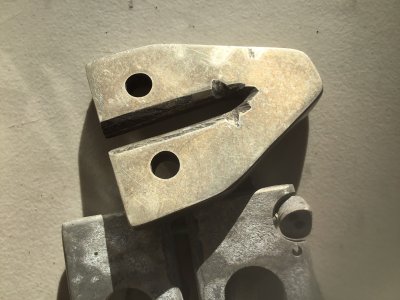
This a picture of early iterations of my bridle plate, made from 7075 aluminium.

The top example is one I anodised at home. The process worked relatively well - but is a bit fiddly, concentrated sulphuric acid needs a bit of care. I tried to pigment the coating with brown Dylon, unsuccessfully - but there is a brown tinge. The plate suffered some damage or the anodising is not even and along the top edge are 2 areas of corrosion under or at the interface of the anodised layer.

The top plate has been exposed to the same conditions as the lower plate, both made from the same piece of 7075, which is un-anodised and corroded

IMG_1089.JPG

Use of 7075 in the marine environment has its place, as the aluminium Excel anchor clearly shows.. (I simply accept the evidence) and my bridle plates are now made from Duplex stainless or Thermal; Diffusion Galvanised SSAB Hardox 450 or Bisalloy Hard 450

This one is black painted duplex stainless.

IMG_0027.jpeg

Jonathan
 
Based on your theory it should be a pile of dust
It’s not my theory. This was your comment earlier in the thread about using 7075 aluminium:
7075 when anodised does not corrode but raw 7075 does corrode, in the marine environment. But as all items are anodised, those pretty colours - 7075 does not corrode until the coating is lost.
I wholeheartedly agree with these comments, and this is also supported by Thinwater’s experience:
I don't know. I do know that climbing carabiners (7075) do great on the boat until the anodizing fails, then they corrode like mad.
When anodised 7075 aluminium used above the waterline is acceptable in a marine environment, especially in an inexpensive, easily replaced product such as the 4X4 LFR. However, in my view, using raw (non-anodised) 7075 aluminium in the shank of an expensive anchor, as has been done with the aluminium Excel is a mistake.

Some of us anchor frequently, and everyone is in agreement that raw, non-anodised, 7075 corrodes rapidly in the marine environment, even above the waterline, let alone when it is immersed in seawater. Instances where manufacturers have used raw 7075 are worth raising in any thread discussing 7075. The aluminium Excel anchor is the only example I am aware of where this has been done. Manufacturers don’t always make the most durable choices when selecting materials, and this information should not be hidden.
 
It’s not my theory. This was your comment earlier in the thread about using 7075 aluminium:

I wholeheartedly agree with these comments, and this is also supported by Thinwater’s experience:

When anodised 7075 aluminium used above the waterline is acceptable in a marine environment, especially in an inexpensive, easily replaced product such as the 4X4 LFR. However, in my view, using raw (non-anodised) 7075 aluminium in the shank of an expensive anchor, as has been done with the aluminium Excel is a mistake.

Some of us anchor frequently, and everyone is in agreement that raw, non-anodised, 7075 corrodes rapidly in the marine environment, even above the waterline, let alone when it is immersed in seawater. Instances where manufacturers have used raw 7075 are worth raising in any thread discussing 7075. The aluminium Excel anchor is the only example I am aware of where this has been done. Manufacturers don’t always make the most durable choices when selecting materials, and this information should not be hidden.
You have been denigrating the use of 7075 for years, maybe 10. In all that time you have not one single example of the 7075 failing. By all means issue a word of warning but balance that warning that despite 10 years passing and you keeping a 24 hour check you cannot find a single example of corrosion of the shank. By all means mention that you find the absence of negative comments on the design of the anchor something of a mystery but do emphasise that many users are perfectly happy.. To emphasise your support you can also mention that the anchor has been available for over 10 years and that if there was an issue the anchor would have been withdrawn. The reality is the opposite - I believe Jimmy Green sells tham in the UK and Ground Tackle sell them in N America.

Just stop the unqualified, and totally unsupported, trolling. Its a success story to be applauded.

Jonathan
 
My Excel (in a very wet locker) is about 7 years old and spotless (gray). Brackish water.

I mentioned the 7075 carabiners corroding like crazy with the anodizing cracks. That actually requires some explanation. If chrome plating fails the metal underneath intermediately pits, more deeply than if the whole item was bare. An anodized mast pits rapidly when there is a failure, but non-anodized masts corrode more slowly, but evenly all over. Painted aluminum pits aggressively when the coating fails, but the same un-painted alloy would only turn gray. In the case of carabiners, when the anodizing fails the stainless steel gate starts a galvanic cell, with all of the current focused on the failure point.

I have used 7075 and other alloys, not anodized, for many things over the years. Normally you get overall graying and no pitting. Nothing like the severe pitting of a painted item with paint failures. So comparing unanodized Excel with carabiners is way off the point. It feels like a witch hunt with no evidence of witches. I have no reason to believe that the corrosion is more severe than galvanized steel anchors, but it could be explored.
 
I checked,

I can confirm that my Alloy Excel anchor with its 7075 shank was first used in September 2005. When we sold Josepheline 2 years ago the Alloy Excel No 4 was the primary anchor sitting on the bow roller. The shank was never changed in the time we owned and used the anchor. We did have an earlier alloy Excel No 4 which I destroyed resulting in a re-engineering of the fluke and our being awarded a new alloy Excel No4 - the one first used in September 2005 and sold with Josepheline.

A good life for one with a shank reputed, not once, not twice but many times, by Noelex, to corrode like mad in the marine environment.

I wish well used galvanised steel anchors would last as well as an alloy anchor with a 7075 shank

Jonathan
 
You have been denigrating the use of 7075 for years, maybe 10.
7075 aluminum is an excellent material when employed in the appropriate application. Aluminum exhibits unique properties, with even minor variations in alloying elements and heat treatment resulting in significant differences. Consequently, non-anodized 7075 is a terrible choice for a marine environment. Marine grade aluminium alloys, such as the five and six series (5083, 6061, etc), are far superior.

The corrosion resistance of 7075 has been extensively studied through controlled experiments, as evidenced by numerous scholarly publications on the subject. You don’t have to accept the word of people on a sailing forum.

For instance, the following paper is just one example. This publication tested corrosion of 7075 exposed to salt air in a coastal location. The results from immersion in seawater would have been even more dramatic:

Impact of Marine Atmospheric Corrosion on the Microstructure and Tensile Properties of 7075 High-Strength Aluminum Alloy - PMC.

Some of the conclusions:

"The results showed that the 7075 alloy was corroded rapidly in the marine atmospheric environment, and corrosion pits and intergranular cracks were generated."

"In the marine atmospheric environment, the strength and plasticity of the 7075 alloy gradually declined during exposure, and the plasticity of the alloy was extremely sensitive to the corrosion pits and intergranular cracks. After 6 months of exposure, the elongation and reduction of area decreased from 12% and 15% to 8% and 12%, respectively. Increasing exposure time to 12 months, the plasticity of the alloy decreased by more than 45%."
 
Last edited:
My Excel (in a very wet locker) is about 7 years old and spotless (gray). Brackish water.
As I understand things, the aluminium Excel was originally designed with a marine grade 5083 aluminum shaft. 5083 has far better corrosion resistance than 7075. When one of the early anchors bent, 7075 was substituted as a means of strengthening the shaft without redesigning the construction.

One correction that I discovered recently exploring this subject further is that this change was only made for the models size 4 and larger (according to the information I can find). Therefore, smaller sizes don’t use any 7075 and should have excellent corrosion resistance.

Brackish water helps, but this may be one of the models with the much more corrosion resistant 5083 shank. What sized Excel is this?
 
Last edited:
Sorry for the above thread drift, but the information about the corrosion of 7075 aluminium is relevant to 4x4 LFR as some of these are constructed using this material. Marine low friction rigs are different as marine grade aluminium usually 6061 is used.

However, unlike the anchor that sidetracked the discussion, the 4x4 LFR are anodised and this adds significant corrosion protection.

My advice would be if buying one of the 4x4 LFR, pick a model constructed using marine grade 6061 aluminium rather than 7075. However, if this is not possible (Jonathan indicates he finds 6061 4x4 LFR difficult to find in his location), an anodised 4x4 LFR in 7075 is fine, especially given the low price.
 
My alloy Excel had 7075 stamped into the edge of the shank.

Given that some, if not many alloy Excels will have had a 7075 shank - you fail to explain how there have been not one single known failure of the shank. As far as I know Jimmy Green sell them, Ground Tackle in Canada sell them. My shank lasted a decade and was still going strong 2 years ago.

Perhaps, Noelex, you need to find tests conducted in the same environment as the Excel anchor where the shank is in direct contact with 5083 (in the fluke) with a sealed piece of lead in the toe, a stainless bolt holding the shank securely in the 5083 slot and the whole in contact with galvanised alloy steel. So buy an Excel and use it - let us know when it turns into a pile of white dust, you imply it will not take long (and when it does disintegrate Anchor Right will offer you compensation - so no loss to you).

But in the absence of a single shank failure since the anchor was introduced you are just trolling - or as Thinwater says describing a witch hunt without witches.

The problem appears to be you prefer scare mongering to reality and a bit like paracetamol don't care of the damage you inflict on commercial operations with inadequate or no supportive documentation nor relevant research.

Jonathan
 
Last edited:
The thread title specifically suggested 'no mention of anchors'

The thread was posted to explore the developments, if any, on the use of monster LFRs. The thread moved in the right direction until......

Zoidberg has 2 gathering dust, I also have two (also gathering dust) -

Anyone who wants to ignore the diversion is welcome to contribute.

I'm not bored and restrict my threads and posts to the few areas that I have researched - if my posts are going to be used as platform for a troll - maybe I need to retire.

Jonathan
 
Back to 4x4 LFR. There have been a few products that appeared on the market since I purchased my 4x4 LFR that may be of interest.

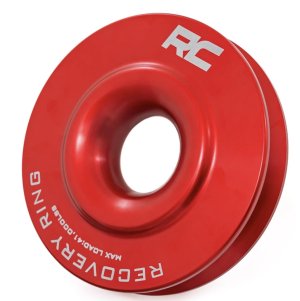
The first is the addition of a raised ridge in the centre of the LFR that in many applications would help reduce friction between the LFR and the attaching soft shackle. I think this is a worthwhile improvement, but I have not used this type of LFR, so this is just speculation. Below is an example made from 6160 aluminium (this has similar corrosion resistance to the more common 6061).

IMG_8784.jpeg
 
Last edited:
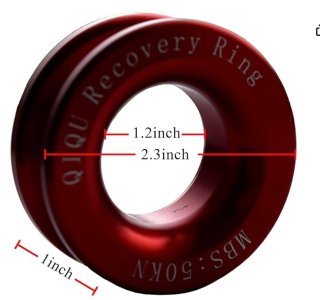
The second development is the availability of smaller rings. They are still sold for 4x4 recovery rather than from marine stores, but in a reduced size. The one below, for example, is only 2.3 inches across versus my "traditional" 4x4 recovery, which is around 4 inches in diameter. The width however at 1 inch is similar. The vast majority of 4x4 LFR are close to 4 inches in diameter which is big when see them in the flesh.

These smaller rings are hard to find and, of course, have less strength, but would be a more useful size for many applications on our-sized boats without the expense of the larger marine LFR. The one pictured below is made from 7075 (anodised), but unfortunately, the choice is very limited in this smaller size.

So you do not need to dismiss 4WD outlets as a source of LFR even if the four-inch models are too large for your application.


IMG_8783.jpeg
 
Last edited:
I'd like to see a thread on using low friction rings (or other low friction rigging) for moorings. unlike JSDs, a common application. The bow chocks on my boat are so bad I don't use them. Cafe on mooring pendants is common.

  • Bow roller. Sounds good, but the anchor is there and the side places can be sharp or burred by the chain. For anchoring.
  • Chocks. Nearly always too small. Angle too great. Rope can jump out. stretch between cleat and chock. Mostly designed for tying up to floating docks.
Yes, I know my chafe gear. Ships sometimes use rollers; common for towing, but also for tie-ups, sometimes with auto-adjusting winches.

It seems like low-friction chocks or mooring pipe should exist for yachts. There are a few out there, but they are typically bespoke items.

Factory-Sales-New-Steel-Round-Bulwark-Mounted-Mooring-Equipment-Marine-Boat-Panama-Chocks.jpg_300x300.jpg
 
The 4x4 LFR all look much the same and for those that check dimensions they are very similar.

If a UTS is quoted its the same for all suppliers.

6 series aluminium has a tensile strength, it varies wit the temper, a fraction of that of 7075 - the 6 series 4x4 LFRs cannot be the same as those made from 7075.

I don't think the UTS is relevant for marina applications - it will be high, the 4x4 devices are seriously big. But for 4x4 application, retrieving bogged vehicles, it might be relevant (though of more importance might be the UTS for the snatch cord).

The fact that both 6 series and 7 series LFRsa are quoted with identical UTS suggests to me an absence of testing. I also wonder how they test them for strength.

If you want security - buy the 7 series (and if/when they corrode - buy another 2.

Aluminum Alloys - Mechanical Properties

The same will be true of marine LFRs - the 7 series will be factorially stronger than the 6 series - for the same or similar dimensions.

Jonathan
 
It appears I have not been keeping in touch with Anchor Rights developments.

The 7075 shank on the alloy anchor has been anodised now for a significant number of years - explaining why my 10 years old shank has not converted to a pile of rust.

Noelex take actual evidence as being valid, If you see an inconsitancy check it out - don't troll.


Maybe the trolling can now stop.

Jonathan
 
It appears I have not been keeping in touch with Anchor Rights developments. The 7075 shank on the alloy anchor has been anodised now for a significant number of years
This is an improvement that will help reduce corrosion(y). This additional feature has not been mentioned on their website and is a modification I was also unaware of.

This change supports my contention that raw, non anodised 7075 is not suitable for anchor construction.

The extra manufacturing cost of anodising the shank is tiny on an anchor that is likely to retail for around $1500 for the smallest size incorporating 7075 (the 9kg aluminium size 4 ). The very inexpensive 4x4 LFR discussed in this thread are all anodised.

When was the change implemented? It is relatively straightforward to do tell anodised aluminium from raw aluminium just from the appearance so owners should be able to tell.

The American and Canadian importer and distributor for Excel anchors frankly state to their customers that the expected lifespan of the aluminium Excel is not that great, and is actually shorter than the steel version. Kudos for spelling this out, not all manufacturers are this honest especially on a significantly more expensive option. The quote below was from a little over three years ago, but I presume this was before the version with the anodised shank was released?

Quote:
"Also, if you’re using it full time, anchoring every night, it's not going to have the longevity of a steel anchor."

Keep in mind that (if I understand correctly) the smaller aluminium Excel anchors (lower than size 4) have always been constructed from marine grade aluminium rather than 7075 and therefore should have a very long lifespan (much longer than any steel anchor ) irrespective of any anodising.
 
Last edited:
Top