40 hp johnson

fred b.

New Member
Joined
28 Sep 2021
Messages
8
Visit site
Hello everyone. New to this forum. I just bought a boat with a 40 hp Johnson. It has the VRO ? system. Oil and gas mixed from separate tanks. It is a 1996 model j40el8ds. Plate is damaged so I think so. ser.# G04192197. I am having trouble with idle, and low speed miss. At mid rpm it straightens out and runs fine. Sometime starts fine, other times it starts hard. my mechanic who is so far behind it is 2 months just to look at it. He says just eliminate system and mix gas in tank. If that is issue it will eliminate it. Cheaper and better than figuring it out, and repair or replace cost. Several things can cause this problem. So start there. Has anyone done this. I assume I will have to use an electric fuel pump, but does entire unit have to come off or just plug it off ? Any advise is appreciated.
 
The important number isthe model number, not the serial number
BUT
You have it wrong . It should be J40 EL EDS
Johnson, 40 hp, electric start, long shaft, 1996, production suffix S
ED are the date letters for 1996.

It was the early VROs which caused problems . This one is a VRO 2, called OMS (oil metering system) from 1993 onwards.
It is a vacuum/pressure pulse operated pump and can be replaced if defective with a suitable, ordinary pulse operated fuel pump and fuel mixed 50:1.

Use a 50:1 fuel mix while you determine whether or not the VRO is defective.
I doubt if the VRO is causing your running problems

Do a compression test
Check the sparks,
It may need the carburettors cleaning /overhauling

For the best advice go to the Johnson & Evinrude forum at iBoats
Johnson & Evinrude Outboards

People there are the experts. They will be able to advise on diagnostics and on a suitable conventional fuel pump if appropriate

Quote the model number!
 
Last edited:
vic. Thanks for the response, and info. I think some of issue was fuel supply. replaced fuel bulb and some lines. Checked the OEM plugs and they arc a 1/4". carbs could be issue but rebuilt last year by owner. did he do it right? Did he use ethanol gas? I'm working through the things that may cause issues. Thanks again.
 
The important number isthe model number, not the serial number
BUT
You have it wrong . It should be J40 EL EDS
Johnson, 40 hp, electric start, long shaft, 1996, production suffix S
ED are the date letters for 1996.

It was the early VROs which caused problems . This one is a VRO 2, called OMS (oil metering system) from 1993 onwards.
It is a vacuum/pressure pulse operated pump and can be replaced if defective with a suitable, ordinary pulse operated fuel pump and fuel mixed 50:1.

Use a 50:1 fuel mix while you determine whether or not the VRO is defective.
I doubt if the VRO is causing your running problems

Do a compression test
Check the sparks,
It may need the carburettors cleaning /overhauling

For the best advice go to the Johnson & Evinrude forum at iBoats
Johnson & Evinrude Outboards

People there are the experts. They will be able to advise on diagnostics and on a suitable conventional fuel pump if appropriate

Quote the model number!
edited
 
Last edited:
I had the 2004 Johnson 50hp VRO (same engine different tuning) which replaced my previous Evinrude 40hp VRO.
With the Johnson, as well as the vro failing and replacing it with a standard fuel pump and premixing oil in the fuel tank, the nylon caps for the 2 carbs would warp causing air leaks and rough idle and low speed running. Over the 10 years I had that engine I had to replace these caps every two years, along with the VRO, the hydraulic tilt pump, the main head gaskets and loads of other bits, I was glad to get rid of it.
It was the made in the first year of Bombardier ownership of Johnson/ Evinrude and their support for spares for the VRO engines plummeted
 
Last edited:
D13
Thanks for that info. Can you expand on carb caps. Where are these. I have manuals but want to make sure I understand. I think I am going to have to replace engine soon as boat it is on is not a good fit. I have never had more than a jonboat till now, so this is new to me. After my first trip out I realized boat was not performing well, and prop was getting air on tight turns, slow to plane out. Top speed was lower than it should be to me. So I have spent a lot of time on online research and find motor is way short of proper depth. 2" or so. It already hits the cowling before going up all the way. So lowering it is going to require a lot more redkneck engineering to make it work right. Somebody just made it work w/o concern for proper heights to get good performance. It works, but not well. I would say losing 1/3 to 1/2 of it's potential. Prop was changed too. Smaller more twist. It is a mess. Sorry I bought the rig now. Don't know weather to sell her, and just get different boat, or try and fix this one. I did a lot of repair and restore on boat assuming engine was fine. It started and ran fine, but once I put in water I found all this. Don't think I can get money out of it, but by time I get another motor more suited I'm in even deeper. Expensive lesson. I am leaning toward selling it and take the loss. Boat is 16ft well craft center console. Just what I wanted for type of fishing I do and want to do, but there are plenty of these boats around and now I know what to look for. Thanks again for your response.
 
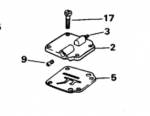
The caps are the square tops to the carbs, with a screw in each corner and a brass insert for a small hose, with a nylon gasket. They are black nylon on the 2004 model, they may have been metal on earlier versions.
I can't imagine that your boat needs an extra long shaft outboard, measure the height of the transom to check. As for losing grip on tight turns, I think that is fairly normal for the average boat.
Do you have a tacho to check you are getting about 5500rpm flat out? You might have the wrong pitch prop.
40hp is about as small as I would want to go on a 16 foot boat and still expect it to plane reliably.
 
Last edited:
Hey d13
Thanks for info. I have seen these but didn't know what they were called. It is weird the way this is going. At home on hose it runs fine and never stalls. Still seems to not be running as smooth as it should. Like one of the cylinders is off. Could be carb. I just haven't figured it all out yet. Plan to do compression test, although I don't think that is issue. I filled her up with premium no ethanol gas and added some treatment to it knowing carbs may be dirty from sitting. Used about 5 gal. on first time out. I don't have a tach so don't know where she is on RPM. However I think I am in high 3000 to 4000 at wide open. I think engine is bogging down due to improper fit. One the prop is smaller with more twist. Stainless prop, but can't find any info on it anywhere??? No brand, no pitch or size on it at all?? I put original back on now. Biggest issue is my engine has a 18 1/2 inch shaft. I thought they were all 20's but I checked it three times. Now my transom is 22" It is mounted on a jack plate for tilt and trim. However at full up tilt it hits transom with steering arm. All the way down is ok. I was going to raise it one hole to get clearance, but then realized it is to high already. Past owner had taken it down as far as possible. Throttle cable and steering arm wont allow any more adjust down. Not only that but mounting holes to jack plate and motor bracket have been drilled to gain all they could get. Bolts to jack plate are already at floor of boat floor so no gain there. Even if adjustment possible I would have to shim motor out at least 1 1/2 " so motor would clear transom when raised for transport or more than half potential trim. Measuring from keel bottom center with level puts cavitation plate on motor 2 3/8" to high. If shaft was a true 20" as it should be I would be a lot closer. They may have changed prop to try and overcome prop, and cavitation plate being to high. It all works, but losing a lot of power and working engine hard all the time. Boats and motors are supposed to follow certain guidelines as far as shaft, and transom measurements. However over the years they have started variating from that and it is causing issues everywhere. Boat fitters are having to do some weird stuff to make things work. My issue is not that rare. New boats are just as bad. I have done a lot of reading trying to get up to speed on these kind of boats. I think I am going to buy a new 4 stroke with 25" shaft. It will cost more than I paid for this whole rig. I live on the coast and getting into coastal fishing. Boat and equip better work right. Any opinion on what I should get HP wise or brand. I'm looking hard at Suzuki 50hp 4 stroke. Thanks for your time and interest.
 
Hey d13
Thanks for info. I have seen these but didn't know what they were called.

my engine has a 18 1/2 inch shaft. I thought they were all 20's but I checked it three times. Now my transom is 22"

The carb top is actually called the carburettor "cover"

If your transom height is 22" you will need an extralong shaft ( 25") motor.

The 40 HP Johnson is either a standard shaft (15") or a long shaft (20")
As far as I can see there are no "specials" with in between shaft lengths
How are you measuring it to arrive at 18½"?


1633011715263.png1633011815757.png
 
The carb top is actually called the carburettor "cover"

If your transom height is 22" you will need an extralong shaft ( 25") motor.

The 40 HP Johnson is either a standard shaft (15") or a long shaft (20")
As far as I can see there are no "specials" with in between shaft lengths
How are you measuring it to arrive at 18½"?


View attachment 123390View attachment 123391
#2 that's the cover that kept warping and leaking air in, I had a handful of bent ones left over when I sold the engine and bought a new Yam F70A. Best engine I ever bought.
I can confirm the 40 / 50 VRO model by Evinrude / Johnson were the standard 20" in long shaft version.
for evinrude and johnson engine model numbers, the letter code for the year is based on INTRODUCES, eg '05 was SO, '93 was ET.
eg J50 PL SO C = johnson 50hp power trim, long shaft, 2005 series C
 
Last edited:
I measured from flat part of bracket that would sit on transom to the cavitation plate just above the prop. I thought that is how it was done but maybe wrong. I had read an article that said that manufactures of boats and motors were cheating on these standards some. I may be measuring wrong, but at this point it is mute issue as it isn't long enough for this transom. 2 people I know have Yamaha engines and they seem to do really well for them. Thanks guys for the info, and input. I'll keep you posted and feel free to share any opinions on new motor selection.
 
I measured from flat part of bracket that would sit on transom to the cavitation plate just above the prop. I thought that is how it was done but maybe wrong. I had read an article that said that manufactures of boats and motors were cheating on these standards some. I may be measuring wrong, but at this point it is mute issue as it isn't long enough for this transom. 2 people I know have Yamaha engines and they seem to do really well for them. Thanks guys for the info, and input. I'll keep you posted and feel free to share any opinions on new motor selection.
They seem to vary
My nominal 20" Evinrude measures 22½" to the AV plate

I reckon yours must be a 15" ( standard) shaft model , but has either been converted from a 20" ( long ) shaft or it does not have the original bracket and ID plate .. In the latter case the rest of the number will most likely be wrong!

Sometimes you can find the model number stamped on a core plug on the power head. My Evinrude is so marked but I think it depends on the factory which built it
 
#2 that's the cover that kept warping and leaking air in, I had a handful of bent ones left over when I sold the engine and bought a new Yam F70A. Best engine I ever bought.
I can confirm the 40 / 50 VRO model by Evinrude / Johnson were the standard 20" in long shaft version.
for evinrude and johnson engine model numbers, the letter code for the year is based on INTRODUCES, eg '05 was SO, '93 was ET.
eg J50 PL SO C = johnson 50hp power trim, long shaft, 2005 series C
THanks They were very warped. could see it just holding it up to the light. Did some othr things as well. Runs like new.
 
They seem to vary
My nominal 20" Evinrude measures 22½" to the AV plate

I reckon yours must be a 15" ( standard) shaft model , but has either been converted from a 20" ( long ) shaft or it does not have the original bracket and ID plate .. In the latter case the rest of the number will most likely be wrong!

Sometimes you can find the model number stamped on a core plug on the power head. My Evinrude is so marked but I think it depends on the factory which built it
Thanks vic got new covers a did a few other things while I was at it she runs like new.
 
Top