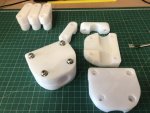
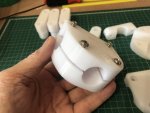
3D Printer ideas

Can you play with the fill density on your printer so that the core has air pockets trapped inside?
Obviously that relies on the exterior being watertight

Yes ... you can make it hollow inside if you want - but then it can sag during printing - so it would need at least 'support' enabled.

The infill can be selected to style to suit ... honeycomb ... rectilinear etc.

But to make it float ?? Would need to be quite large. Better use a Champagne Cork !!
 
How many people have pulpit mounted nav lights ? When you go to replace - the new ones are usually wrong angle due to the curve in of the rails either side.

After having a fairway buoy jump up and break one of my side lights ... I bought a new set but of course they angle in too much ...

3D printer to the rescue ... measured the angle needed, measured the light mount plate ... bit of 'pythagoras' and I printed matching wedges to fit between lights and mounting plates on pulpit.

Next I want to 3D print a 'Figurehead' ... actually two medium sized motifs ... one each of bow ... to stick on ...

Pal of mine had vinyl decal Dolphins on his bow ... looked really nice.
 
Yes ... you can make it hollow inside if you want - but then it can sag during printing - so it would need at least 'support' enabled.

The infill can be selected to style to suit ... honeycomb ... rectilinear etc.

But to make it float ?? Would need to be quite large. Better use a Champagne Cork !!

When printing a "solid" object using the Cura software one selects the percentage fill. The default is 20%. One only needs to enable supports for overhangs on the outside - so not in this case. So if you want something really strong then 50% or even 100% solid is possible.

For the keyring I printed at 20% and then tested that it floated with the key attached and it does. It goes in a pocket more easily than a champagne cork! Although Cura is made by Ultimaker it is open source and works with most other printers apparently

TS
 
How many people have pulpit mounted nav lights ? When you go to replace - the new ones are usually wrong angle due to the curve in of the rails either side.

After having a fairway buoy jump up and break one of my side lights ... I bought a new set but of course they angle in too much ...

3D printer to the rescue ... measured the angle needed, measured the light mount plate ... bit of 'pythagoras' and I printed matching wedges to fit between lights and mounting plates on pulpit.

I used to do a lot of off-road cycling, often in the dark in winter.
I printed lamp holders that went straight in the handlebars, fitted them with 12v spotlamp bulbs and then printed a holder to put a 12v battery in the bottle cage.
 
Last edited:
My attempt at a deck gland for the VHF RG58 cable that I don't want to bend more than necessary as where it comes thru to the inside there is only about 15mm clearance ...

RG58 Deck Fitting v4.png

Once I'm happy with the fitting, I'll design a matching drill guide for it.
 
My attempt at a deck gland for the VHF RG58 cable that I don't want to bend more than necessary as where it comes thru to the inside there is only about 15mm clearance ...

View attachment 82192

Once I'm happy with the fitting, I'll design a matching drill guide for it.

That looks very nice. What software did you use?
Would it be better printed in slightly flexible material? I have had success with FlexFil by FormFutura

I still have most of the roll if you want me to print it for you in white

Tudorsailor
 
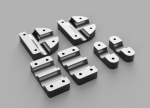
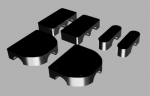
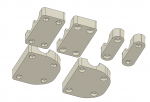
I wanted to go and play with a solar arch on Friday and didn't like the pricings of metal fittings (especially to trial things out) so I quickly knocked up some brackets in PETG.
Planning on taking one of the Prusa's to the boat and print out anything I need special on site.

I will post an update on how I got on.

clamps_2019-Dec-24_06-43-47PM-000_CustomizedView18300239813.pngclamps_2019-Dec-24_06-43-18PM-000_CustomizedView7865821023.pngScreen Shot 2019-12-24 at 19.01.52.png
 
Last edited:
Might not need to, the PETG is pretty stable I hear and I’ve put a quite high infill in, so strength isn’t my main worry.
plus of course I can keep tweaking the design ?

UV in south UK not my biggest worry, it looking crap is!
 
Give layer lines and load paths some though ;)
I’ve seen some pretty impressive failures because the “designer” didn’t consider 3D printings weakness through Z
Agreed! I’ll put it up and play with loads on the brackets before committing. My main observation is that more is (in this case) not less - printed with .6 nozzle to increase layer strength.
The first few out look good.
49FB3DB3-3A6B-4BE1-BBDF-4234980ECB67.jpeg9370108F-C664-41DC-83B8-CBFDB0CE40B9.jpeg
 
There's logic there. I took one of the clamps and inserted a short broom handle and gave it some welly - couldn't break it.
Now.. let's address the "design" bit, which has I have to admit been niggling me somewhat as this was actually thought about.

The clamps are "designed" to not take any vertical (z) stress as they are for lateral forces, lateral forces which exert (if much at all) stress on a horizontal plane over a very short distance (300mm).
In a similar fashion, the double rail clamps will be at 45 degrees to lateral stress which is coming at the clamp from indeed z but given that the clamp is then rotated 90 degrees (deliberately) the weaker z structure is rotated away.

That leaves me with the solar panel clamps which indeed will be directly stressed via the z-axis, but however, should never have an extreme load placed on them - and if they did - well I suspect that other factors might be worrying me more. Besides which, the contact area is large with a very small leverage amount to be considered.

So I'm left with the issue of 'sheer' avoidance, cross braces are intended to be fixed with steel brackets as I will admit to being a little pessimistic about the capability of a PETG part when faced with actual stress from a couple of angles - in what is clearly a mission critical element of the overall design.
 
I only have to think about moulded brackets for BBQ marquees etc. - doesn't take long for them to break and they are not printed ... they have uniform plastic in all directions.

Your caution and thought to use metal as final may be wise choice.
 
There's logic there. I took one of the clamps and inserted a short broom handle and gave it some welly - couldn't break it.
Now.. let's address the "design" bit, which has I have to admit been niggling me somewhat as this was actually thought about.

The clamps are "designed" to not take any vertical (z) stress as they are for lateral forces, lateral forces which exert (if much at all) stress on a horizontal plane over a very short distance (300mm).
In a similar fashion, the double rail clamps will be at 45 degrees to lateral stress which is coming at the clamp from indeed z but given that the clamp is then rotated 90 degrees (deliberately) the weaker z structure is rotated away.

That leaves me with the solar panel clamps which indeed will be directly stressed via the z-axis, but however, should never have an extreme load placed on them - and if they did - well I suspect that other factors might be worrying me more. Besides which, the contact area is large with a very small leverage amount to be considered.

So I'm left with the issue of 'sheer' avoidance, cross braces are intended to be fixed with steel brackets as I will admit to being a little pessimistic about the capability of a PETG part when faced with actual stress from a couple of angles - in what is clearly a mission critical element of the overall design.
maybe some items are best left to a CNC router working on bronze/brass whatever :D
no z-axis forces issues on that, and it may be cheaper than a v.good (as in 2-3k) 3dprinter
 
Not so much if the counterbores are deeper than the loaded clamping area. It would be quite easy to end up with three bolted areas attached to the opposite part of the clamp but that large flat area completely separate :)
 
Top