3D Printer ideas

Don't rule out paper. You will struggle to get much structural intergrity out of most home printers (home being defined as less than $5,000!!) and paper has the added advantage of being able to print out a coloured result. Some of the relief maps I've seen are just stunning.

I'm a long way from an expert though I know a little bit about this, partly from working in IT but mostly through my great-nephew, who has printed titanium and medical components amongst other things - he's doing a PhD now but robotics and 3D printing were the main part of his masters.

http://www.gizmag.com/mcor-iris-paper-3d-printer/32903/

I've seen some very pretty parts, for want of a better description. I must admit that I'm not a fan of it though.

Some of the Titanium parts are outstanding, very easy to make a pigs ear of it though, even some respectable companies are selling some very substandard parts :(
 
The world of 3D printing unfortunately suffers from media hype, it’s not as bad as it was a few years ago, but it’s still there, this falls very much into that category. It’s unlikely that it will ever be a viable solution for something so large, unless it has a very low volume or even bespoke application.
Looking for a fast, cheap solution for low volume tooling, a rather large aerospace company I’ve worked with came up with a printed solution, it takes about 5 times longer and is significantly more costly than the usual solution used in motorsport. It’s a great example of finding a technological solution for a problem that has a perfectly good low tech solution.
 
The world of 3D printing unfortunately suffers from media hype, it’s not as bad as it was a few years ago, but it’s still there, this falls very much into that category. It’s unlikely that it will ever be a viable solution for something so large, unless it has a very low volume or even bespoke application.
Looking for a fast, cheap solution for low volume tooling, a rather large aerospace company I’ve worked with came up with a printed solution, it takes about 5 times longer and is significantly more costly than the usual solution used in motorsport. It’s a great example of finding a technological solution for a problem that has a perfectly good low tech solution.

Not really, it depends on its use case, ignoring the hype, it can be really useful.

https://www.youtube.com/watch?v=wsxFXTKaXdI
https://www.youtube.com/watch?v=OKj38woOmKI

Personally I use it in my job, as its an ideal way of printing brackets and mounting devices for use in video production.
 
The world of 3D printing unfortunately suffers from media hype, it’s not as bad as it was a few years ago, but it’s still there, this falls very much into that category. It’s unlikely that it will ever be a viable solution for something so large, unless it has a very low volume or even bespoke application.
Looking for a fast, cheap solution for low volume tooling, a rather large aerospace company I’ve worked with came up with a printed solution, it takes about 5 times longer and is significantly more costly than the usual solution used in motorsport. It’s a great example of finding a technological solution for a problem that has a perfectly good low tech solution.

Not sure that I would agree with this negative summary.

I have a 3D printer. I can print this using a variety of filaments. PLA is the basic. Its easy to use and and comes in lots of colours. I have used UV resistant material, wood-like material and flexible material

I have printing things for inside and outside that includes:
Support for spinnaker pole
Cutlery drawer divider
Cockpit stereo speaker covers
ST60 covers
Rubbery protectors for cockpit protruberances
Toothbrush./toothpaste/razor holder
Knife holder

and lots of other things

If I was setting off round the world, I would take a printer with me. They can print at any angle and while the boat is underway. This video shows the printer in action while being delivered from one place to another

https://youtu.be/FjABsSxWlpk

TudorSailor
 
It’s not a negative summary, I’m afraid I based it on fact.

3D printing has been my specialty for the last 21 years, the department I run has £9m worth of industrial printers an we consume over £1m per year in material.
 
I find that my farm of Prusa MK3’s are really very reliable and for me are a cost effective manufacturing tool for the navigation training aids that I produce and sell worldwide.

Grey filament is available on Amazon, I recommend the AMZ3D PLA, it’s very very good.

I made a couple of ST60 covers in PLA last January, and as yet have not degraded in the sunlight, however - being under a sprayhood probably helps! I’ve also made a few odds and sods but mainly it’s buoys and model boats keeping the farm busy.
 
I find that my farm of Prusa MK3’s are really very reliable and for me are a cost effective manufacturing tool for the navigation training aids that I produce and sell worldwide.

Grey filament is available on Amazon, I recommend the AMZ3D PLA, it’s very very good.

I made a couple of ST60 covers in PLA last January, and as yet have not degraded in the sunlight, however - being under a sprayhood probably helps! I’ve also made a few odds and sods but mainly it’s buoys and model boats keeping the farm busy.

Can we see your navigation training aids?

TS
 
If I was setting off round the world, I would take a printer with me. They can print at any angle and while the boat is underway. This video shows the printer in action while being delivered from one place to another

https://youtu.be/FjABsSxWlpk

TudorSailor

I’m no expert on filament printers, but how was that ulitimaker being powered while it was on the sack truck?
 
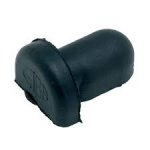
I've been told by Z spars that they can no longer obtain Gibbs T bungs for their masts as Gibbs are no longer, but that they have a demand for them - got to be an opportunity for someone!
 
A TPU material should work well enough for that.
I’ve heard good things about Ninja Flex, but never tried it.

I have printed with FlexiFil from FormFutura. Here are the specs

FlexiFil is a rubber-like high-performance and partially bio-based flexible TPC (Thermoplastic Co-Polyester) type of 3D printer filament.
FlexiFil has unique flexural strength properties, as 3D printed objects with FlexiFil will have a “flexural memory”, allowing objects to return back to their original position or shape after being bent, dent, or folded. Next to this FlexiFil offers a unique combination of flexibility, long term heat resistance, strength, excellent UV resistance and good resistance to chemicals.

Unique features

Very flexible filament with “flexural memory”

Shore hardness of 45D

High impact resistance

No deformation or breaks when stressed by bending

Strong & durable

Good resistance to chemicals

Excellent UV resistance

IEC 60695-11-10 Flammability classification: HB

43% renewable bio-based content


Does the rubber have to be flexible/rubbery???

TS
 
TPC’s aren’t as good as TPE’s and TPU’s outdoors, although probably a bit better with UV and heat.
TPU’s are better for cooler applications and have better wear resistance.

You would probably find in general, that you get better prints from a TPU, might be worth trying a spool :)
 
I have printed with FlexiFil from FormFutura. Here are the specs

FlexiFil is a rubber-like high-performance and partially bio-based flexible TPC (Thermoplastic Co-Polyester) type of 3D printer filament.
FlexiFil has unique flexural strength properties, as 3D printed objects with FlexiFil will have a “flexural memory”, allowing objects to return back to their original position or shape after being bent, dent, or folded. Next to this FlexiFil offers a unique combination of flexibility, long term heat resistance, strength, excellent UV resistance and good resistance to chemicals.

Unique features

Very flexible filament with “flexural memory”

Shore hardness of 45D

High impact resistance

No deformation or breaks when stressed by bending

Strong & durable

Good resistance to chemicals

Excellent UV resistance

IEC 60695-11-10 Flammability classification: HB

43% renewable bio-based content


Does the rubber have to be flexible/rubbery???

TS

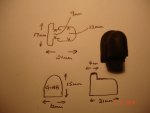
Sounds interesting - here are a couple of photos of the "bung" showing the sizes. It would have to be flexible/rubbery as you say. The idea is to hold the T section of the shroud terminal in place whilst lifting or lowering the mast when there is no tension on the shrouds. Once the terminal is inserted into the mast the bung is fitted and as can be seen in the photo,DSC00031.JPGDSC00032.JPG there is a flat side that surrounds the hole in the mast and a bulbous bit that inserts which is slightly larger than the mast hole ( hope that makes sense!)
 
Top