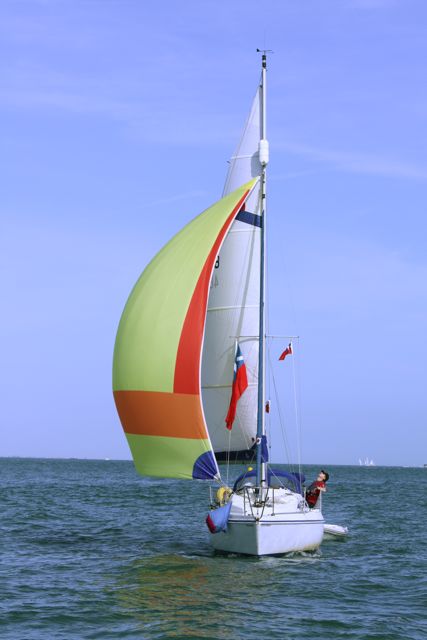
3 tips for chutes?

Tis is a wee bit of a hijack. My new boat has come with a cruising chute. I've never used one (or a spinnaker) before. Can anyone point me to some general guidelines on what to do with it? Is it basically just a big, baggy free flying jib? All enlightenment gratefully received.

Having come from dinghies with asymmetric kites (read cruising chutes..) the Kemp guide ain't too bad.
I would suggest you go out with crew who have flown this kind of sail before trying it short handed in any way. You'll probably need to check the state of your spinnaker halyard & upper block before using this sail.
If you have a fractional rig - this following comment may not matter as much.
Another point is the relative height of the spinnaker block on the mast to the forestay. Some masts have mount points for more than one spinnaker halyard (ours has two -slightly port and starboard ). Hoisting is generally simpler if you use whatever is the initial leeward halyard -reduces friction and any interference with the top of the forestay/foil.
In wind up to 10kts it's quite possible to hoist, sail, and drop a CC/gennaker with 2 people on board, trimming needs a fair bit of attention - but it's rather satisfying to feel the sail pull well. The way to get the best downwind performance is usually as done in dinghies- reach then gybe (repeat!). Having done some single handed asymmetric dinghy sailing -I decided that stuffing a huge sail in the bag on my own at the bow or down a hatch, with SWMBO on the helm was just too heavy duty (and in case she reads this- her helming is not bad at all).
We have a snuffer -which works pretty well -and dropping the snuffed chute and stuffing the "sausage" into the sail bag is reasonably easy.

A conventional spinnaker really needs more crew to operate successfully, though they pull better dead downwind. Sail areas are kind of comparable with C chutes-about twice your average foresail. BIG...

Hope that is of some use,

Graeme
 
The kit needed to use the cruising chute is simple and basic, though adding the snuffer and its control lines will perhaps make retrieval easier if shorthanded.

Place a swiveling block just ahead of the genoa fairlead or aft of it on each side of the hull outside of the lifelines. Place another swivelling block on the spare bow roller fitting,this is your TACK block. Make up a long tack line and feed through the tack block; to this line attach a snapshackle with a loop of braidline through the locking-pin. The other end of the tack line is taken back to the cockpit and fed through a spinlock( or other) jammer,and if preferred then to a small winch behind the jammer position.
Prepare two sheets and feed one through the port side block and outside of lifelines and rigging ,and secure to the port side pulpit rail. (Suggest you do not use metallic shackles to attach to the sail clews).
Repeat feed of the other sheet on the starboard side, also securing to the pulpit rail. I suggest that at least one and a half boat lengths for each sheet,of suitable diameter to make comfortable handling. If you have a spare winches besides the genoa winches they will be used to trim the chute, else the main winches which are idle are used.
The spinnaker halyard should,ideally, have a swivel shackle ( or a flag hoist type of clip) fitted to it in case of accidental 'wrapping' of the sail or wine-glass twists. The halyard will be fitted to the Head of the sail. If not already marked a waterproof marker can used to mark CLEW,TACK,and HEAD on the appropriate corners.
The sail can be packed in a sailbag, or a bag called a' turtle' that is strapped to the leeward rail at the launch and will have the three corners protruding from it; the windward sheet will be led around the bow, outside of the furled genoa ,and attached(knotted) to the CLEW of the chute. The leeward sheet is also attached to the same CLEW. The Spinnaker halyard is clipped to the HEAD of the sail and the tackline snapshackle is attached to the TACK.This line should be 18" or so out from the tack pulley position.
The helmsman should bear away to a broad reach angle and when steady, the hoisting of the spinnaker halyard is done as quickly as possible. At the same time the slack in the leeward sheet is taken up and made up on the leeward winch, making sure that the windward sheet is not free to fall in the water, with a light turn around its winch.
A crew member goes forward and checks the sail for twists,collects the sailbag or turtle, and brings it back to the cockpit hatchway area. Trim the sail for power.
With the sail in this position and a reasonable wind, try sailing upwind and bring the mainsail and chute up to a close reach angle,this will generate some heeling until the chute will 'lift' on its windward edge; at this point you have probably reached the closest to the wind the chute will be efficient ;now bear away downwind freeing the
leeward sheet and the mainsail. Too far downwind will collapse the chute and cause a gybe so avoid dead runs unless you have to, or have prepared a pole to hold the chute out 'running by the lee'.
Between the two angles you have sailed you can now play with the tackline, easing out a foot or so or tightening in when coming on to the wind.
I do ease the HEAD of the chute in light airs whilst keeping the original setting of the TACK , but nothing excessive, 18" or so. There will be a lot of pressure on the halyard, not so much on the tackline.

Depending on how good your retrieval crew are you can unfurl the genoa to help blanket the chute as it is taken down. As usually the reason is that the wind is increasing I normally attend to the retrieval of the chute first ,then unfurl with free genoa winches available.

One crewmember moves forward to release the tackline by pulling the braided loop on the snapshackle ;this allows the sail to fly ,without pressure ,behind the mainsail,and one of the cockpit crew will start retrieval of the chute into the hatchway and the sailbag/turtle, using the leeward sheet to gather the clew and tack corners of the sail together; meanwhile the returning foredeck crew will release the spinnaker halyard gradually, as the sail is packed into the sailbag or turtle, leaving each corner protruding from the bag.
Detaching and securing the halyard, undoing the sheets and tidying or readying for the next launch.
As a rule I would suggest that F2-3 would be the best for training and for shorthanded chute hoisting and retrieval,and if the above seems complicated get a furler,but I prefer simple.

Cruising chutes make a lot of noise, and the sheets can fly around a lot when not trimmed properly, so take care- and enjoy the experience.
Edited to say that I haven't described gybing the chute in this description above but has been done previously.
ianat182
 
Last edited:
buy a spinniker ! or just pole it out as a spinny :rolleyes:

Yeah, yeah, a spinny is on the list, but in the meantime I've got to get that tack inboard - I think I'll try strapping it to the forestay (alas, a bowsprit is probably not an option) in the style of the Seateach _Tacker_

chute.jpg


(Sail with friends; take pics of each others boats; spend the winter analysing cut and lie of sails ;-)
 
Top