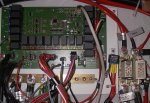
12v circuit refit - ideas/refinements?

Maybe, always cautious of articles that say do it this way and add a link to buy it. Subtle marketing imo.
.

Not a great judgement, he doesn't say "do this, do that" he goes in with sophisticated test gear showing why doing this or that might be a good or very bad idea. Excellent free resource.


Didn't take long for the squabbles to start ;)
 
Many millions of engines have survived with unfused starter circuits.
You could weigh up the risk of short circuit against the reliability of fuses and extra connections.
 
The acid truth is how many vehicles can you find with such an arrangement. Much more likely to get a problem in a shunt than in a boat securely clipped.

As I stated at least one of my cars had a fuse.

Also consider this.

Boat batteries tend to be much bigger that a car battery so there is much more energy to cause a fire in a boat that a car.

Also if a fire does happen in a car it is much easier to get out to safety than in a boat and particular a GRP boat that will burn to the water line.

Cost of including a fuse in a car starter circuit compared to the any increase in safety would be knocked on the head in any value engineering exercise undertaken by the car manufactures having been involved in lots of value engineering exercises in the past.
 
Last edited by a moderator:
Maybe, always cautious of articles that say do it this way and add a link to buy it. Subtle marketing imo.

The acid truth is how many vehicles can you find with such an arrangement. Much more likely to get a problem in a shunt than in a boat securely clipped.

I don't like the way he's got fat cables only supported by the fuse.
And I'd be careful what fuses you put that close to where it says 'Danger Hydrogen.....'
Plus there is a little irony in the little plastic cap covering the fused side of the fuse.

Sometimes it's better to use secondary insulation to prevent shorts happening in the first place.
 
Maybe, always cautious of articles that say do it this way and add a link to buy it. Subtle marketing imo.

The acid truth is how many vehicles can you find with such an arrangement. Much more likely to get a problem in a shunt than in a boat securely clipped.


Actually, the real truth is, most modern cars have fused battery cables.
 
Effectively they're all fused, it's just a matter of the current at which they blow. :)


And how much boat burns.

A friend of mine was about to leave his recently acquired flybridge mobo when he smelt something burning. He opened an aft locker and found it full of smoke. A fire extinguisher promptly put it out. Upon examination, someone had fitted a bilge pump without a fuse, the pump and seized and the wiring quickly melted. Unfortunately they had cable tied the wiring to the hydraulic steering hoses. The wire melted through the hose and hydraulic oil had escaped and caught fire.

This was a small pump with maybe 1.5mm cabling, if he had left 5 minutes earlier there is no doubt a major fire would have ensued. Imagine what a 35mm cable, wired directly to the battery would do if it shorted.

It's not always practical to fit a fuse in the starter circuit, such as big engined mobos, but with small yacht engines it is good practice.

To answer GHAs question regarding breakers, suitably rated breakers make more sense than fuses, IMO.
 
....

To answer GHAs question regarding breakers, suitably rated breakers make more sense than fuses, IMO.

The good thing about fuses is that in general terms the are fail safe, don't have moving parts etc.
I'm not sure how much I'm going to trust a cheap breaker that's been in a boat for a few years, and big ones are not trivial to test in a meaningful way.
 
The good thing about fuses is that in general terms the are fail safe, don't have moving parts etc.
I'm not sure how much I'm going to trust a cheap breaker that's been in a boat for a few years, and big ones are not trivial to test in a meaningful way.

There are cheap and cheap, I still have many 1,000 breakers in operation we supplied in switch panels 35 years ago still working, in fact still look like the day they left the factory. At the time a number of people told me they looked to cheap, they were in fact a good bit of product engineering. To day I use resettable fuses with no moving parts.

Simple is the answer, not cheap.

Brian
 
The good thing about fuses is that in general terms the are fail safe, don't have moving parts etc.
I'm not sure how much I'm going to trust a cheap breaker that's been in a boat for a few years, and big ones are not trivial to test in a meaningful way.

Me neither, which is why i won't fit cheap rubbish.

My boat has close to 30 breakers fitted, some are decades old.
 
When I wire our Trident I am going to do so the same way we wire our vehicles. For some vehicles the requirements are very tight, both for safety, and redundancy, as time on set repairing is very expensive indeed. If we supply a vehicle that proves to be unreliable, or kills some starlet we have a huge potential liability. Most of it is common sense. We have a back up system for several circuits. They may be for instance, ignition, fuel pump, lghts, starter.
If one circuit goes down it is just a matter of knocking one missile switch shut and opening it's secondary. It is not a cure all, but helps! As for the starter circuit, we double that up also. The feed to the starter solenoid goes from the start button via a 70a relay. The backup circuit is just a conventional wire. The main battery to starter cable is not fused. BUT there is a cut off switch in the dash also to kill everything in the event of a meltdown.
With components such as Ignition modules, coils, they are doubled up also so if one goes down it is just a matter of moving the plug. A lot of that is not applicable to a simple diesel boat engine, but things like the bilge pumps etc we are going to build redundant systems in to. Chances are they will never be needed.
As for split charge systems, we use a simpler approach on expedition vehicles with a simple relay. Less efficient in theory, but more up to the hostile environment. As for those 1-2-both switches, they were really designed for emergency starting as far as I can make out, and seem good enough for that. Their primary purpose is to make a connection to the starter motor, not to distribute power in the boat.
There is merit in both a low tech approach, or a hi tech one, circuit breakers or fuses is a matter of personal preference as much as anything else. An easily accessible cut off switch is an essential on any loom. If things are going very wrong just turning the battery off will be your first safety action. Never have the cut off inside a box with the batteries, you don't want to have you face in there scrabbling about to turn them off as they boil away. When they go bang it is like an acid and shrapnel grenade.
Most important is to know your system, and if you are building it yourself DO NOT TRUST YOUR MEMORY. Write it all down, both as a diagram, and a simple list. I notice relays are used less on many boat circuits where they would be taken for granted in a car.
 
There are cheap and cheap, I still have many 1,000 breakers in operation we supplied in switch panels 35 years ago still working, in fact still look like the day they left the factory. At the time a number of people told me they looked to cheap, they were in fact a good bit of product engineering. To day I use resettable fuses with no moving parts.

Simple is the answer, not cheap.

Brian

Ta for some real world input :encouragement:

So back to the start - main point of this particular bit of rewiring is to try to get max life out of cruising batteries, in use year round with no mains power.

General plan is in order of obsessiveness..

  • Get back to real full 100% as often as possible, couple times a week hopefully worst case. Usually most days.
  • Try not to cycle too deep, looking like 75/80% for a normal night on the hook.
  • Equalize once a month or so, maybe a bit less if SG of the cells have very little variation.
  • Have the ability of some kind of repeatable load test with logged volts/amps/temperature. Sort of getting there with that one but not been touched for a while.

As you have spent many years 'at the coal face' with batteries - any comments? Additions? Be nice to keep them cool as well but that's not really going to happen. There will be a temperature sensor fitted so at least keeping an eye on the temp over time is possible.

Thanks!
 
Last edited:
When I wire our Trident I am going to do so the same way we wire our vehicles.

I've spent many years working on car electrical systems, very similar to boats, but there are some differences.

The main battery to starter cable is not fused. BUT there is a cut off switch in the dash also to kill everything in the event of a meltdown.

This will be one of those differences. My cut odd switches are in the saloon, easy to reach and not in the battery compartment. If a 35mm cable shorts out i'm not sure what it's going to look/smell like by the time i get back from putting a reef in at the mast :)


As for split charge systems, we use a simpler approach on expedition vehicles with a simple relay.

No need to spend a fortune on split charging. A good quality VSR is not expensive and will protect you from certain failures that would cause you issues with a standard relay.

Less efficient in theory, but more up to the hostile environment.

I don't think a standard relay would be any more up to a hostile environment than a good VSR.

As for those 1-2-both switches, they were really designed for emergency starting as far as I can make out, and seem good enough for that. Their primary purpose is to make a connection to the starter motor, not to distribute power in the boat.

This is wrong Mark. They do isolate all circuits, they are a battery selector switch. Position (1) runs the engine and domestics from battery 1, position (2) runs everything from battery 2. Both joins the whole lot together, so both banks are in parallel, running all circuits.

There is merit in both a low tech approach, or a hi tech one, circuit breakers or fuses is a matter of personal preference as much as anything else. An easily accessible cut off switch is an essential on any loom. If things are going very wrong just turning the battery off will be your first safety action.

Separate circuits and a VSR is pretty low tech. I use a mixture of breakers and fuses. Simple and inexpensive blade fuses are fine for most low current circuits. I wouldn't want fuses for some applications though, my windlass for example.

Again, don't lose sight of the fact that on a cruising boat you'll be outside, away from the isolators. Fuses/breakers are your first line of defense.

Never have the cut off inside a box with the batteries, you don't want to have you face in there scrabbling about to turn them off as they boil away. When they go bang it is like an acid and shrapnel grenade.

Been there, got the T shirt (although it does have a lot of burn holes in it :)

Most important is to know your system, and if you are building it yourself DO NOT TRUST YOUR MEMORY. Write it all down, both as a diagram, and a simple list.

Good advice.

I notice relays are used less on many boat circuits where they would be taken for granted in a car.

You are generally correct there Mark. A lot of boat owners and indeed electricians seem to be stuck in a time warp, although we do have some posters here with more modern/advanced views. Obviously depends on the boat too. I have several on my boat, including RF remote controlled ones. For instance, my LED saloon lighting is in four zones, each zone can be individually turned on/off or dimmed, or can be turned on/off dimmed in any combination of banks. The bank next to the companionway can be turned on/off via a keyfob remote. I shall shortly be re-wiring and updating the heads, including fitting an electric diaphragm pump that will be operated via a push button switch and a timed relay.
 
That's a cool set up. I was talking more about us duffers in old boats.

Might look cool, but I imagine it would be a nightmare if anything significant went wrong! The fuses and relays are just plug-in items, but there's a lot of electronic witchcraft there as well. From a DIY point of view, there's much to be said for being able to trace wires.
 
Paul, thanks for the corrections/ revisions. It just goes to show that taking for granted that a boat is like an expedition vehicle is not so. Our primary aim with expedition vehicles is to have simplicity and easy of replacement parts as a high priority, hence using low tech relays for charging etc. This also means parts are easy to come by , and easily fixed by any local mechanic wherever you may be... Of course that does not really apply so well to boats at all, something I need to take on board as it were.

A lot of damage that occurs to our vehicle electrics are as a result of some impact or other actually tearing the harness or smashing components. this can be the result of a catastrophic mechanical failure , a prang, or something moving /breaking over rough terrain. . I am curious to know how often such damage occurs in a boat, not often I suppose, but it would be good to know.
The other major difference is yachts are able to leave solar and wind in place, where as vehicles mostly are not, so the charging system demands and outputs are a tad different.
 
I am curious to know how often such damage occurs in a boat, not often I suppose, but it would be good to know.
The other major difference is yachts are able to leave solar and wind in place, where as vehicles mostly are not, so the charging system demands and outputs are a tad different.

Unless wires are routed poorly mechanical damage is very rare. The main risk is corrosion in the damp atmosphere, especially if salt water gets below (it takes ages to really dry compared to fresh water). Flooding and resultant corrosion is also a bit of a risk. I definite avoid the typical crimp connectors, preferring waterproof glued heatshrink ones, although some argue for the lucar type connectors as they are easier to inspect. Also try to keep the wiring a fair few inches up just in case you get a few inches of flooding.

Another non-auto risk is boiling of batteries from solar charging if the boat is left too long uninspected on a mooring, so make sure the charging regime is suitable.
 
Top