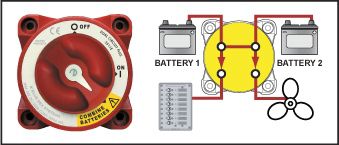
1,2 Both Switch - When on Both do the 2 batteries even out on charge?

Interesting statement, what is modern ? this pdf link is a 1982 system and goes someway to answering your question .... http://www.kddpowercentre.co.uk/data/P4000_82_lit.pdf

Times change and requirements change, back in 1972 when I started alternators were almost unknown and most boats had a dynostart, by 1982 you had small alternators, 30 amp if you were lucky, but bigger demand. Plus towed generators, solar panels etc. had yet to be invented for long range cruising yachts. but the basic idea was to split charging so prioritize engine battery and maximize charge by making use of how the a battery works.

Today you have engine battery, service bank, bow and stern banks, complex to do manually, easy to do automatically and show indication of battery level, but still only a expansion of the 1982 system, but there is still the future !!!

The bottom line is what I have always said, the optimum solution is what suits you.


Brian

+1
 
You can't keep saying that modern systems are superior without any reasoning.

The reason is obvious and has been well explained on numerous occasions by many posters, including on this thread. It hardly needs repeating.

Your "reasoning" may be personal to you, even though you were confused by its lack of logic originally. Learning to avoid a failing is not sound reasoning.
 
You can't keep saying that modern systems are superior without any reasoning.


Bullseye there Rupert.

When you hear "times have changed" you can be pretty sure that someone is floundering at the limit of their capacity to tell us about it.

The fact is that innovations are:

a) Sometimes an outstanding breakthrough:
Almost everyone sees this, though some stick out, sometimes for specialist reasons. For example: Small affordable AIS, Chart Plotters.

b) Very often are old designs/ideas rehashed, often moving one step forwards and one step back.
The more discerning can see a balance of advantages and disadvantages and if the one clearly tips the other, they make their own judgement - based on their own requirements.
The easily led tend to focus on excerpts from advertising literature, they always know which of the alternatives is best. They say: "things have moved on". For example Boat Designs, Charging Systems.

c) Occasionally useless.
Almost everyone see this - at least in the end.
Examples might be: Dodgy Anchors, Nylon Shirts, Donald Trump etc

The three paradigms overlap, which is an even greater challenge to the flat thinker.
 
Last edited:
When you hear "times have changed" you can be pretty sure that someone is floundering at the limit of their capacity to tell us about it.

Assuming you are referring to the subject of this thread, I would have thought the average forum member's capacity to be told about the advantages of having separate house and engine circuits has been nearly maxed-out. Paul Rainbow, in particular, has been doing missionary work on this for years.

I followed the advice last year, dumped my 1, 2, both switch and have not looked back. Those with infallible memories, no other reason to change and crew who never touch a switch may be quite happy to continue with 1, 2. both. Good luck to them.
 
Bullseye there Rupert.

When you hear "times have changed" you can be pretty sure that someone is floundering at the limit of their capacity to tell us about it.

The fact is that innovations are:

a) Sometimes an outstanding breakthrough:
Almost everyone sees this, though some stick out, sometimes for specialist reasons. For example: Small affordable AIS, Chart Plotters.

b) Very often are old designs/ideas rehashed, often moving one step forwards and one step back.
The more discerning can see a balance of advantages and disadvantages and if the one clearly tips the other, they make their own judgement - based on their own requirements.
The easily led tend to focus on excerpts from advertising literature, they always know which of the alternatives is best. They say: "things have moved on". For example Boat Designs, Charging Systems.

c) Occasionally useless.
Almost everyone see this - at least in the end.
Examples might be: Dodgy Anchors, Nylon Shirts, Donald Trump etc

The three paradigms overlap, which is an even greater challenge to the flat thinker.


The reasoning has been done to death, so pointless repeating it just because somebody can't be bothered to read it. He has clearly no intention of accepting the detailed explanations so trying to explain it again is simply a waste.

Your pontification does not apply in this situation. The two approaches to managing batteries start from different points. One requires positive actions from a person and the other does not. The requirement for human intervention leads to mistakes (as this particular user has admitted) and these mistakes are removed in an automatic system.

So, it is not an outstanding breakthrough, just a different (and more reliable) way of achieving similar outcomes. It is not an old idea rehashed and it is not useless.

The flounderer seems to be the person who continues to use a method that is prone to mistakes and seems to be proud that he has learned to overcome its deficiencies rather than recognise that he can eliminate them.
 
When you hear "times have changed" you can be pretty sure that someone is floundering at the limit of their capacity to tell us about it.

On this forum "times have changed", like "the market/world has moved on" generally means "I used to do it that way but now I do it this way and anyone who does it that way must be wrong because I am always right". It has a counterpart, which is "nobody wants that", equivalent to "I decided not to get one of those and so anyone who does must be wrong because I am always right".

In due time, of course, they change their minds and buy one of those and then, as you'd expect, the world has moved on ...
 
Paul Rainbow, in particular, has been doing missionary work on this for years.

I followed the advice last year, dumped my 1, 2, both switch and have not looked back. Those with infallible memories, no other reason to change and crew who never touch a switch may be quite happy to continue with 1, 2. both. Good luck to them.

I've been extolling the virtues of simple separate on/off switches for many years; Paul only joined the forum last year.

Glad to see you're now benefitting from a simple system.
 
You can't keep saying that modern systems are superior without any reasoning.

There has, as Tranona says, been much reasoning written, some people just don't read it. You claim your 1-2-both switch offer greater flexibility, perhaps you could share the reasoning there ?

1-2-Both switch. You can elect to run everything from one bank, everything from another bank or everything from both banks, combined in parallel, giving up your backup.

To keep your batteries charged you have to either change banks or run the engine on (both), again given up your backup.

You have to explain to crew how your system works, let's hope they remember.

Separate switches. You have a bank designed for and dedicated to the engine and another for the domestics. These banks can differ greatly in their composition, typically consisting of a high CCA starter battery dedicated to starting the engine and a high ah bank for the domestic circuits. When you arrive at the boat you turn the domestic circuits on, the engine circuit is still isolated, you cannot deplete it's starter battery, no matter what you do. When it's time to start the engine you turn the engine switch on. At your destination you can turn the engine switch off or leave it on, makes no difference.

To keep your batteries charged you have to .....erm.......do nothing.

You have to explain to crew how your system works. "turn the engine battery on please". Let's hope they know how to turn a switch on, most people do.

You have a 3rd switch for emergency use, should a battery fail or go flat. If you feel your crew may be especially stupid, you can remove the key for this switch, hang it on a string nearby.

This modern system is superior because it still offers all of the functionality of the antiquated 1-2-both switch. It's simpler to use and pretty much foolproof. Keeping the batteries separate at all times (other than an emergency start) means less chance of flat batteries and no means of starting the engine. No fiddling around with switches underway. No trying to explain to crew how it works. Greater redundancy with separate circuits and switches, if one fails you use the other. More flexibility with charging arrangements, each bank can have different charging regimes or systems.

Bot everyone will want, or need, all of the possible features and benefits a modern system offers, but it is none the less superior.
 
So, it is not an outstanding breakthrough, just a different (and more reliable) way of achieving similar outcomes. It is not an old idea rehashed and it is not useless.

I thought it was 40 year ago when I designed it, remember it included multistage mains charger, low voltage drop out, twin engine three battery banks split charge and battery status display :D

Sorry could not resist had a frustrating day with builder.
 
The reasoning has been done to death, so pointless repeating it just because somebody can't be bothered to read it. He has clearly no intention of accepting the detailed explanations so trying to explain it again is simply a waste.

Your pontification does not apply in this situation. The two approaches to managing batteries start from different points. One requires positive actions from a person and the other does not. The requirement for human intervention leads to mistakes (as this particular user has admitted) and these mistakes are removed in an automatic system.

So, it is not an outstanding breakthrough, just a different (and more reliable) way of achieving similar outcomes. It is not an old idea rehashed and it is not useless.

The flounderer seems to be the person who continues to use a method that is prone to mistakes and seems to be proud that he has learned to overcome its deficiencies rather than recognise that he can eliminate them.

So its the Tranoma way or the wrong way again.........
 
So its the Tranoma way or the wrong way again.........

If you give a 6 different design Engineers the same problem the chances are you will get 6 different solutions to the same problem ans all of then will be valid with pros and cons for each solution.

In this case Tranona is insisting the same solution will fit all cases where we know yachts like cars are designed for different applications which will require different solutions.
 
If you give a 6 different design Engineers the same problem the chances are you will get 6 different solutions to the same problem ans all of then will be valid with pros and cons for each solution.

In this case Tranona is insisting the same solution will fit all cases where we know yachts like cars are designed for different applications which will require different solutions.
Bang on. :encouragement:
 
Separate switches. You have a bank designed for and dedicated to the engine and another for the domestics.

My dear fellow, separate switches are sooooooo last decade and I cannot believe that you would use or recommend them. The world has moved on. All sensible people have a dual circuit + combine switch, which is far easier to use.

81001.jpg
 
My dear fellow, separate switches are sooooooo last decade and I cannot believe that you would use or recommend them. The world has moved on. All sensible people have a dual circuit + combine switch, which is far easier to use.

LOL I was designing systems using these switches when they first came about, about ten years ago. It's a big improvement on the 1-2-both switch, for sure. Two potential issues though.

a) Single point of failure.
b) In the event of a catastrophic battery failure, no way to isolate the dead battery and continue using the "combine" setting.

You are motoring in heavy weather and the engine battery catastrophically fails and the engine cuts out. The engine battery fuse has blown (if you don't have one, the battery wiring is on fire so you need to deal with that). You switch to "combine" and the domestic fuse also blows (or you have a second fire to deal with if you have no fuses).

What now skip ?

Personally, i just turn the engine switch off, hit the emergency switch and lean on the throttle lever :encouragement:

Used to use them, but as you say, my World moved on :)
 
My dear fellow, separate switches are sooooooo last decade and I cannot believe that you would use or recommend them. The world has moved on. All sensible people have a dual circuit + combine switch, which is far easier to use.

81001.jpg

At least they have a warning sticker on them. :)

Taking it slightly more serious, seems strange to have a switch that turns the engine battery on even when you've just gone to the boat to do a bit of maintenance and just want the domestics on to listen to the radio, or have working lights or to keep the milk in the fridge cool so you can have a cuppa whilst you work.
 
LOL I was designing systems using these switches when they first came about, about ten years ago. It's a big improvement on the 1-2-both switch, for sure. Two potential issues though.

a) Single point of failure.
b) In the event of a catastrophic battery failure, no way to isolate the dead battery and continue using the "combine" setting.

You are motoring in heavy weather and the engine battery catastrophically fails and the engine cuts out. The engine battery fuse has blown (if you don't have one, the battery wiring is on fire so you need to deal with that). You switch to "combine" and the domestic fuse also blows (or you have a second fire to deal with if you have no fuses).

What now skip ?

If I really needed to I would just pop the breakers on the individual batteries, as required. But honestly, "catastrophic battery failure" ... what century are you living in? We no longer have rubber-cased batteries sealed with bitumen, you know. And I am just dying to know how that quaint circuit you posted copes when both fuses have blown and the wiring's on fire ...

Not that it's a bad circuit, of course, just rather out of date.
 
Taking it slightly more serious, seems strange to have a switch that turns the engine battery on even when you've just gone to the boat to do a bit of maintenance and just want the domestics on to listen to the radio, or have working lights or to keep the milk in the fridge cool so you can have a cuppa whilst you work.

Why on earth would you want to isolate the engine every time you switch it off? Do you do the same in your car?
 
Top