1,2 Both Switch - When on Both do the 2 batteries even out on charge?

My point is that ,when your start battery is flat, substituting a good battery is better than paralleling. We often get 'poor starting ' threads on here where it turns out that the voltage is down on the battery.
You also seem to have got lost.

The idea of having separate switches is so that individual banks can be isolated. The third (emergency) switch parallels the systems at the load terminals of the isolators.
 
If the VSR and wiring are suitably rated there isn't really any difference whether the wire from the alternator goes to one bank or the other. At the end of the day the CSR will parallel the two banks very shortly after the engine starts anyway. Once that happens you basically have one big battery. There is no need for you to change where your alternator is wired, just fit the VSR between the two banks.

How about some real World stuff :

My boat has a single 110ah engine battery and two 110ah batteries for the domestic bank. The alternator is connected to the engine battery and the solar panels to the domestic bank. Each bank has it's own isolator switch. A dual sensing VSR allows both charging sources to charge all of the batteries. A third switch is fitted for emergency use, should a bank fail.

I also have a mains charger, which since the Sun disappeared i've left switched on 24/7, connected to both banks. I have a fridge on 24/7, the Eber is on 24/7, laptop is on 24/7, FM radio is on a lot, as are lights (albeit LED). Water is pumped by an electric pump.

Let's take a look at my monitoring gubbins :

Engine battery volts : 13.6
Domestic bank volts : 13.5 (slight difference as i have stuff running)
Mains charger volts : 13.4 (float)
Mains charger amps : 4.0
Solar panel voltage : 30.0
Solar charging volts : 13.4 (float)
Solar charging amp : 0.3

Those figures were taken now, as i'm typing. In the Summer i keep the mains charger off most of the time, the solar panels keep up with most of my use. The engine battery will sit at 13.6v and the domestics will vary a bit, i keep an eye on them and if they look a bit low when the Sun goes down i put the main charger on for a while.

My solar controller software keeps a log for 30 days so i can see where the battery voltages have been and i never see any problems. My domestic batteries are open cell and can be topped up, i have not topped them up since i bought the boat, almost a year ago.

How about some real World, extreme battery bank disparity ?

My van has two heavy duty batteries and a 150a alternator. The nature of use means that sometimes these batteries are charged for 10-12 hours non-stop, sometimes left for days unused, sometimes they get some heavy use without the engine running.

Also on the van is a small jump pack, fitted with a tiny, sealed battery, smaller than most motorcycle batteries. For charging, this is connected to the main van batteries. So, this tiny little battery is connected in parallel to two heavy duty batteries all of which are being charged for up to 12 hours straight via a 150a alternator, if they are not being abused by the electrical stuff on the van, which includes a heavy duty winch.

The van batteries are coming up to four years old, not sure about the jump pack, but it's had a hard life and looks like it will finish falling apart before the battery fails, it still manages to start some good sized diesel engines.

I hesitate to jump in to this frothing pond, but since you now say that you have a mains charger switched on 24/7, how are your circumstances in any way relevant for those of us who actually go to sea, and rely on the capacity of our batteries?
 
If the VSR and wiring are suitably rated there isn't really any difference whether the wire from the alternator goes to one bank or the other. At the end of the day the CSR will parallel the two banks very shortly after the engine starts anyway. Once that happens you basically have one big battery. There is no need for you to change where your alternator is wired, just fit the VSR between the two banks.

How about some real World stuff :

My boat has a single 110ah engine battery and two 110ah batteries for the domestic bank. The alternator is connected to the engine battery and the solar panels to the domestic bank. Each bank has it's own isolator switch. A dual sensing VSR allows both charging sources to charge all of the batteries. A third switch is fitted for emergency use, should a bank fail.

I also have a mains charger, which since the Sun disappeared i've left switched on 24/7, connected to both banks. I have a fridge on 24/7, the Eber is on 24/7, laptop is on 24/7, FM radio is on a lot, as are lights (albeit LED). Water is pumped by an electric pump.

Let's take a look at my monitoring gubbins :

Engine battery volts : 13.6
Domestic bank volts : 13.5 (slight difference as i have stuff running)
Mains charger volts : 13.4 (float)
Mains charger amps : 4.0
Solar panel voltage : 30.0
Solar charging volts : 13.4 (float)
Solar charging amp : 0.3

Those figures were taken now, as i'm typing.....s.
What do you read into the different voltages?
Is the VSR open crcuit at float voltage? Do you think it should be?
Is your house battery really at a higher voltage than a charger that is putting out 4A?
 
I hesitate to jump in to this frothing pond, but since you now say that you have a mains charger switched on 24/7, how are your circumstances in any way relevant for those of us who actually go to sea, and rely on the capacity of our batteries?

Have another read of what i posted and you will find the answer.
 
What do you read into the different voltages?
Is the VSR open crcuit at float voltage? Do you think it should be?
Is your house battery really at a higher voltage than a charger that is putting out 4A?


The first two figures are taken from voltmeters. The third and fourth are from the mains charger itself and the solar figures are from the controller log. I suspect the voltmeters read a little high.

The VSR is closed circuit, as expected.

Most of the 4a charger output will be due to the domestic loads, fridge, eber, FM radio. This varies of course and currently it is 2.8a.
 
The first two figures are taken from voltmeters. The third and fourth are from the mains charger itself and the solar figures are from the controller log. I suspect the voltmeters read a little high.

The VSR is closed circuit, as expected.

Most of the 4a charger output will be due to the domestic loads, fridge, eber, FM radio. This varies of course and currently it is 2.8a.
I think anything less than a 3 1/2 digit voltmeter would drive me nuts!
 
image: http://www.ybw.com/forums/images/ybw/misc/quote_icon.png
Quote Originally Posted by PaulRainbow
image: http://www.ybw.com/forums/images/ybw/buttons/viewpost-right.png
View Post
If the VSR and wiring are suitably rated there isn't really any difference whether the wire from the alternator goes to one bank or the other. At the end of the day the CSR will parallel the two banks very shortly after the engine starts anyway. Once that happens you basically have one big battery. There is no need for you to change where your alternator is wired, just fit the VSR between the two banks.

What you say might be ok for your installation. You have a tiny domestic battery capacity. In my case it would make a difference how it was wired since I have 240 amp hour engine and 900 amp hour on the domestic batteries.
We manage perfectly well with our simple set up without a VSR. Its horse for courses. You sound like you live in a marina most of the time as you are on shore power. We are on shore power about once a year for a day. Access to failed electronics is not so easy when you are cruising off the beaten track. 1,2,both switches I suspect have a lower failure rate than VSRs. That is an important aspect for some people. The KISS principal works for many cruisers. Also can I repair it in the middle of nowhere. These comsiderations are important to me.
 
What you say might be ok for your installation. You have a tiny domestic battery capacity. In my case it would make a difference how it was wired since I have 240 amp hour engine and 900 amp hour on the domestic batteries.

The text that you quoted was a direct reply to a question by the OP and related to him leaving the alternator connected directly to the domestic bank. In his case and in my own i don't believe it makes a difference either way.

To be honest, i'm not convinced it makes a difference even when the domestics are much bigger than the engine battery, if the split charge system (whatever that may be) and cabling is suitably rated. It's obviously important that the cabling doesn't suffer from voltage drop.

You sound like you live in a marina most of the time as you are on shore power. We are on shore power about once a year for a day.

My boat is based in a marina but the reason the shore power is on 24/7 is because i'm not getting enough power from the solar panels and i can't be bothered to keep turning the shore power on and off. I could manage without the convenience of shore power if i had to, i could run the engine or the generator, but i's simpler and cheaper to turn the shore power on.

During the Summer i'm almost self sufficient with Solar power, i used £15 of shore power in 7 months from April to end of October, when i only turn the shore power on as needed. Were i at sea i'd occasionally run the engine.

Access to failed electronics is not so easy when you are cruising off the beaten track. 1,2,both switches I suspect have a lower failure rate than VSRs. That is an important aspect for some people. The KISS principal works for many cruisers. Also can I repair it in the middle of nowhere. These considerations are important to me.

Yes, i understand that. I did say earlier that a VSR isn't the be all and end all. But for the average boat that's just used for coastal cruising it does provide a cost effective solution to keeping all batteries charged. Having the emergency switch does provide some redundancy in the event of a failed VSR.
 
We manage perfectly well with our simple set up without a VSR. Its horse for courses. You sound like you live in a marina most of the time as you are on shore power. We are on shore power about once a year for a day. Access to failed electronics is not so easy when you are cruising off the beaten track. 1,2,both switches I suspect have a lower failure rate than VSRs. That is an important aspect for some people. The KISS principal works for many cruisers. Also can I repair it in the middle of nowhere. These comsiderations are important to me.

As I posted earlier, that is also my viewpoint.

It seems to me that a lot of the problem is having switches with the 1-2-both facility. I almost never use 'both', it's either 1 or 2. This has kept my batteries sufficiently well charged for the past 30 years that we have never lost power either for starting or domestic. We are relatively sophisticated today with solar panels and large(ish) domestic banks but the same applied many years ago when we knew a lot less about the subject and only had two small batteries.
 
I submit the perfect basic wiring diagram

Perfect%20wiring%20diagram.jpg
 
Thanks. I had assumed these (12b switches) were a good thing! Never used one myself, but quite surprised at the flak they get. So I need to decide whether to design mine out of the new wiring I'll be working on.
 
Thanks. I had assumed these (12b switches) were a good thing! Never used one myself, but quite surprised at the flak they get. So I need to decide whether to design mine out of the new wiring I'll be working on.

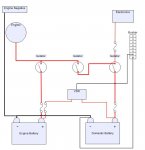
Something like this, IMO :
 

Attachments

  • Charging 2 Baatteries One engine with VSR.jpg
    Charging 2 Baatteries One engine with VSR.jpg
    34.2 KB · Views: 1
That's my line!:D
I rewired my boat a few years ago and removed the 1 2both. Replaced it with VSR.. On two occasions I had non starting engine battery. I discussed the circumstances with the suppliers and they agreed that this was a weakness with them... I may have had a single bank charger at the time.

In any case I put the previously removed 12both into my new boat with a diode and never had any problems..

I cannot recall precisely the circumstances that the problem arose but I think it was related to the vsr opening with the shore charger and the marina power subsequently failing resulting in the fully charged start battery draining into the depleted domestic bank....

I often think electrics in boats are ok in practice but may be offensive in theory
 
I rewired my boat a few years ago and removed the 1 2both. Replaced it with VSR.. On two occasions I had non starting engine battery. I discussed the circumstances with the suppliers and they agreed that this was a weakness with them... I may have had a single bank charger at the time.

In any case I put the previously removed 12both into my new boat with a diode and never had any problems..

I cannot recall precisely the circumstances that the problem arose but I think it was related to the vsr opening with the shore charger and the marina power subsequently failing resulting in the fully charged start battery draining into the depleted domestic bank....

I often think electrics in boats are ok in practice but may be offensive in theory

If that was the case, you had a defective VSR. It should close when you turn the shore power on, but if the shore power is cut, it should open again. VSRs are only one solution, probably the best one for the money. Zero loss spliters are another good solution, just a little more money. Of the cheaper solutions a diode is the least desirable, due to the voltage drop.
 
We have the simple 12both setup. I use both for an engine start unless we've been anchored overnight in which case I'll use one battery overnight and use the other for starting the next day. Use both when engine is running. My last pair of identical leisure batteries lasted 10 years...possibly because mostly each only has to provide half the starting current.
 
Top