Z Spars shackles - price doesn't mean quality

wonkywinch

Well-Known Member
Joined
30 Jul 2018
Messages
3,914
Location
Hamble, UK
Visit site
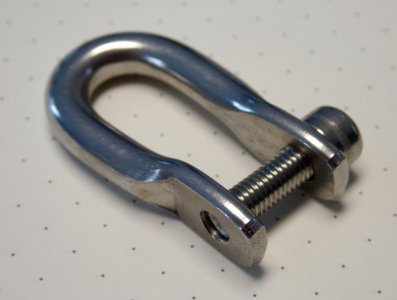
I just received replacement shackles from Z Spars for the halyard and tack of our in mast furled sail. They were more expensive than Wichard but I had trouble finding the tack one in any chandler and guess they are a proprietary Z Spars product. £61 for the pair :(

I'm curious and/or disappointed that the shackle is made like this or even passed QC before it left the factory. Maybe it's meant to be like this, I've asked the question of them, awaiting reply but thought would share.

shackles1.jpg

shackles2.jpg

shackles3.jpg
 
Fitted a new wide jaw Z-Spars shackle a few weeks ago, attaches the tack of the mainsail to the gooseneck fitting.
I had just had a new mainsail made and the sailmaker was helping me out getting the sail bent on. He managed to drop the original shackle on the deck, and sods law made sure it took one bounce and went over the side.

I looked at loads of shackles online and was not able to find one with the same jaw opening as the Z-Spars one.
 
Would a soft shackle work?
Not on the tack.

The tack shackle pin also fastens the joint between the luff reefing tube extrusion & the plastic insert which transmits the drive from the in mast furling drum spiral carrying the furling line.

The scissor action between extrusion and insert would destroy any soft shackle very quickly!

To the op.
A tap with a hammer on the shackle in a vice might get the pin a bit more square to the shackle.

I don't think the shape of the shackle is as critical as being able to get the pin fastened into the opposite leg of the shackle.
This has to be done whilst picking up on the sail luff tack loop and aligning the two parts of the in mast reefing system through the key holes in the side of the mast!

I found putting a small screwdriver in from the opposite side to prealign and guide the shackle pin in as you extract the screwdriver saved much time and a fortune out of the swear jar.🙂
 
Last edited:
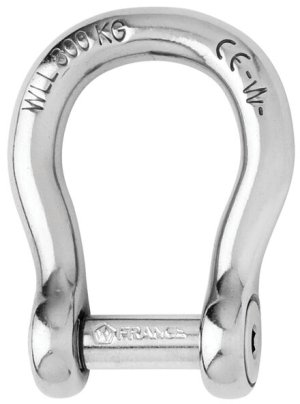
Z Spars got back to me. New one in the post, in the meantime, Wichard do something similar that will fit. For £11 at the chandleries.

View attachment 199301

Return the Z Spars ones under distance selling regs, get the Witchard ones.
I had tried something similar as used on the jib furler. Even my delicate little fingers had difficulty in holding on to a shackle pin with no ears. I lost it down the mast into the furling gear which involved removing the complete furling drum.

I suppose this was better than losing it overboard!🙃
 
I had tried something similar as used on the jib furler. Even my delicate little fingers had difficulty in holding on to a shackle pin with no ears. I lost it down the mast into the furling gear which involved removing the complete furling drum.

I suppose this was better than losing it overboard!🙃
I have had the sail on/off a few times in my ownership so know the drill. My trick is to wrap a tea towel around the mandrel to block the gap down to the base of the mast so, hopefully, I can recover anything I drop.

The whole reason for ordering them is because current set up has a bent countersunk screw in there so I guess earlier hands haven't been as careful.
 
Lot's of comments about different shackles, but let's look at the smaller one supplied by Z Spars.
How bad could it be?
There are only two parts: the shackle and the pin.


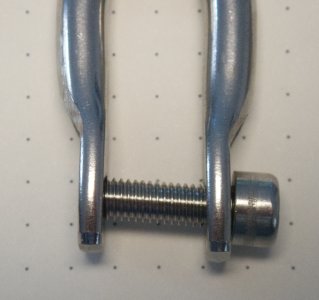
Looking at the bottom photograph, you can see that one leg is longer than the other so the holes don't line up.
This means the bearing face of the cap screw cannot meet the face of the leg and tighten up.

The cap screw is actually threaded the whole length. This thread will act as a file or a saw on the tack cringle, damaging it.
Also the cap screw is not long enough. You can see that the thread screw end before it is fully engaged in the other leg.
Even the larger shackle has too much thread exposed!

In conclusion we have a shackle that cannot be tightened properly and with out seizing will come loose.
We have a shackle that instead of capturing a sail will actually damage it.

And they talk about low quality Chinese cr#p!!!
 
Hi Wonky winch.
When you return them add a link to this page!!

Final point, How can you seize these if there is no hole in the pin?

gary
 
Last edited:
Hi Wonky winch.
When you return them add a link to this page!!

Final point, How can you seize these if there is no hole in the pin?

gary
I put a drop of Loctite on the thread when I fit them but the point about the exposed thread being bad for the cringle is very valid.

I've found a Wichard equivalent for the halyard one too.

wichard_bow.jpg
 
This thread will act as a file or a saw on the tack cringle, damaging it.

The threads do not make contact with the sail material,
Both the head and tack of the sail make contact with the smooth bar of the undeformed shackles.

The most wear takes place on the upper mandrel . This can be reduced but not eliminated with a plain shank type pin like the winchard.
 
The threads do not make contact with the sail material,
Both the head and tack of the sail make contact with the smooth bar of the undeformed shackles.

The most wear takes place on the upper mandrel . This can be reduced but not eliminated with a plain shank type pin like the winchard.
Ah, you're quite right, the threaded bolt goes through the parts of the furling mechanism, not the sail. Both at the drum/mandrel and halyard swivel.
 
I put a drop of Loctite on the thread when I fit them but the point about the exposed thread being bad for the cringle is very valid.

I've found a Wichard equivalent for the halyard one too.

View attachment 199319
These are excellent: I have used one on my anchor to chain connector for 25 years. At one time they were made in 17/4PH, and their standard shackles still are, but for some reason the countersunk versions are now in 316.
 
Top