
YHK V-Tronix VHF Antenna With Wind Indicator

bluerm166

Well-Known Member
Joined
29 Sep 2009
Messages
1,119
Visit site
IMG_20171209_191132652_HDR.jpg

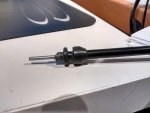
Does anyone have working knowledge please of the connection between the whip aerial and it's base.The aerial had gradually worked it's way out of the socket although continuing to work OK and the vane attachment is sound.
Is it a simple matter of gluing the plastic part back into the socket (keeping the s/s clean) - is the electrical connection designed to 'grab' the stainless end as it is inserted or is a complete new assembly desirable ?
 
I don't know what's inside, but it's crucial to keep the water out.
IT might be worth a look to check the coax is not corroding.
I've had a couple of these with excellent performance, but never had one come apart.
 
It may be as simple as whip attached to Centre coax core or it may have a small loading coil inside which will be more difficult to reconnect. This is not as easy to test as it’s inductive resistance and a normal test meter cannot check this.
 
This old thread has a link to the instructions for solderless connection.
http://www.ybw.com/forums/showthread.php?196499-Vtronix-Hawk-VHF-aerial-connection

It does however look like you are missing the threaded nut that holds the whole lot in... Unless that has slipped down the cable and out of the photo.

As to the centre pin. I would have expected the cable to have been cut off straight and the centre stranded core would get pierced by a pin within the base of the antenna when the co-ax is inserted. Is that silver tip in the end of your co-ax perhaps that antenna central pin that has dropped out? If so then new antenna needed.
 
Don't think I've ever seen one dismantled to that degree before! Do you have pics of the other bits?

As long as once reassembled the centre core of the cable is in good contact with antenna you should be OK but I'd still do a check with an SWR meter afterwards. Ideal would be to check it using a new cable to eliminate any problems there.

Would perhaps still be a bit concerned about its integrity overall though.

Is the cable still inserted into the base OK?
 
Many thanks for your replies.
To clarify that the shot is of the bottom of the aerial so the 's/s pin' is part of the whip itself.
You have confirmed my suspicion that a new aerial is the safest way to go,bearing in mind it's position.
Thanks.
 
Ah . Now you've said that, yes.... It's usually permanently fixed into the coil within the base... Once loose it will have let water in and the base will be waterlogged.... As other have said, better to replace the antenna and whilst you're at it, the feeder cable as well (all the way back to the radio)...

I think we all thought that was the feeder cable in the photo and it had dropped out of the antenna base...
 
View attachment 67783

Does anyone have working knowledge please of the connection between the whip aerial and it's base.The aerial had gradually worked it's way out of the socket ...... is the electrical connection designed to 'grab' the stainless end as it is inserted or is a complete new assembly desirable ?
Having just dissected my old Vtronix Hawk, I thought it worth recording what I found to answer the above questions for the curious.
The following refers to an antenna old enough to be stamoed 'Made in Britain' and may not apply to more recent examples.

The SS pin shown in the photograph is an interference fit to a copper/brass pin that pokes in horizontally from the edge of the base. The outer end of the pin is in 'touch' contact with one end of a wound coil made of heavy guage wire that looks like copper but is far stronger and springier tha plain copper. The spring in the coil is used to provide the 'touch' and 'interference' contacts at the ends of the horizontal pin.

The wound coil is about 1" long and has the diameter of the base with just enough space left for a thin copper leaf shield (I'm guessing that the coil's wire was finished in some non-conducting material to avoid short circuitingof the turns?

At the bottom of the coil, there is another horizontal pin which 'touches' both the coil and the tiny pinhead in the coax inlet. This pinhead is just that. It has no electrical contact other than the lower horizontal pin.

That tots up to five contacts that can corrode and therefore reduce performance.

I could find no electrical path for the coax sheath beyond the inside the coax inlet.

I do have one or two photos but my butchery gives them dubious value.

My personal reaction to my findings are "I wish I hadn't already bought a replacement of the same type". (I had hoped to install a Metz with a Hawk equivalent but it wasn't available at the time of purchase). With hindsight, I should have cut the old Vtronix back to retain the Hawk and installed a Metz separately. Ah well. Hope this is of interest to some.
Cheers
Bob
 
Thanks RIBW,
Yes this is still of great interest because,after the recent high winds,I now have two antenna which worked up out of the socket.Fortunately I had placed the first one complete with Hawk in the garden on a pole so was able to retrieve the Hawk part recently and put it on a basic new antenna.I'm thnking of adding some external non metallic binding of the whip to hold it down to the bracket as I can't bear the thought of buying any more ! Whereas I wouldn't risk reusing one of my 'spares' up the mast I will see if I can get it back into the socket for use on the pushpit as an initial upgrade to the dinky aerial that came with my DVBT AIS dongle.
Coincidentally this video
includes the design for such an aerial and confirms the coil that you discovered .
 
Top