yet another fridge query

DanTribe

Well-Known Member
Joined
8 Jan 2002
Messages
5,673
Location
Essex
Visit site
Sorry, I expect this subject has been done to death, but I cant find the answer to two questions.
I am replacing a Waeco CU55 compressor and VD02 evaporator which has failed with corrosion in the suction pipe.
1/ This pipe exited the cold cabinet at low level and was subject to collecting condensation which I guess is why it failed. Would it be better to have it exit at a high level?
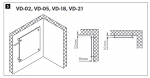
2/ The new plate is slightly wider[ couldn't get an exact replica]. the only way it will fit without surgery is to have the suction pipe at the top, vertically out of the plate. The instructions say " it is very important that the short part of the hose attached to the evaporator via a jumper remain directed to the wall". Does this mean I can't have it vertical? Unclear to me. No helpful diagrams in the manual or usefule Google videos.
Maybe I'm thinking too much!
 
Sorry, I expect this subject has been done to death, but I cant find the answer to two questions.
I am replacing a Waeco CU55 compressor and VD02 evaporator which has failed with corrosion in the suction pipe.
1/ This pipe exited the cold cabinet at low level and was subject to collecting condensation which I guess is why it failed. Would it be better to have it exit at a high level?
2/ The new plate is slightly wider[ couldn't get an exact replica]. the only way it will fit without surgery is to have the suction pipe at the top, vertically out of the plate. The instructions say " it is very important that the short part of the hose attached to the evaporator via a jumper remain directed to the wall". Does this mean I can't have it vertical? Unclear to me. No helpful diagrams in the manual or usefule Google videos.
Maybe I'm thinking too much!

FWIW I once installed a long evaporator plate vertically, with pipe work exiting at the top. It worked fine for the sixteen years we kept the boat. :-)
 
Thanks.
I have the instructions for the old Dometic which I'm removing. They are clear with good diagrams. I'm replacing it with an Isotherm, almost identical but with subtle differences, it's millimetres too big! And the instructions are ambiguous, poor diagrams. It looks like I shall have to bend the plate, something I wanted to avoid.
There are 38 pages of health and safety notes in umpteen languages though.
 
The natural percolation of the refrigerant is upward through the evaporator plate grid as it warms up.

It is also natural for the suction pipe returning to the compressor to sweat when the unit is correctly charged. At the same time it is also important to allow the suction gas to warm up as the suction superheat ideally needs to be ~ 6K as it enters the compressor (did you see what I did there ?), i.e. 6oC of measured temperature above the saturation point for the refrigerant. Assuming your grid will be operating on the surface at ~ 2-3 oC in the middle of the grid, to achieve a box temperature ~ 5-6oC, then the saturation temperature will be ~ 0oC which for R134a = 1.9 Bar, so the pipe ideally should be at ~ 6oC as it enters the compressor. If you have a fridge gauge and Schraeder AP you can check the suction pressure correlates with this, and if its below say 1.8 Bar then the fridge is likely undercharged. On any moderate day 6oC will be below the dew point for moisture in the surrounding air so sweating is quite normal. For this reason avoid insulating the suction pipe, otherwise you risk cold liquid refrigerant entering the compressor, which can shorten its operating life considerably.
 
The natural percolation of the refrigerant is upward through the evaporator plate grid as it warms up.

It is also natural for the suction pipe returning to the compressor to sweat when the unit is correctly charged. At the same time it is also important to allow the suction gas to warm up as the suction superheat ideally needs to be ~ 6K as it enters the compressor (did you see what I did there ?), i.e. 6oC of measured temperature above the saturation point for the refrigerant. Assuming your grid will be operating on the surface at ~ 2-3 oC in the middle of the grid, to achieve a box temperature ~ 5-6oC, then the saturation temperature will be ~ 0oC which for R134a = 1.9 Bar, so the pipe ideally should be at ~ 6oC as it enters the compressor. If you have a fridge gauge and Schraeder AP you can check the suction pressure correlates with this, and if its below say 1.8 Bar then the fridge is likely undercharged. On any moderate day 6oC will be below the dew point for moisture in the surrounding air so sweating is quite normal. For this reason avoid insulating the suction pipe, otherwise you risk cold liquid refrigerant entering the compressor, which can shorten its operating life considerably.

I saw that you got your username in but failed to address either of the OP's questions ;)
 
I saw that you got your username in but failed to address either of the OP's questions ;)
OK I meant exiting at the top should be just fine, indeed correct.

Without sight of the instructions not sure what is meant by 'towards the wall', but if it is a layered evaporator then it would be correct that the warmest gas would exit at the position of the warmest cooling air entering the grid (counterflow).
 
It was the "towards the wall" bit I was unsure of, there was no diagram.. I have interpreted it to mean at the top of the plate but horizontal I,e, "towards the wall".
Therefore I have had to bend the plate to make it fit.
I was wrong, there are in fact 75 pages of safety warnings.
 
Top