Yanmar SD20 - oil drained, need opinions please

I was thinking that trapped oil could be the reason. Ideally I'd like to remove the oil in there and replace with fresh, and this should stay clean. The oil removal procedure according to the Yanmar documentation describes a method for removing oil whilst afloat - using compressed air! I presume this means that using a simple pump and long tube is not viable?
 
I was thinking that trapped oil could be the reason. Ideally I'd like to remove the oil in there and replace with fresh, and this should stay clean. The oil removal procedure according to the Yanmar documentation describes a method for removing oil whilst afloat - using compressed air! I presume this means that using a simple pump and long tube is not viable?

I’ve had a few oil scares with Yanmar saildrives albeit mine is the notorious SD50.

I’ve never tried to empty the oil while afloat, according to the Yanmar handbook, using air. It does seem a bit bizarre. I always drain by removing the plug when on the hard. Refilling is not straightforward as pouring the oil into the gearbox seems to create small cavity air locks. It seems to take a few hours of use to get these clear.

Also, immediately after use my oil (I have to use the Quicksilver expensive stuff with lots of snake oil additives) appears cloudy, as though sea water has entered through a leaking seal. After a while though, it returns to its normal state. I hope this is also the case for yours.
 
It is encouraging to hear that your oil went cloudy David. I will check mine again in a day or so and see what I find.

Removing with compressed air does seem like quite an operation - but if it was possible to suck it out via a pipe I suppose that would be the procedure.
 
It is encouraging to hear that your oil went cloudy David. I will check mine again in a day or so and see what I find.

Removing with compressed air does seem like quite an operation - but if it was possible to suck it out via a pipe I suppose that would be the procedure.

I've never tried with a pipe as I've only ever changed mine when the boat is out of the water. However, I believe that there is too much gubbins inside the saildrive for the suction pipe to find it's way down to anywhere near the bottom. Still, if you can suck out only half the oil and replace that half that would be much better than not doing it at all ..... a bit like some of my car brake system fluid changes where i just drain and fill the master cylinder reservoir. Not perfect but very easy and better than doing nothing. :)

Richard
 
I checked the oil yesterday, and it is still cloudy. This evening I plan to have a go at sucking out what I can, and we'll see where it goes from there. Presumably, if there is a leak at the bottom of the saildrive assembly the level of oil would rise, if the cap was left off?
 
I checked the oil yesterday, and it is still cloudy. This evening I plan to have a go at sucking out what I can, and we'll see where it goes from there. Presumably, if there is a leak at the bottom of the saildrive assembly the level of oil would rise, if the cap was left off?

Did you put the correct washer on the drain plug as I suggested earlier?
If you can beach the boat & drain the oil again some PTFE tape on the thread may be a good idea
 
Are you sure this is not just aerated oil. I would repeat the test and then draw some oil out and let it settle out first.

That is an interesting idea, I suppose it could be. I've only seen the oil as a smear on the dipstick which looks milky. I'll withdraw some this evening for a closer look.

Thank you for the suggestion
 
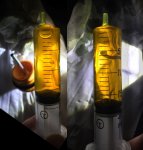
I sucked out a small amount of the saildrive oil last night. It had not been run since the weekend, and having had a chance to settle the suggestion that what I thought was emulsification was actually air bubbles was correct! See comparison picture below. On the left is oil from the saildrive, on the right is unused new oil from the bottle.

sail-drive-oil-15-11-18_3.jpg

There is a very small difference between the two, which I put down to a small amount of old oil being left in the saildrive.

I ran the boat in slow ahead for a couple of minutes and checked the saildrive oil again, as expected it had turned a milky colour, and closer inspection showed it was a frothy air bubble mixture, which looks very similar to emulsified oil!
 
Top