Yanmar SD20 - oil drained, need opinions please

gilesfordcrush

Well-Known Member
Joined
23 Jan 2017
Messages
109
Location
N. Fambridge
Visit site
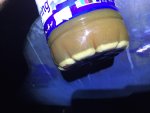
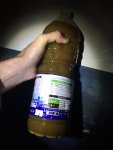
This is the oil from my Yanmar SD20 sail drive.
oil3.jpg

oil1.jpg

I drained it into a clear plastic bottle, where it has been sitting for a few days. I presume the condition of this oil means that my seals are starting to fail, and I should replace them?

If so, is this a DIY job?

Thanks for any advice,

Giles
 
The 2 saildrive shaft seals are definitely well gone. :(

It's a fairly simple DIY job and no special tools are required, just two new seals and possibly a new anode whilst you have it all apart.

However, with that level of water and crud ingress, I would not be surprised to find that the shaft is badly scored. You will then either have to use a Speedi-seal or replace the shaft or have it filled and re-machined. There is also an option to add extra spacers either side of the new seals to move them along the shaft to a new section but until you have it all apart it's difficult to decide.

If you want to pursue the spacer idea you could by another one, when you buy the seals, ready to use as there will already be one present and you will need one more. It's Yanmar part number 196315-02880.

Richard
 
Last edited:
Giles,

Please accept my condolences, it doesn’t look very good, does it!

Any idea for how long the oil has been in that condition? How often do you check the gearbox oil? When did it last resemble oil?

Changing the seals isn’t difficult and there are a number of YouTube clips showing it being done.

If there is no scoring on the shaft, per Richards comment, I would certainly flush with clean oil, drain, discard and refill.

Out of interest, how old is the gearbox and/or hours run since either new or last changed?
 
The oil is at least two years old, and has done plenty of work in that time. Until this haul out I have been unable to remove the filler cap. I've ordered the seals, but I'm concerned about getting the prop nut and cone off.
 

Attachments

  • IMG_6430.jpg
    IMG_6430.jpg
    505.5 KB · Views: 2
The oil is at least two years old, and has done plenty of work in that time. Until this haul out I have been unable to remove the filler cap. I've ordered the seals, but I'm concerned about getting the prop nut and cone off.

The oil will last a long time provided that the seals are keeping the water out and the oil in. I only change my oil when the seals need changing although that is not the Yanmar recommendation. I think the Yanmar manual says to change the oil annually and the seals every 2 years but they should last longer than that in normal use.

The nut/allen bolt should come off without too much trouble unless it has been rounded off. The problem with mine was that the cones had been put on with far too much Loctite and there was no way I could budge one of them. A wooden block between the prop blade and the hull is the best way to lock the assembly whilst you try to loosen it.

I tried to use heat from a gas torch to free the Loctite but the heat wasn't getting through the cone and to the shaft thread where it was needed so I had to cut away the cone with an angle grinder, apply the torch, remove the centre of the cone and then buy a new cone. :ambivalence:

Richard
 
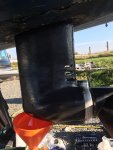
Thank you for all the advice. This evening I was able to remove the prop, and the front of the lower saildrive assembly. I didnt have much bother with any of the bolts, which was a nice surprise.

The new oil that I had foolishly put in on Sunday is now drained out, and is a mixture of new oil with some streaks of yellow emmulsified oil.

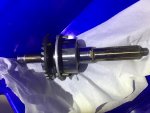
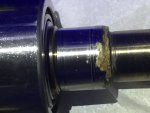
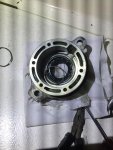
I think that the shaft is in good condition. There are two marks where the seals were on it, but there is only the slightest indentation, it is only just noticable when felt with a fingertip. I'm hoping that this is going to be ok? I'd like to know how best to remove the salty deposit that is on the shaft, see photo. What could I use that won't damage the shaft?
IMG_6444.jpg

IMG_6443.jpg


I was unable to remove the two old seals from the housing - they are quite reluctant to move. Any ideas how best to get them out? Hot water perhaps?

IMG_6441b.jpg

Thanks for all the help
 
A strong acid like HCL or brick acid will remove the deposit in a few seconds. A weaker acid like vinegar or oxalic would also work but you would need more and to leave it for longer.

You should be able to push the seals out using a screwdriver and a hammer from the restricted aperature end. Don't worry about destroying them but just take care not to force the screwdriver into the housing so it scores the inner surface. One you get them to move a bit you can probably push/pull them out with your fingers. The new ones might well push in by hand with a bit of oil on the outside although a bit of drifting in with a round object helps.

The scoring doesn't look too bad so I think you have caught it in time. You could probably get away with just polishing it up with metal polish. However, there are two approaches which are slightly better. One would be to buy twin lip seals rather than single lip seals and the other would involve the use of an extra spacer. You should find a single metal spacer between the two seals. If you buy another spacer you can put it into the seal housing before the outer water seal, then insert the seal and then the original spacer and finally the inner oil seal. This moves both seals a couple of mm along the shaft onto a new surface.

Insert the two seals so that the springs are facing outwards and the two flat surfaces are either side of the middle spacer.

I pack the space between the two seals with waterproof grease although I'm not sure whether that really helps but it feels like it does. :)

Richard
 
Last edited:
Thank you for all the info Richard, very helpful.

What grease do you use? There were the remains of some grease around the seals. I was wondering if I should be using something when reassembling the whole assembly anyway. I have some white marine grease, but I guess this isn't the right stuff?
 
Thank you for all the info Richard, very helpful.

What grease do you use? There were the remains of some grease around the seals. I was wondering if I should be using something when reassembling the whole assembly anyway. I have some white marine grease, but I guess this isn't the right stuff?

Glad to be of help.

I use a calcium-based waterproof grease, often referred to as "Waterpump grease" like this https://www.ebay.co.uk/itm/Millers-...h=item2a2ccfb4b2:g:ZekAAOSwqfNXoakP:rk:3:pf:0 for use in underwater locations but white marine grease could well also be a calcium grease, although probably a bit thinner, so I would use that if that's what you have. I would pack all the area between the two seals and the recess where the spring sits, particularly on the water-side seal. I'm not sure that it will give you more than a few months extra longevity but it can only help.

Richard
 
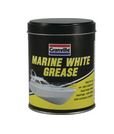
The grease I have is:

gran.JPG

Described as:

Marine White Grease is a high quality mineral oil based product with solid lubricant additives. Marine White Grease has been formulated specifically for use in areas of high water ingress including both fresh and salt water. Designed for the lubrication of plain bearings, ball & roller bearings and for most general lubrication duties especially in aqueous conditions. The product is particularly tenacious and highly water repellent. The grease has been specifically blended to contain elevated levels of anti corrosion additives.

Sounds pretty good to me, I might pack some around the bearings too.
 
I just cannot find any stock for the spacer, there would be a wait of about a month until I get one. I am planning on re-launching next week. The question is whether to reassemble with just a clean of the shaft. Would a gentle clean/polish with Autosol be worth considering? I know it is abrasive, so perhaps not. I'll be cleaning off the salt deposits with warm water and oxalic acid.
 
In that case I would just polish the shaft with Autosol, as you say to smooth out a little any sharp edges on the grooves and then reassemble with the new seals. You might find that the seals fail a little earlier than they would otherwise but you can keep an eye on it and you'll probably be talking about several years either way.

Richard
 
I have removed the two old seals from the housing. I was surprised to find that I already have two spaces. I wonder whether I should reassemble using only one?

Interesting. I had two spacers in one of my saildrives and one in the other. If you look at some of the Yanmar exploded diagrams for the SD20, it looks as if there are two spacers in there in some diagrams whilst others show one. The twin spacers are also labelled as "seals". I spoke to the Yanmar agent and they contacted Yanmar as they had never spotted these errors. The answer came back that there should only be one spacer and that it was not a seal.

However, there clearly is latitude in the design to play around with the spacing so I suspect that Yanmar have flip-flopped from time to time as to how many spacers should be used.

If you use one spacer then the water-side seal will still run in the same groove, if there is one, whereas the oil-side spacer will run on new shaft. If you put the spare spacer in first, then the water-side seal will run on new shaft whereas the oil-side spacer will run in the same groove.

Depending which groove is the most pronounced, you could use the spacers to displace the seal away from the worst groove. If the two grooves are similar, then your suggestion of reducing from two to one spacers in the middle seems to be the best solution.

Richard
 
I have theVolvo 120 saildrive but my comment may apply.
I was in Le Havre on the way to Brest when I noticed water in the oil- Panic.:ambivalence:

I took the boat to Cherbourg where I was unable to obtain new seals from the French Volvo dealer, so Volspec sent them from Tolesbury. When I spoke to the engineer at Volspec he asked when I had changed the oil & if I had put a new washer on the drain plug. I confirmed that I had changed at start of every season & this year I had put a new copper washer on the plug.
He laughed & told me that it was a good chance not a seal failure but the wrong washer.
I should renew with the correct neoprene type washer every time I removed the plug.

Volvo France said that it was rubbish; but as they could not do anything for me for some time, I had the boat lifted, changed the oil & the washer. Problem solved!!!

Did not change the shaft seals for another 3 years when i changed the main saildrive rubber hull seal. That being said , it was only a "just in case" change.
 
I am still waiting for my new seals to arrive. When they do I will evaluate the two marks on the shaft and decide where to place the washers. I'm nervous about getting the reassembly correct, as any mistake will mean another lift out at some expense. It is a simple matter to reassemble, but I'm still nervous!
 
I have reassembled the sail drive, and I used one of the spacers on the outside of the water seal to move that seal along the shaft a few mm. Because I had water in my oil, rather than oil leaking out, this seemed like the best course of action. I used a little marine grease when reassembling, and everything went back together easily - which makes me suspicious! When things are easy there is usually something wrong! Hopefully I'll be back in the water next week, and all will be well!

Thanks for all the advice, very much appreciated.

Giles
 
Following on from my questions about the seals in the saildrive, I am now back in the water and ran the engine for a test yesterday whilst in my berth. I checked the gearbox oil level after a short run, both in ahead and astern. I was dismayed to see that the oil was showing signs of emulsified oil within it. I refilled the oil when the boat was on the hard. There was no oil leak at all, and it was several days before the boat was relaunched. I am hoping that what I'm seeing in the oil is actually the old oil that was left coating the cogs in the gearbox, and not that the seals I fitted are leaking. Rather worrying though.
 
Following on from my questions about the seals in the saildrive, I am now back in the water and ran the engine for a test yesterday whilst in my berth. I checked the gearbox oil level after a short run, both in ahead and astern. I was dismayed to see that the oil was showing signs of emulsified oil within it. I refilled the oil when the boat was on the hard. There was no oil leak at all, and it was several days before the boat was relaunched. I am hoping that what I'm seeing in the oil is actually the old oil that was left coating the cogs in the gearbox, and not that the seals I fitted are leaking. Rather worrying though.

There is at least one "oil trap" in the SD20 as you probably noticed when you removed the drive shaft. The drain plug opening is about a cm above the bottom of the saildrive casing so removing the shaft removes a lot more oil that simply removing the drain plug. There might well be some smaller oil traps elsewhere in the SD20.

Richard
 
Top