
Yanmar ignition switch

Mataji

Well-Known Member
Joined
3 Jul 2012
Messages
420
Location
Plymouth
Visit site
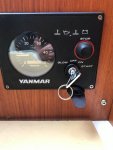
1343164C-CB7F-4654-AB83-BA900517EF66.jpegThe starter switch on my Yanmar2YM has a habit of sticking when the engine has not been used for a few days. When turned to “on” all is ok, lights come on and warning signal sounds. But when switched to “start” nothing happens. Operating the switch several times eventually gets the starter going and all is ok on subsequent starts of the engine, until I leave it for more than a couple of days. I am thinking of putting a new switch in (about £85).
Has anybody else had this problem, and is it simple to change the switch? I fear taking the panel off and finding a complicated collection of wires behind.
 
The wiring is sound. Don’t know how to check relays/solenoids. I was told some time ago that this was a known problem with Yanmar switches.
 
Had the same thing happen to mine, couldn’t stomach the cost of a new switch for what it is, bought a used one from eBay for£15
been fine ever since. Easy to swap out
 
I have had a similar problem with an older Yanmar 2gm20 which was caused by the 40 amp fuse in the circuit to the starter motor solenoid, The fuse holder is a really cheap design and the contacts just need cleaning every now and again.
 
View attachment 125974The starter switch on my Yanmar2YM has a habit of sticking when the engine has not been used for a few days. When turned to “on” all is ok, lights come on and warning signal sounds. But when switched to “start” nothing happens. Operating the switch several times eventually gets the starter going and all is ok on subsequent starts of the engine, until I leave it for more than a couple of days. I am thinking of putting a new switch in (about £85).
Has anybody else had this problem, and is it simple to change the switch? I fear taking the panel off and finding a complicated collection of wires behind.
Try a bit of silicone lubricant spray into the switch and work it a few times. NB use silicone lub. Not WD40!
 
With originally an identical panel and switch I first had a problem with the start part of the keyswitch not operating. Changed the keyswitch. A few years later starter motor died. New starter motor.

After changing the third starter motor in five more years, admittedly on a well used high hours engine, discussions with the local Yanmar service agent came round to either changing the complete panel to a new-type pushbutton one, at completely insane expense, or rewiring to add a separate start pushbutton bypassing the turn key to start bit . Agent says these keyswitches are prone to either not contacting or sticking on, in which case destroying the starter motor as it's spun at ultra-high revs with power still to the coils.

I fitted a separate start pushbutton. So far so good with pushbutton start.
 
The wiring is sound. Don’t know how to check relays/solenoids. I was told some time ago that this was a known problem with Yanmar switches.

So you've disconnected every connection between the switch and the starter solenoid, cleaned them and refitted ?
You've removed the heavy cables on the start and starter battery, cleaned and refitted them ?

There should be enough detail in the thread i linked to, to determine if it's the switch, a solenoid, relay or wiring. If not ask more questions.

There are known problems with the switches, but there are also know problems with every other component it the starter circuit. Spending money on random parts without isolating the problem could prove costly.

You'll need to wait until the problem rears it's head before carrying out any of the tests, but if you feel it's the switch, start at that end. Undo the panel and identify the incoming live wire and the one that goes to the starter, then carefully short the two together. If the engine starts it's the switch, if not, it's something else.

If it turns out to be the switch i'd fit a new starter button, as per post #7. Again, if you need help with that, post again.
 
Thanks for the advice Paul. No I’ve not disconnected everything, just checked that every connection I can get to is tight. The engine is a really tight fit and many items are difficult to reach and my arthritic fingers don’t help. Fixes like “a bit of silicon lubricant” are brilliant - if it works. Sounds like it’s worth a try. I’ll then try shorting the two wires as you advise.
 
Thanks for the advice Paul. No I’ve not disconnected everything, just checked that every connection I can get to is tight. The engine is a really tight fit and many items are difficult to reach and my arthritic fingers don’t help. Fixes like “a bit of silicon lubricant” are brilliant - if it works. Sounds like it’s worth a try. I’ll then try shorting the two wires as you advise.
Tbh the jury is probably still out on the issue I had in the post Paul refers to. I do appear to have traced the problem as the engine does consistently start ok now. It’s not until next season that I’ll be completely satisfied ! Follow Paul’s guidance in the first instance and I do understand the issues of a snugly fitted engine !
 
The loom on my 3GM30F has a total of four connectors in the starter solenoid wire, some wrapped in tape or other sleeving and almost impossible to access. After similar starter problems, i.e. no action on turning the key, I bypassed the whole lot with a single wire, switch to solenoid. That was several years ago, since when turning the key has always resulted in the motor turning over.
 
On a mate's Catana the key got stuck on. Nearly caused a fire as the starter motor burnt out. It wrecked the ring gear too. On my new to me boat I'm planning on getting rid of the daft key and replacing it with a switch.
 
The simplest and easiest solution seems to have worked. I returned to the boat in December and as usual to the same starting problem. I sprayed a silicon lubricant into the ignition key hole as per Alex’s suggestion. As the problem only occurred when the engine had not been started for a while I did not know whether this had worked as I was only there for a couple of days. Returned to the boat yesterday after a 5 week absence. It was 5 degrees inside the boat but the ignition key worked immediately and engine fired first time. This has not happened for over a year so I am hopeful. I’ll be back again next month and if any different will report back again.
 
The simplest and easiest solution seems to have worked. I returned to the boat in December and as usual to the same starting problem. I sprayed a silicon lubricant into the ignition key hole as per Alex’s suggestion. As the problem only occurred when the engine had not been started for a while I did not know whether this had worked as I was only there for a couple of days. Returned to the boat yesterday after a 5 week absence. It was 5 degrees inside the boat but the ignition key worked immediately and engine fired first time. This has not happened for over a year so I am hopeful. I’ll be back again next month and if any different will report back again.
?Hope it is OK Glad to hear you had a result.
 
I've found that the much maligned WD40 often helps with problems like this. I've used it to free stiff switches on my angle grinder and palm sander and even stopped the volume control on my Strat from crackling. I know it shouldn't work but it often does - and it costs nothing to try.
 
I've found that the much maligned WD40 often helps with problems like this. I've used it to free stiff switches on my angle grinder and palm sander and even stopped the volume control on my Strat from crackling. I know it shouldn't work but it often does - and it costs nothing to try.
Only when it gums the unit up and you have to get a new one! Seriously, yes it is used all over the place and mainly without a problem but there are better materials on the market for electrical units such as contact cleaning sprays and as I suggested Silicone lubricants where required.
 
Top