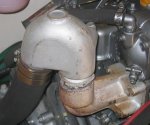
Yanmar exhaust elbow dimensions

differentroads

Well-Known Member
Joined
16 Apr 2012
Messages
412
Location
Mediterranean
blog.offbeatsadventures.com
Can anyone help me with the dimensions of the Yanmar riser exhaust mixing elbow. I need the total height above the exhaust outlet on the engine, the height of the mixing point above the engine outlet and how far it projects forward of the engine, please. I'm checking that a different type of mixing elbow will fit in my engine space before I buy this type https://www.parts4engines.com/yanmar-3gm30-stainless-exhaust-outlet/ I have a 3GM30 but the same riser looks like it is used on many other models, just with different engine mounts
I want to replace my current downward facing mixing elbow with a u shaped riser as the top of my engine is level with the waterline. so the current mixing point is below it. It's also the same height as the top of the current waterlock. Pretty poor design, I gather, and probably the reason why I've had seawater in the cylinders twice in two years. ☹
Thanks
Mark
 
I'm wondering if you could blow up a photo (or diagram) and with verniers measure the exhaust to get a pretty accurate idea? (You'd have to find the dimensions of the engine as well but that shouldn't be too hard)

https://www.google.com/search?q=yan...4M3lAhVH6XMBHePGA8oQ_AUIEigC&biw=1024&bih=632

This has to be the riser elbow? But I can't see where the water is injected.

Screenshot_2019-11-03 Exhaust elbow (Yanmar 3GM30F, hull 653).jpg

https://c320.org/mediagallery/popup.php?s=20081116143759372&sort=0

https://www.marineenergy.com.au/products/yanmar-gml-stainless-steel-exhaust-bend-replacement

https://www.parts4engines.com/yanmar-3gm30-stainless-exhaust-outlet/
 
Last edited:
Can anyone help me with the dimensions of the Yanmar riser exhaust mixing elbow. I need the total height above the exhaust outlet on the engine, the height of the mixing point above the engine outlet and how far it projects forward of the engine, please. I'm checking that a different type of mixing elbow will fit in my engine space before I buy this type https://www.parts4engines.com/yanmar-3gm30-stainless-exhaust-outlet/ I have a 3GM30 but the same riser looks like it is used on many other models, just with different engine mounts
I want to replace my current downward facing mixing elbow with a u shaped riser as the top of my engine is level with the waterline. so the current mixing point is below it. It's also the same height as the top of the current waterlock. Pretty poor design, I gather, and probably the reason why I've had seawater in the cylinders twice in two years.
Thanks
Mark

Do you not have an antisyphon loop and vent valve.?

This should prevent problems with water syphoning into the cylinders, but the water lock in the exhaust must also be large enough to safely hold all the water left in the exhaust system when the engine is stopped.

Youll find info on both in the Vetus on-line catalogue

Fitting an anti siphon loop and vent ( or servicing one that is already fitted :) ) may be cheaper and easier that changing to a high rise elbow.
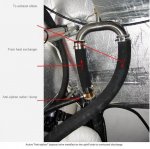
 
Do you not have an antisyphon loop and vent valve.? .

Yes, and it seems to be working fine. But I'm going to be taking it off for cleaning and checking. I'm fairly sure that water is getting back up the exhaust hose through plain old gravity rather than siphoning. The exhaust system is so badly designed that something like 30 degrees pitching and rolling could tip water from the waterlock back into the engine. And the problem occurred immediately after a fairly rough passage.
I used the Vetus site to check the capacity of the waterlock - large enough but not at the lowest point of the exhaust system - there's a metre of hose between the mixing elbow and waterlock, looped down below the level of both. The waterlock can't be moved to where it should be sited, hence my wish to raise the mixing point.
I might also have to fit a small second waterlock at the low point if I can find one to fit the tiny space available. That's a whole 'nother thread perhaps.
 
I'm wondering if you could blow up a photo (or diagram) and with verniers measure the exhaust to get a pretty accurate idea? (You'd have to find the dimensions of the engine as well but that shouldn't be too hard)

https://www.google.com/search?q=yan...4M3lAhVH6XMBHePGA8oQ_AUIEigC&biw=1024&bih=632

This has to be the riser elbow? But I can't see where the water is injected.

View attachment 81407

https://c320.org/mediagallery/popup.php?s=20081116143759372&sort=0

https://www.marineenergy.com.au/products/yanmar-gml-stainless-steel-exhaust-bend-replacement

https://www.parts4engines.com/yanmar-3gm30-stainless-exhaust-outlet/

Cheers, that idea might well be accurate enough for my needs.
Yes, that's the fellow. There's a hose tail low down on the other side of the u bend
 
I swear by what this guy has to say about wet exhaust design and the failure of anti-siphon valves. I am certainly following his design and I will bleeding water out of the exhaust and over the side.

View attachment 81409

https://www.sbmar.com/articles/designing-a-marine-exhaust-system/

Thanks, he makes a very strong case for redesigning from scratch, though he's also pretty scathing about anyone doing that from an ill informed point of view. I can read my Calder, understand the Vetus specs and appreciate sage advice from VicS, but I don't think he'd rate my engineering competence to do the job right. Or my language skills to commission someone out here in Spain to fabricate a bespoke mixing elbow to his standards.
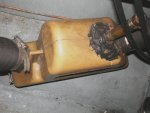
But your advice reminds me that before I rebuilt the aft end of the exhaust system to raise the transom outlet and gooseneck (thinking the problem was at that end) and replaced the old Vetus waterlock, I noticed that it had a blanked off hose fitting bodged onto it. I now think that was for cooling water injection and it would have had a dry exhaust to the plastic waterlock. Presumably this would be to address the problem of having no fall between the engine and waterlock (a dry hose riser could easily be fabricated) but would then be delivering exhaust gas at full temperature to the plastic waterlock, which sounds like a terrible idea to me!
 
I reckon I'm pretty good at assessing people's expertise and from what you've said so far I'm surprised that you don't feel confident to undertake the modifications.

I worried too about getting hot gases into the Vetus exhaust but the water injected exhaust I designed seems to work fine though I've yet to run it for an extended period. Tomorrow (my bed-time now) I'll take a photo of my set-up and post it here. (I followed that guys instructions to the letter.) Cheers.
 
Do you not have an antisyphon loop and vent valve.?

This should prevent problems with water syphoning into the cylinders, but the water lock in the exhaust must also be large enough to safely hold all the water left in the exhaust system when the engine is stopped.

Youll find info on both in the Vetus on-line catalogue

Fitting an anti siphon loop and vent ( or servicing one that is already fitted :) ) may be cheaper and easier that changing to a high rise elbow.

You have got me thinking about the anti siphon though, Vic. There are two things that worry me about it's installation:
1, it's installed between the mixing elbow and the raw water outlet on the engine. There is a small drop from the engine outlet before it rises to the antisiphon valve which is bound to hold a few tens of ml water when the engine is stopped. That can't be good. I can easily shorten the pipe to eliminate that
2, I fitted a raw water strainer just before these problems occurred. Following the Vetus instructions I installed it above the waterline (it's only plastic, I wouldn't want it below the waterline!) and it happens to be at the same height as the antisiphon valve. I've noticed that the strainer always retains water until I crack open the lid for inspection. If the antisiphon valve was working as I've assumed it was (water dribbles out of the telltale), wouldn't it have let air in to the pipe already?
 
If I read this correctly, you are thinking of putting hot gas into a Vetus waterlock? Don't, they melt. Seen two like that.

Thanks. Yeah, I'm aware of that danger. But it's what I think a previous owner had done to overcome the problem I have of seawater getting into the engine through the exhaust, before reverting to an engine mounted mixing elbow. It looked like this
Offbeat (36).jpg
I'm either going to fit an off the shelf u shaped riser mixing elbow (£250 or so) or a bespoke dry exhaust riser leading to a mixing elbow at least a foot before the waterlock (£ and time to be determined). Or I'm going to find that it's an antisiphon valve problem all along. Still think I need to deal with the waterlock currently being at the same height as the mixing point, though
 
You have got me thinking about the anti siphon though, Vic. There are two things that worry me about it's installation:
1, it's installed between the mixing elbow and the raw water outlet on the engine. There is a small drop from the engine outlet before it rises to the antisiphon valve which is bound to hold a few tens of ml water when the engine is stopped. That can't be good. I can easily shorten the pipe to eliminate that
2, I fitted a raw water strainer just before these problems occurred. Following the Vetus instructions I installed it above the waterline (it's only plastic, I wouldn't want it below the waterline!) and it happens to be at the same height as the antisiphon valve. I've noticed that the strainer always retains water until I crack open the lid for inspection. If the antisiphon valve was working as I've assumed it was (water dribbles out of the telltale), wouldn't it have let air in to the pipe already?

The antiphon valve only empties the pipe on the exhaust side, by letting air in when the water runs down to the water lock. On the engine side, the pipe will still be water filled, but this will cause no harm. So no need to worry over 1 nor 2, if I understand you correctly.
 
cheers for that. maybe I'm now over thinking things. Best I concentrate on raising the mixing point or lowering the water trap. Or both. Or taking the dry exhaust higher before it is mixed with cooling water. The answer is in there somewhere!
 
You have got me thinking about the anti siphon though, Vic. There are two things that worry me about it's installation:
1, it's installed between the mixing elbow and the raw water outlet on the engine. There is a small drop from the engine outlet before it rises to the antisiphon valve which is bound to hold a few tens of ml water when the engine is stopped. That can't be good. I can easily shorten the pipe to eliminate that
2, I fitted a raw water strainer just before these problems occurred. Following the Vetus instructions I installed it above the waterline (it's only plastic, I wouldn't want it below the waterline!) and it happens to be at the same height as the antisiphon valve. I've noticed that the strainer always retains water until I crack open the lid for inspection. If the antisiphon valve was working as I've assumed it was (water dribbles out of the telltale), wouldn't it have let air in to the pipe already?

Between the engine ( or heat exchanger) outlet and the mixing elbow is a common location for the anti-siphon loop and vent. Sometime it's fitted between the pump and the inlet to the engine or HE.

I dont think the small drop will matter.

Id be more worried about the height of the strainer but hopefully its not actually above the anti-siphon loop. If it is then when you open it water from the strainer might run through the engine , over the loop and into the exhaust. Even that should be no problem if the waterlock is large enough.

Id not fit the strainer much higher than Vetus' recommended minimum.... thinking about the troubles people have with getting the system to prime sometimes and having to smother the joint between the body and the lid with all manner of things from starting ointment to waterproof grease.
 
i have the same issue - 3GM30F installed about 20 years ago. according to Yanmar spec should have had a high riser mixer elbow - but no space. (height of mixer elbow relative to waterline)

so i went for the cheap and cheerful option - vetus exhaust trap has a drain plug on it - laid a piece of garden hose from this to an accesible part of bilge, and simply drain exhause when engine when turned off. also fitted a seacock (that arguablly should have been there already) to exhaust at near transom. no problems so far.

(twice got seawater in exhaust - at mooring when was wavy. but also worry about sailing with engine off in e.g. tidal chop/rough weather)

a previous surveyor suggested simply adding another vetus water trap in series in the exhaust, but if one can be overwhelmed by repetitive wave action, unsure if two would too? esp if e.g sailing offshore for a while?
 
Youll find info on both in the Vetus on-line catalogue

Fitting an anti siphon loop and vent ( or servicing one that is already fitted :) ) may be cheaper and easier that changing to a high rise elbow.

This is good advice. If you follow the Vetus instructions you won't have a problem. You need a gooseneck on the exhaust outlet (either a moulded one or simply a big loop of pipe), plus a vent valve on the water injection point.

104608881
 
i have the same issue - 3GM30F installed about 20 years ago. according to Yanmar spec should have had a high riser mixer elbow - but no space. (height of mixer elbow relative to waterline)

so i went for the cheap and cheerful option - vetus exhaust trap has a drain plug on it - laid a piece of garden hose from this to an accesible part of bilge, and simply drain exhause when engine when turned off. also fitted a seacock (that arguablly should have been there already) to exhaust at near transom. no problems so far.

(twice got seawater in exhaust - at mooring when was wavy. but also worry about sailing with engine off in e.g. tidal chop/rough weather)

a previous surveyor suggested simply adding another vetus water trap in series in the exhaust, but if one can be overwhelmed by repetitive wave action, unsure if two would too? esp if e.g sailing offshore for a while?
Thanks. Like you, I've got a workaround. Currently I turn of the raw water seacock before switching off the engine the moment water stops coming out of exhaust. And I've started to put together a pipe and drain arrangement on the water lock, thinking along the same lines as you.

I have already raised the gooseneck to 700mm above the waterline plus raised the exhaust outlet from under the transom to higher up on it, with a rubber flap on the outlet. All that was in response to the first time seawater got into the engine, 12 miles off the Portuguese coast after bombing down big following waves under sail all day. They were gathering under the transom, sometime slapping hard were the exhaust outlet was. Im with you, if waves were pushing even small amounts of water back through the system, it would add up to enough to overwhelm a 5L waterlock in a few hours, aided by the pitching and rolling you get in those sort of seas.
With my subsequent modifications I'm sure that seawater isn't getting in from the transom end. It's either the siphon valve or the low spot in the hose between the mixing elbow and waterlock, hence thinking I ought to raise the mixing elbow or add a second waterlock in the tiny space available. Or do both. I'm not made of money but it could work out cheaper than the damage that could happen if I persisted with trying to start a flooded engine. I got away with it twice. I imagine that I've run out of luck on that front by now
 
Top