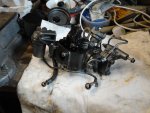
yanmar exhaust elbow. beware!

Worried about mine now, but I wanted to get a new gasket before taking it off. So down at the boat I found that the manifold flange has four bolt holes, but only three bolts are fitted. I thought raw cooled engines used a three-bolt flange, so has someone fitted a freshwater cooled manifold on mine, or would the three holes not line up?

I think my raw-water cooled 1GM10 has four 'oles in the 'ead, but only three in the flange. I just went out into the garden to find the old head and check, but it's buried somewhere under a foot of snow.
 
Worried about mine now, but I wanted to get a new gasket before taking it off. So down at the boat I found that the manifold flange has four bolt holes, but only three bolts are fitted. I thought raw cooled engines used a three-bolt flange, so has someone fitted a freshwater cooled manifold on mine, or would the three holes not line up?

From what I gather it's the same manifold whether fresh or raw water cooled. It's a different elbow depending on the model. 3 bolts for raw. 4 for fresh.
 
I think my raw-water cooled 1GM10 has four 'oles in the 'ead, but only three in the flange. I just went out into the garden to find the old head and check, but it's buried somewhere under a foot of snow.

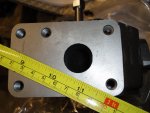
Now checked. Four holes in the head. I can't see why they didn't give the elbow a four-hole flange.
 
Went down to boat yesterday to remove and check the exhaust manifold on my Yanmar 1GM10, last checked four years ago, and found all okay. Gave it a wash and blow dry and put back on. I have owned the boat/engine for approx ten years and when I spoke to the previous owners who had the engine installed in 1994 they had no recollection of ever having replaced this exhaust manifod. Not trying to say there is not a problem, but not a reason for over reaction either.
 
SAM_0291.jpg
Looked fine in situ but this fell apart when I tried to take it apart for closer inspection. (see previous post)
Is their any manufactures out there who has produced this 'U' style cooling elbow? other than yanmar !
 
Last edited:
I'm sure you know that that is the optional "Hi-rise" elbow for engine installations below the water level. Most engine marinisers supply a version of this as an option.

Rob.
 
New Elbow arrived yesterday 9 days after ordering from www.exhaustelbow.com. Hope it performs as good as it looks. Had to pay the post office £11.80 for customs and handling that on top of the £77 for the elbow is not too bad compared to the Yanmar price.

WP_20150205_002_zps00586e4d.jpg


WP_20150205_005_zps85db88bf.jpg


WP_20150205_004_zps7f75532b.jpg
 
Last edited:
Ordered mine from Ben on Fri 6th last week. Arrived today, nothing to pay on import, happy, happy, happy! :encouragement:
 
Spyro do you have a photo of the failed elbow looking from the flange end. I currently have mine stripped down. Its done 700 hours over 7 years. I was expecting to see some sign of corrosion where the cooling water impinges on the inner tube but it looks pristine. The only visible sign of damage is very slight pitting on the engine exhaust side but well away from the heat effected zone of the weld. The welding looks like semi automatic TIG. This type of weld is often done without using filler wire. If the tubes are not held in the correct position in the welding fixture it is possible to finish up with a weld which looks perfect but only has a paper thin area of fused metal. The second type of defect is lack of root fusion which would leave a very narrow circumferential gap which could promote corrosion cracking and eventual failure due to vibration. Its possible that there are a limited quantity of elbows in service with weld defects, causing the observed failure, rather than an overall design or quality problem. The workshop manual does however say clean and check this item every 250 hours and repair any cracks or damage by welding.
 
Yanmar Exhaust Elbow

Spyro do you have a photo of the failed elbow looking from the flange end. I currently have mine stripped down. Its done 700 hours over 7 years. I was expecting to see some sign of corrosion where the cooling water impinges on the inner tube but it looks pristine. The only visible sign of damage is very slight pitting on the engine exhaust side but well away from the heat effected zone of the weld. The welding looks like semi automatic TIG. This type of weld is often done without using filler wire. If the tubes are not held in the correct position in the welding fixture it is possible to finish up with a weld which looks perfect but only has a paper thin area of fused metal. The second type of defect is lack of root fusion which would leave a very narrow circumferential gap which could promote corrosion cracking and eventual failure due to vibration. Its possible that there are a limited quantity of elbows in service with weld defects, causing the observed failure, rather than an overall design or quality problem. The workshop manual does however say clean and check this item every 250 hours and repair any cracks or damage by welding.

I too have similiar experience of the exhaust elbow showing only minor wear and tear on having been checked after nine years running of at least 100 hours per season.. Indeed I have reason to believe that the elbow is the original since engine instalation in 1994.
 
Spyro do you have a photo of the failed elbow looking from the flange end. I currently have mine stripped down. Its done 700 hours over 7 years. I was expecting to see some sign of corrosion where the cooling water impinges on the inner tube but it looks pristine. The only visible sign of damage is very slight pitting on the engine exhaust side but well away from the heat effected zone of the weld. The welding looks like semi automatic TIG. This type of weld is often done without using filler wire. If the tubes are not held in the correct position in the welding fixture it is possible to finish up with a weld which looks perfect but only has a paper thin area of fused metal. The second type of defect is lack of root fusion which would leave a very narrow circumferential gap which could promote corrosion cracking and eventual failure due to vibration. Its possible that there are a limited quantity of elbows in service with weld defects, causing the observed failure, rather than an overall design or quality problem. The workshop manual does however say clean and check this item every 250 hours and repair any cracks or damage by welding.

Sorry Idon't have a picture. Just threw out the old elbow this week.
 
Today we removed mixer elbow because of leak. Yanmar Engine 3YM30 manufactured 2010. Engine Hours 907 in Jeanneau 36i. On the mounting plate of elbow is stamped:'0904', and possibly a 'W' etched on it.

Weld of tube to plate is visibly cracked, but no evidence of leak. (I plugged salt water port and filled outer tube to top of inner tube with boiling water- no leak.)

More troubling is the concavity of the mounting plate, particularly between the two lower/bottom mounting holes. I think this is the problem. Have you seen or heard of anything like this before?

Thank you for the many posts and any assistance you may offer. Lori
PS we will try to send images. We are new to this forum.
 
Had the same problem over the winter. See here..............http://www.ybw.com/forums/showthread.php?421692-3YM30-exhaust-elbow-gasket&highlight=

Change the elbow in any case. I had to and it is a common problem apparently for them to leak. I also had the heat exchanger removed and its mounting plate/surface skimmed and the studs renewed. Time will tell if that did the trick long-term.

Check that the drips have not affected the electrics below the exhaust elbow.

Good luck.
 
Today we removed mixer elbow because of leak. Yanmar Engine 3YM30 manufactured 2010. Engine Hours 907 in Jeanneau 36i. On the mounting plate of elbow is stamped:'0904', and possibly a 'W' etched on it.

Weld of tube to plate is visibly cracked, but no evidence of leak. (I plugged salt water port and filled outer tube to top of inner tube with boiling water- no leak.)

More troubling is the concavity of the mounting plate, particularly between the two lower/bottom mounting holes. I think this is the problem. Have you seen or heard of anything like this before?

Thank you for the many posts and any assistance you may offer. Lori
PS we will try to send images. We are new to this forum.

Welcome to the forum LunaSea.

I'm going to check my 3YM30 elbows this summer. Engines are 2008 but both run smoothly so hoping it's all OK.

One question ........ I can see how a concave area between the manifold studs might lead to exhaust gas escaping but how could water escape through the gap as the water injection point into the elbow is downstream of the flange. Perhaps when the engine is stopped a little water might run out from the injection point once the exhaust gases have ceased flowing but this would be a tiny amount as the impelller has also stopped turning.

Richard
 
Top