Yanmar 3YM30 won't start

Koeketiene

Well-Known Member
Joined
24 Sep 2003
Messages
18,433
Location
Le Roussillon (South of France)
www.sailblogs.com
When I turned the key, nothing happened. Though I could hear the engine going 'clunck' down below.
After a couple of tries, it started wanting to turn over.
And eventually it did.
When I got down below, the low voltage alarm on the plotter was blaring.

My first thought was that the battery is [Inappropriate content removed] .
However, the start battery (only replaced last year) read a healthy 12.65v. Plenty to start and same voltage reading as when I left the boat last week.

Any thoughts 💭?
 
Last edited by a moderator:
The solenoid energising wire from the switch has about four junctions in it, any of which will induce enough resistance to prevent the starter solenoid from engaging. Later engines had a relay in the circuit but I just bypassed the original one with a single wire. It has never failed since, about 10 years.
 
Need more info.
If it hadn't been started of a long time, 'clunk then crank' could be hydraulic lock at first?
More likely electrical. chase the volts!
I use the boat whenever possible - at least once a week.
Last took her out Friday last week.

Starting the engine has been getting progressively more erratic over the last 4-5 months.
Could often take 3-4 tries before the engine turned over.
Originaly, I suspected a dud starter battery.
Replaced it 3 weeks ago and that seemed to have done the trick.
Then, last Friday, it started acting up again.
And the yesterday (see post #1).

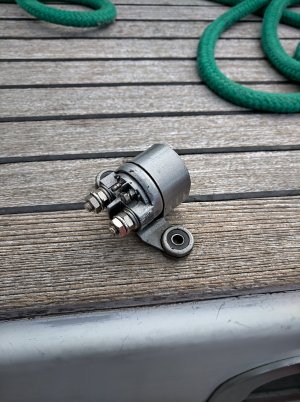
I've also posted this on a Yanmar forum, and it was suggested that this might be the culprit (apparently a known Yanmar issue):

109451355_153247863104609_8797822174341765210_n.jpg
 
Yes just fixed the same problem. Start went slightly intermittent last season. Thought it was a frayed earth cable but it wasn't the root cause. Easy fix with a generic replacement for less than 10% of the Yanmar price. It's a lifed item and worth replacing before it fails.
 
Yes just fixed the same problem. Start went slightly intermittent last season. Thought it was a frayed earth cable but it wasn't the root cause. Easy fix with a generic replacement for less than 10% of the Yanmar price. It's a lifed item and worth replacing before it fails.
Can I ask where you purchased, also what is it !?
 
Amazon.co.uk

I'm using one of these. No guarantees but quality seems reasonable.
Is it man enough for a diesel? There is no indication of voltage or current rating in the tech. description. A diesel tends to take a bit more starting "OMPH" than the engines that is designed for. May be alright, just hope if it fails it is not with the contacts welded on! :unsure: There are heavier duty ones available for not much more in the way of beer tokens.
 
Quick update on the engine.
A boat moored near me has the same engine.
Happened to tell him about my predicament.
Spent 2 hours swapping starter relays.
Mine starts his engine at the first turn of the key.
Fitting his relay aboard my boat doesn't start my engine.
Considered opinion is now that the culprit is a wiring fault, a corroded contact somewhere or the engine control panel.
Managed to get hold of a diesel mechanic and he'll be round tomorrow before lunch.
Yes, I know, very un-🇫🇷 😇
 
Quick update on the engine.
A boat moored near me has the same engine.
Happened to tell him about my predicament.
Spent 2 hours swapping starter relays.
Mine starts his engine at the first turn of the key.
Fitting his relay aboard my boat doesn't start my engine.
Considered opinion is now that the culprit is a wiring fault, a corroded contact somewhere or the engine control panel.
Managed to get hold of a diesel mechanic and he'll be round tomorrow before lunch.
Yes, I know, very un-🇫🇷 😇
See my post #3. It is very easy to test for this, just touch a wire, or even a screwdriver, between the battery cable terminal on the starter motor and the solenoid terminal next to it. This almost always will turn the engine over.
 
Engine latest/final:
It was a combination of faults.
1. Corrosion/bad connection of the earth - replaced (as identified by @gordmac in #10)
2. Ignition switch FUBAR (electrical fault)
Repacement on order.
Temporary work-around in place.
After some rewiring the starter battery isolator switch now acts as ignition.
Good enough for now.
Should be all fixed early next week.

Many thanks all for your input - most apprectiated
 
My Yanmar has a similar problem. Push the starter button hard and nothing happens, tickle it gently and off she goes. Try not being so ham fisted!:unsure:
 
Is it man enough for a diesel? There is no indication of voltage or current rating in the tech. description. A diesel tends to take a bit more starting "OMPH" than the engines that is designed for. May be alright, just hope if it fails it is not with the contacts welded on! :unsure: There are heavier duty ones available for not much more in the way of beer tokens.
Havent a clue. It's only pulling in the solenoid. I don't think it's a particularly heavy starter. It's working at the moment. When it fails I'll do a post mortem on the two units and report back. Once you know the fault it's easy enough to put a spanner accross the terminals to start the engine.
 
Havent a clue. It's only pulling in the solenoid. I don't think it's a particularly heavy starter. It's working at the moment. When it fails I'll do a post mortem on the two units and report back. Once you know the fault it's easy enough to put a spanner accross the terminals to start the engine.
It will pull the solenoid OK, not the problem it is the started contacts that need to take the high current. It may be OK but as said diesel engines tend to draw more starting current than petrol two stokes. I hope it is OK but I am genuinely pointing out a possible cause of failure, not trying to be funny.
 
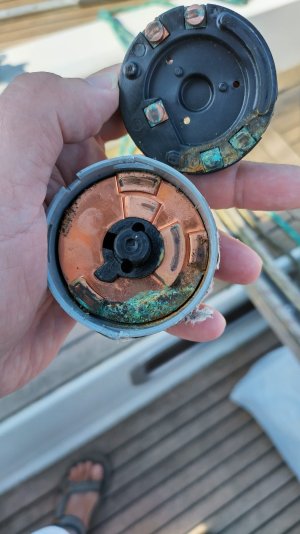
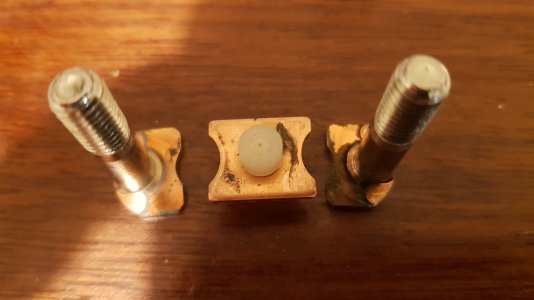
Just post mortemed the failed "relay" . Interesting design and very well made. Substantial pair of contacts with opposing springs. The off spring is much stronger than the on spring. It has a solenoid which compresses the off spring and allows the on spring to make contact. No sign of wear from vibration but it looks as if the moving contact has been slightly off centre and tilting slightly which may have been allowing the guide to jam now and again. The nuts holding the main power terminals also retain the contacts inside in the correct position. If these are loose it could malfunction. It's possible the plastic body has crept under load and caused the contacts to come loose. I'm not familiar with the design logic for this type of relay but it looks like its designed to limit the possibility of it failing in the on position.
 

Attachments

  • 20231002_191137.jpg
    20231002_191137.jpg
    1.5 MB · Views: 8
Top