Yanmar 3YM30 engine oil

Kwik Decision

Well-Known Member
I was checking the 3 L of Comma XT2000 oil I have in the garage, left over from something else, wanting to use it for the annual boat engine oil change. It is 15w40, and so (according to the Yanmar manual) fine for operating temperatures from -15 to 40°C. The oil can also states it is to API service category CF and CG-4. Now Yanmar say CF is fine, but oils to CG-4 should never be used. Why is this, and do I say this oil is CF and therefore fine, or it is CG-4 and shouldn't be used...
Many thanks,
 
Vyv Cox can tell you more than you ever wanted to know about engine oil:. Oil for yacht engines
Essentially your unstressed diesel needs basic mineral oil rather than a modern synthetic with lots of additives as it may not reach high enough temperature for these.
May be different if you have a turbo but personally I don't think these are a great idea in a boat as they tend to need to be run at an uneconomic speed.
 
CF-4 is compatible with copper-lead bearings whereas CG-4 is not. I assume that, like gasoline fuelled cars, more modern high powered diesel engines now use aluminium-tin bearings. More info here Oil Service Classifications

I don't actually know that the YM series engines use copper-lead bearings but the GM series do, as do current Volvos. Copper - lead is more tolerant of dirt and water than aluminium but has lower load capacity, so is perfectly acceptable for yacht engines.

As to the answer to the question - no idea.
 
I was checking the 3 L of Comma XT2000 oil I have in the garage, left over from something else, wanting to use it for the annual boat engine oil change. It is 15w40, and so (according to the Yanmar manual) fine for operating temperatures from -15 to 40°C. The oil can also states it is to API service category CF and CG-4. Now Yanmar say CF is fine, but oils to CG-4 should never be used. Why is this, and do I say this oil is CF and therefore fine, or it is CG-4 and shouldn't be used...
Many thanks,
CG-4 is a later classification than CF and was designed to replace the earlier category. For a relatively recent design engine I would have no concerns about using the Comma oil which is similar to the semi-synthetic 15W-40 that I'm using in my 3YM30 engines.

Richard
 
  • Like
Reactions: pvb
I was checking the 3 L of Comma XT2000 oil I have in the garage, left over from something else, wanting to use it for the annual boat engine oil change. It is 15w40, and so (according to the Yanmar manual) fine for operating temperatures from -15 to 40°C. The oil can also states it is to API service category CF and CG-4. Now Yanmar say CF is fine, but oils to CG-4 should never be used. Why is this, and do I say this oil is CF and therefore fine, or it is CG-4 and shouldn't be used...

Use it, it'll be fine, your engine won't explode or die prematurely.
 
Isn't CG-4 only for use with low sulphur fuel?
So Yanmar would not recommend it with actual marine gas oil, AKA olde worlde red diesel.
These days, i think 'red diesel' in the Uk is generally low sulphur, but we use the white stuff anyway.
 
Shame that Yanmar have it wrong again. What do they know about oil and engines? Great that the forum oil experts have put them right.

All over the world, there are little Yanmar diesel engines rumbling away for years on end in industrial machinery. Do you really think that in third-world countries people bother to research what special grade of oil to put in them? No, they just use whatever's to hand, and the engines keep on running, day in, day out. The typical boat engine spends much more time turned off!
 
You are just guessing. If Yanmar says don't use it I suggest it makes sense to believe them.

If corrosion by a particular additive is something that has been picked up by Yanmar, maybe in a copper strip test or something similar, it makes little difference if the engine is running or not.
 
As to the answer to the question - no idea.

You are just guessing. If Yanmar says don't use it I suggest it makes sense to believe them.

If corrosion by a particular additive is something that has been picked up by Yanmar, maybe in a copper strip test or something similar, it makes little difference if the engine is running or not.

So first you claim to have no idea, but then you take me to task for suggesting that the oil will be OK (as indeed RichardS also said). Am I mistaken in my belief that little diesel engines all over the world run happily for years on whatever oil they can find?
 
An engine costs a few thousand pounds.
The best oil which meets the manufacturer's spec costs maybe £40.
Even if cheap oil only shortens the life by a year or two in 25, it's still false economy.

For sure there are industrial engines smoking away for years on end on cheap oil, but there are also worn out yacht engines.
 
For sure there are industrial engines smoking away for years on end on cheap oil, but there are also worn out yacht engines.

Hardly any yacht engines ever wear out. They perhaps corrode, and eventually the lack of parts (or the price of parts) makes them uneconomic to repair. But they don't wear out.
 
I bought cg-4 semi synthetic . Wrong!

Reread olde threads including Vyv Coxes diligent thoughtful responses over a number of years ..

Accepted I had probably just wasted £15

And ordered CF-4 mineral through and through for £21 .

The thought of knackering my trusty GMs bearings prematurely on a chancey-chances, who knew ? Not I .

Thank you , as ever , Vyv ?
 
So first you claim to have no idea, but then you take me to task for suggesting that the oil will be OK (as indeed RichardS also said). Am I mistaken in my belief that little diesel engines all over the world run happily for years on whatever oil they can find?
The 'no idea' was to precisely what the Comma oil may be. It no doubt passes specification for both CF and CG-4 but they take no account of the additive package. If Yanmar say don't use CG-4 that's good enough for me.
 
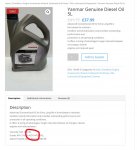
The Yanmar oil is CI-4.
That meets every requirement of CG-4 and older specs.
CG and CH were different chemistry from CF and older.
CI covers all the bases.
 
Hardly any yacht engines ever wear out. They perhaps corrode, and eventually the lack of parts (or the price of parts) makes them uneconomic to repair. But they don't wear out.
The South Coast has plenty of 20 and 30 year old yachts with smoky engines, a fair few which don't start as easily as they should, lots of signs of wear which could be reduced by better oil.
 
Top