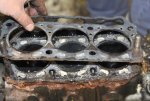
Yanmar 3GM head gasket

tomaso

New Member
Joined
2 Sep 2013
Messages
1
Visit site
I have a Yanmar 3GM30 sea water cooled. This season 3 impellers failed and some steam smoke in exaust. Decided to remove head and inspect. Head gasket not burned but tubings and exaust manifold almost completely clogged.
After removing head and gasket I noticed something interesting, cooling water passages on gasket go thru small holes (6mm) and easy get clogged . Cylinder side and head side have finger size large cooling water passages but they are not used because gasked is not punched thru on this places. Such places on gasket are not in full thickness-only covering foil at one side of the gasket-why. Engine was rebuilt 10 years ago with reboring by a service man. Before puchase of new gasket set I'm wondering if old gasket is OK or should be additional passages in foil of the gasket opened

2014.0808r.jpg
 

Attachments

  • 2014.0808r.jpg
    2014.0808r.jpg
    94.4 KB · Views: 6
Last edited:
I have a Yanmar 3GM30 sea water cooled. This season 3 impellers failed and some steam smoke in exaust. Decided to remove head and inspect. Head gasket not burned but tubings and exaust manifold almost completely clogged.
After removing head and gasket I noticed something interesting, cooling water passages on gasket go thru small holes (6mm) and easy get clogged . Cylinder side and head side have finger size large cooling water passages but they are not used because gasked is not punched thru on this places. Such places on gasket are not in full thickness-only covering foil at one side of the gasket-why. Engine was rebuilt 10 years ago with reboring by a service man. Before puchase of new gasket set I'm wondering if old gasket is OK or should be additional passages in foil of the gasket opened

Definitely fit a new gasket - the gasket/head problems are about the only weak point on the GM series
 
The gasket/head problems are about the only weak point on the GM series

That's the first time I have seen it suggested that there is a weak point in the GM series around the head/head gasket and would be interested to hear it varified by others?

I have a 2GM20 and have noticed what may be a slight oil leak from the rear of the engine in the area of the head gasket, could it be on the way out? Can't say that I have noticed any steam in the exhaust or other problems.
 
I am not surprised that you found this. My 1GM10 has a very similar theme of holes not used and THIS IS CORRECT.
The water flow to the head is obviously only relatively small and that is the design!

No harm in asking your local Yanmar dealer.
 
That's the first time I have seen it suggested that there is a weak point in the GM series around the head/head gasket and would be interested to hear it varified by others?

I have a 2GM20 and have noticed what may be a slight oil leak from the rear of the engine in the area of the head gasket, could it be on the way out? Can't say that I have noticed any steam in the exhaust or other problems.
 
I have a 3GM30. Developed a strong oil jet at the the back of the engine from the position of the head gasket. Is the little hole on the head gasket to the rear of the engine an oil Passage?
 
I have a 3GM30. Developed a strong oil jet at the the back of the engine from the position of the head gasket. Is the little hole on the head gasket to the rear of the engine an oil Passage?

There is a little link pipe at the rear end of the block to the head. I don't think the oil way is an internal connection across the gasket? The pipes tend to rust. ?perforation?

i took the head off our 3GM30 for similar reasons, cleaned out the water passages as best i could then re-assembled with a new gasket. I then took out the thermostat and pickled it in warm white vinegar. Very effective fizzing session. The engine was then run at idle (minus thermostat and ANODES) sucking via a hose from a large bucket of white vinegar and returning to the same bucket via the exhaust. I let it get warm and the dissolving of carbonates from the engine produced a lot of froth. Maybe 20 minutes- until the exhaust water gets too got for your hand. Soak 30 minutes.
Replace anodes and thermostat.
It ran somewhat cooler than before with no steam in the exhaust.

It's a problem with anything involving seawater cooling. Particularly seawater direct and outboards. The various carbonates in seawater come OUT of solution at higher temps (in the engine) and progressively clog waterways.
There is less of a problem with heat ex changers as the seawater only comes in contact with parts at far lower temperatures.
You can unclog an outboard in a similar manner provided it still has some throughput of water.
 
There is a little link pipe at the rear end of the block to the head. I don't think the oil way is an internal connection across the gasket? The pipes tend to rust. ?perforation?

i took the head off our 3GM30 for similar reasons, cleaned out the water passages as best i could then re-assembled with a new gasket. I then took out the thermostat and pickled it in warm white vinegar. Very effective fizzing session. The engine was then run at idle (minus thermostat and ANODES) sucking via a hose from a large bucket of white vinegar and returning to the same bucket via the exhaust. I let it get warm and the dissolving of carbonates from the engine produced a lot of froth. Maybe 20 minutes- until the exhaust water gets too got for your hand. Soak 30 minutes.
Replace anodes and thermostat.
It ran somewhat cooler than before with no steam in the exhaust.

It's a problem with anything involving seawater cooling. Particularly seawater direct and outboards. The various carbonates in seawater come OUT of solution at higher temps (in the engine) and progressively clog waterways.
There is less of a problem with heat ex changers as the seawater only comes in contact with parts at far lower temperatures.
You can unclog an outboard in a similar manner provided it still has some throughput of water.

The oil clearly squirts out from where the head gasket is :-(
 
Top