Yanmar 1GM10 on Achilles 24 Your thoughts are needed!

LP1

Well-Known Member
Joined
15 Dec 2013
Messages
80
Visit site
IMG_0135.jpgIMG_0136.jpgIMG_0137.jpgIMG_0138.jpgIMG_0141.jpgIMG_0143.jpgIMG_0146.jpg

Hi all, I have bought an Achilles 24 with a yanmar 1gm10 shoehorned into her!

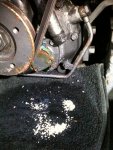
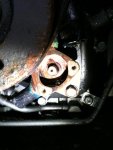
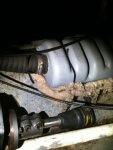
Doing some research I decided to replace the exhaust elbow with a stainless steel one, I removed the old one to find a heavily choked up exhaust outlet, but what is concerning me is the presence to little brown droplets just visible in the picture, but more present in the elbow itself.

What is this likely to be? The elbow is ok and has not failed. Do I need to be worried about possible water in the the head?

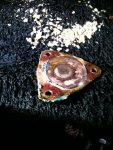
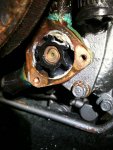
Also, when I took the impeller cover off (outside was heavily covered in verdigris due to gasket failure) there was a lot of calcification in the housing and pipework that you can see on the towel. I am now concerned that the water channels in the head could be quite blocked.

The main problem is that the clearance between the rocker cover and underside of the cockpit is about 5-10mm, so I would have to take the engine out to get the head off.

I was also thinking of fitting a centaflex CF-M-127 on the back of the gearbox if I do take it out to solve any possible alignment problems.

Ok, so there is lots to think about, it's my first post so hello to all, and I would appreciate your thoughts on anything I have mentioned here.

Regards

Lee.
 
The small globules look to be combustion products that have condensed and I see no serious problem in these.

I would suggest that you remove the engine anode cover, the thermostat and the water drain cock - use these openings to poke into the water space and try to remove as much crud as possible. Try to treat with a soaking of (XXX see thread below) and then flush through with a hose pipe using fresh water.
See this thread -- http://www.ybw.com/forums/showthread.php?362808-Clearing-choked-waterways&highlight=descale

The green on your water pump cover would not greatly concern me - it is as you say a sign of some leakage but not necessarily a big issue.

I have fitted a flexible coupler on the drive of my 1GM10 and it certainly did no harm (ten years use to date) - make sure you bridge the flexible unit to get anode protection to your prop.
 
Thanks Mel. I will think about that method. As you can see from the last photo, there is not much space for the centaflex coupling, but i assume that the old collet on the back of the gearbox would be removed, giving me around 140mm from the back of the gearbox to the stern tube boot. Should I get some advice before ordering, if so, who from - T Norris Marine (who sell them)?
 
I have a 1GM10 in my boat.
your water pump does look a bit many but probably only needs a clean up.
As others have said have look at the anode and the drain.
I have never used the drain on mine , not sure it's got one.

The brown bloods as someone has said are just little gobbets of rust. To be expected where there is iron and water.


I would suggest running the engine and making some assessment of the water flow.
these engines do not pump a great deal of water through and it does not get very warm either.
i would think as long as you are getting reasonable flow all should be well.


Whilst the elbow if off check the area around for carbon deposits and make sure it's all free.
 
Thanks Mel. I will think about that method. As you can see from the last photo, there is not much space for the centaflex coupling, but i assume that the old collet on the back of the gearbox would be removed, giving me around 140mm from the back of the gearbox to the stern tube boot. Should I get some advice before ordering, if so, who from - T Norris Marine (who sell them)?

I used an R & D flexible coupling from ASAP Supplies - I think that they will provide advise. This simply fits between existing couplings and I removed a short piece of propshaft at the outboard coupling to accommodate the change
 
I have a 1GM10 in my boat.
your water pump does look a bit many but probably only needs a clean up.
As others have said have look at the anode and the drain.
I have never used the drain on mine , not sure it's got one.

The brown bloods as someone has said are just little gobbets of rust. To be expected where there is iron and water.


I would suggest running the engine and making some assessment of the water flow.
these engines do not pump a great deal of water through and it does not get very warm either.
i would think as long as you are getting reasonable flow all should be well.


Whilst the elbow if off check the area around for carbon deposits and make sure it's all free.


Not sure what you mean by this, as the exhaust outlet (before it hits the elbow) is (in my opinion) quite heavily deposited with carbon as seen in the picture. Or is this subjective i.e. my classification of 'heavily' is what others regard as 'light'.

Also, as this is my first boat, I'm not sure what 'reasonable' flow is. How do I measure temperature? And what is a normal range?

Sorry to pester with so many questions - I'm a total newbie, and want to get these issues sorted before I put to sea!

Thanks.
 
Why's that mate? What am I looking for?

Thanks

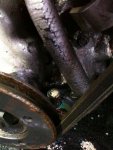
They go rusty underneath as the water pump leaks onto it - if the metal has thinned you need to replace them otherwise they will eventually hole and dump all of your oil into the bilges. If you catch them in time then some corrosion protection would be wise. Somebody on here a while ago got them made up with I think high pressure hose and then you don't need to worry about this problem ever again. The Yanmar pipes are expensive.
 
also, does anyone have any insight into why the impeller housing is strangely shaped so as to stress the impeller unevenly when in a rest position (which may be several months)? The flanges seem weirdly compressed to the upper left hand side. I would have thought that the housing would have been symmetrical or cylindrical so as to allow the impeller to be stressed evenly all the way around. Mine looks egg shaped, but looking at replacements, seems normal - but weird!
 
They go rusty underneath as the water pump leaks onto it - if the metal has thinned you need to replace them otherwise they will eventually hole and dump all of your oil into the bilges. If you catch them in time then some corrosion protection would be wise. Somebody on here a while ago got them made up with I think high pressure hose and then you don't need to worry about this problem ever again. The Yanmar pipes are expensive.

Thanks, I will look into it.

Lee
 
Mine looks egg shaped, but looking at replacements, seems normal - but weird!

It is by design. As the impeller become uncompressed it provides some suction to draw in the water. As it rotates to the outlet pipe it once more compresses thus pushing the water back out.
 
First the water system. As already suggested take the anode plate off - cunningly hidden behind the alternator - and you will get a good idea of whether there are heavy deposits in the water jacket. Replace the anode. Remove the hoses that go up from the pump to the thermostat housing and clean. Remove the fitting that takes the water into the block and clean the hole. Looks like your pump has been weeping a bit and the timing case housing is corroding. You might want to take the pump out, clean the area up and repaint. Replace the screws as they are mild steel and look like the heads are corroding. The threads will probably be OK, but the heads are very soft and round over easily. Worth fitting a Speedseal front cover to the pump as seals better and much easier to remove. If you do get drips here the oil pipe under the engine corrodes as it is only mild steel. Yours looks OK at the moment, but worth cleaning and painting the little spots of rust. If you do ever need to replace, get flexible hoses made up by a local hydraulics shop.

Exhaust looks OK, just needs a clean. Check you have an anti syphon valve fitted in the hose from the head to the injection point as that stops water being sucked back.

Not really worth fitting a flexible coupling from the alignment point of view - you still need good alignment. Only reasons for fitting one is if you get a lot of movement and the shaft hits the side of the stern tube. If you do fit one then R&D is the easiest and cheapest, although it does push the shaft back 25 or 32mm depending on type. Otherwise Bullflex is (in my view) better than Centaflex and is 15mm shorter. Remember to check your shaft size accurately as not sure the Centaflex is available in 1" whereas the Bullflex is. When measuring length both of them need an adaptor to fit the Yanmar box, which from memory adds another 12mm.

Hope this helps.
 
They go rusty underneath as the water pump leaks onto it - if the metal has thinned you need to replace them otherwise they will eventually hole and dump all of your oil into the bilges. If you catch them in time then some corrosion protection would be wise. Somebody on here a while ago got them made up with I think high pressure hose and then you don't need to worry about this problem ever again. The Yanmar pipes are expensive.

I had hoses to replace both the bottom oil pipes made up on the spot by my local Pirtek for about £30, which is about half the Yanmar cost for the long one alone.
 
Thanks for all the replies.

I have a speedseal here ready to go on. Force 4 want £20 for a plastimo impeller. Is that about right?

I'm going to assess whether it is going to be viable to pull the engine into the cabin to work on it as it's a really tight fit. I will post some pictures of it.

Thanks again.

Lee
 
Think I mean Jabsco, and just googled it. Should be able to get two for that price! Anyone else think Force 4 are a bit steep?
 

Other threads that may be of interest

Top