Yacht Maintenance Course

siwhi

Well-Known Member
Joined
21 Nov 2012
Messages
252
Location
Trstena, Slovakia
Visit site
Does anyone know if there is a yacht maintenance course in Scotland? Ideally say a 15 or 20 week course, one evening per week.

Prior to buying our boat a couple of years ago I always chartered yachts and owned dinghies, so maintenance was never really an issue. Now I am finding I struggle with some necessary maintenance work because I am pretty ignorant regarding engineering and materials and lack practical skills.

It's not really the what to do that's lacking - this forum, youtube and magazines & books are a great help. It's more assumed knowledge - which tools are needed, what materials, preparation, tips and tricks, etc, and most important seeing it done and trying it myself, and handling unanticipated complexities and building confidence.

There is a 1 week course down south, which I may end up doing, but I know I would benefit more from a more gradual and less intense course.

If there's anyone experienced who would consider setting up a night school course, let me know, you'd certainly have 1 appreciative student!
Thanks.
 
Does anyone know if there is a yacht maintenance course in Scotland? Ideally say a 15 or 20 week course, one evening per week.

Prior to buying our boat a couple of years ago I always chartered yachts and owned dinghies, so maintenance was never really an issue. Now I am finding I struggle with some necessary maintenance work because I am pretty ignorant regarding engineering and materials and lack practical skills.

It's not really the what to do that's lacking - this forum, youtube and magazines & books are a great help. It's more assumed knowledge - which tools are needed, what materials, preparation, tips and tricks, etc, and most important seeing it done and trying it myself, and handling unanticipated complexities and building confidence.

There is a 1 week course down south, which I may end up doing, but I know I would benefit more from a more gradual and less intense course.

If there's anyone experienced who would consider setting up a night school course, let me know, you'd certainly have 1 appreciative student!
Thanks.

Think you are in the biggest training establishment for matters yachting.

All you have to decide is which of the offered advice, directions, suggestions are the best and how to spot the totally bonkers.

Someone will be along to tell you they have never bothered maintaining their boat, just hit the noisy bit with a bigger hammer until it stops making a noise or drops odd. They also navigate with the map in the back of their diary.

Seriously, ask, listen and resign yourself to making some mistakes. Hopefully they will not be too expensive.
 
Does anyone know if there is a yacht maintenance course in Scotland? Ideally say a 15 or 20 week course, one evening per week.

Prior to buying our boat a couple of years ago I always chartered yachts and owned dinghies, so maintenance was never really an issue. Now I am finding I struggle with some necessary maintenance work because I am pretty ignorant regarding engineering and materials and lack practical skills.

It's not really the what to do that's lacking - this forum, youtube and magazines & books are a great help. It's more assumed knowledge - which tools are needed, what materials, preparation, tips and tricks, etc, and most important seeing it done and trying it myself, and handling unanticipated complexities and building confidence.

There is a 1 week course down south, which I may end up doing, but I know I would benefit more from a more gradual and less intense course.

If there's anyone experienced who would consider setting up a night school course, let me know, you'd certainly have 1 appreciative student!
Thanks.

My circumstances are similar to your own.

I've learned a great deal just through this forum and by searching/asking for specific advice, and as you say, there's lots of advice elsewhere on the Internet, YouTube and in magazines. Is there an owners club or forum for your boat? If so, join that. I'm a member of the Moody Owners site and I have found a wealth of knowledge, information and help there. Also, just talk to other boat owners and folk around the marina/moorings/harbour. I have found most boat owners more than willing to help out if they can.
 
Why not get a good book. I would recommend the Nigel Calder one mentione4d in this thread.
http://www.ybw.com/forums/showthread.php?275752-Best-boat-maintenance-book

I find that Nigel Calder's book is very strong on equipment fitted, design and engineering, but pretty weak on maintenance, troubleshooting and repair. Two years ago I gave a one-day course on yacht systems maintenance and repair at the Cruising Association in Limehouse. It was well attended, seemed to go well but I have never been asked to run it again. Maybe there is a message there!
 
It's not really the what to do that's lacking - this forum, youtube and magazines & books are a great help. It's more assumed knowledge - which tools are needed, what materials, preparation, tips and tricks, etc, and most important seeing it done and trying it myself, and handling unanticipated complexities and building confidence.

I'm not sure a course would give you everything you need. Unless you're going to use a particular skill shortly afterwards you'll mainly forget about it. You'll learn far more actually fixing something.

The secret to completing a job is planning. Give yourself the time to think it through and get the tools and bits and pieces to do it properly. If you run into difficulty, step back and think about it again. Never try to rush a job to completion or try to bodge it with the wrong tool (or at least strongly resist the temptation). Try not to leave a job half finished when starting something else, as the half-finished jobs can accumulate.

Get a basic set of tools, if you haven't already. Even something as small as having the right screwdrivers helps - it's amazing what a difference having the right sized Pozi or Philips screwdriver makes, rather than making do with any old crosshead screwdriver. Then you can build upon it. Adequate tools are not as expensive as they used to be.

Then pick a job you want to - start small - and start asking on the forums about tips for doing it and the tools to do it properly. Research elsewhere too. Once you've got a few jobs under your belt you'll start to get more confident and can increase the size and scope of the jobs you do - don't get over-confident though.
 
I think a lot of people would benefit from a course that covered the basics so that they could then read the Nigel Calder Book.

It's not exactly a page turner.

But once you know what you need to find out, then it's an invaluable resource.
As is the internet.
 
I'm not sure a course would give you everything you need. Unless you're going to use a particular skill shortly afterwards you'll mainly forget about it. You'll learn far more actually fixing something..

Some good advice in many of the answers. However, may I reiterate something I posted in reply to a different question. This followed an engine failure issue.

"This was the spur for me to find out all I could about maintaining my engine. Did the RYA diesel maintenance course, OK but not specific enough so I employed the marina engineer for a couple of hours to take me through all the likely basic problems and how to fix them and also basic annual servicing. Important thing was to actually do the things myself, under supervision, rather than just watch someone else do them. Best money I ever spent on the boat"

Point I am making is that you need hands on with your specific boat/circumstances and no shame in employing someone qualified to show you how to do things and let you do them und supervision. Only issue is that you need to know what you want to know!!
 
I think those of us that are innately practical don't necessarily understand or appreciate the uphill climb that others face who have never before had an occupation or interest that results in the development of practical skills. My father was an agricultural engineer whom I watched, then I worked in farming for ten years before getting an office job. I was welding at age twelve and fabricating and fixing agricultural equipment by the time of my eighteenth birthday. To me it is a natural thing to be able to gauge by experience the required tightness on bolts and that to unscrew is normally an anticlock direction and I know which way to turn the screwdriver when laying upside down feeling an unseen screw behind a bulkhead. To others the whole thing is totally mystifying.

I began to realise this only recently when I have assisted great friends of ours one of whom is an economist and worked in the city all of his life and the other an HR specialist. None of the aforementioned is natural to them and they are baffled by what seems to me to be blindingly obvious. When working on their boat I'd say "please pass a 10mm spanner" and the response would be "how do you know its 10mm?" after which they'd go looking at something like a 7/8AF and have to go through the entire toolbox looking at each size to find a 10mm. To most folk on PBO you'd look at the tool tray and immediately pick up the 10mm first time.

I bought our friends a Calder and also a circuit tester for various Xmas presents in the belief that they would learn; frankly I would have been better buying them wine!

So I fully sympathise with the OP but I think the necessary training needs to be a little more than "stick a strap wrench on the filter and undo it". It needs to be:

1) this is a strap wrench and this is how it works
2) the oil filter is here on the engine
3) turn it anti-clock to remove it
4) have it in a plastic bag to catch the oil
5) apply oil to the new filter seal before fitting
6) tighten 2/3rds of a turn after the seal contacts the block and hand tight only.

I'm rubbish at economics and I'm rubbish at HR but I can change an oil filter! We all have different skills. There is clearly an opportunity here for someone practically minded to run an evening course on "Yacht practical skills". I think the OP is spot on with the suggestion of one session a week for twenty weeks; that's what it needs.

rob
 
Thanks all for your advice, there's certainly no shortage of help on this forum around and it's appreciated. Websites like Vyv's and the MOA one are also invaluable, and have helped me as well. I don't want to frame myself as a complete incompetent, I can change filters, replace anode studs, install plotters and service winches, (ie anything requiring basic use of sikaflex, screwdriver and spanner!), but it doesn't come naturally and the idea of changing the stern gland puts me off - not because I can't visualise the steps involved, but because if (when) something unanticipated happens I'll be lost.

I have most of the tools needed and some idea of how to go about things, but a face to face practical hands on experience is what's required. Maybe I just need to build up to it a bit more gradually. I have asked an engineer to watch and coach me when I'm servicing the engine, so that's a start. The RYA diesel engine course was nowhere near enough.

Rob - your comments are close to the mark, I am an economist! Breaking down the steps into a way which helps me understand what's going on is required, and yes, it's often "how tight is tight", "how to I get that bolt out when it's spinning but the nuts both sides of the hull are seized onto it", "why is the stern nav light connection reading 3.33v and not working", "how do I drain the CAV filter when I can't get anything underneath it" - or, more mundanely "how much fuel is in the tank" (I now monitor it)? Not really rocket science stuff, and I've sorted all the above and lots more, but it took crazy amounts of time to get there with some of them, and a course would help tune me in a little quicker.
 
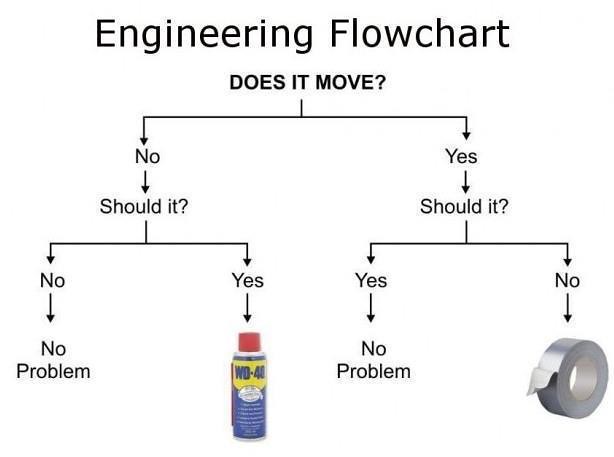
WD40, Duck Tape, and Sikaflex. And a big hammer of course, that's all you need! :)

7214525854_733237dd83_z.jpg
 
The "PBO essential maintenance guide" is quite a good place to start. It's compilation of "how to" articles from PBO over the past few years.

A car maintenance course might be another approach, a lot of the engine and electrical topics covered would be applicable to a boat.

Cheers
Phil
 
Top