Yacht adrift from failed Studland eco mooring last night.

Seems to me you could still achieve that if you put the bungee and the back-up rope or chain at the top just below the buoy.
There is an approach used some places where a chain riser is kept of the seabed by a submersed float so that the slack is at the top. I’m not sure if this area is deep enough for that.
 
  • Like
Reactions: DJE
All moorings come with a warning!

The concept of the bungee is supposed to be that it is “always” tight.

remarkably you know everything that’s wrong with them without understanding what the design was! IF 80% of them fail after 3 yrs you surely replace the bungee before 3yrs, just the same as periodically you replace the rope riser on mooring with rope, or the chain when it wears etc. it looks like there’s dozens of these moorings - so if 1 had failed in use it’s far from 80%. Without knowing the maintenance records, if it had received any damage since, if it had been used by innapropriate vesssels, if the the conditions at the time were outside the operating window etc its difficult to know if its the first of many premature failures or just bad luck.

Don’t think so. But I’m sure council funded moorings have failed in other locations - are you as upset about those?

Don’t get me wrong - I think it would be good if all public moorings had some sort of way to check their maintainence records, and had to carry liability insurance for failure but even that wouldn’t stop failures.
All moorings come with a warning? Mine doesn’t.

I don’t know everything that’s wrong with them or their design.

Your post seems a little hostile . Did you mean it to be?

No I am not upset. This is a forum and you will write in whatever manner befits you.
 
All moorings come with a warning? Mine doesn’t.
Sorry perhaps I should have written all moorings should come with a warning, and most public moorings will have some form of warning, limit of liability, not our fault type message. If you didn’t install/maintain your mooring yourself, there’s a good chance that whoever did has some small print saying “warning: moorings can be damaged in use and may fail unexpectedly” or similar!
I don’t know everything that’s wrong with them or their design.
Yet you’ve described the design as “very poor”, “not very well thought out”, and suggested that they might be “awful”. And yet you don’t seem to have understood their design, nor have any actual evidence of the failure mode.
Your post seems a little hostile . Did you mean it to be?
Probably! I’m sure you are aware (for despite being hundreds of miles away I certainly am) that these moorings are somewhat controversial, not just in their design but their very existence. The opponents are looking for reasons to get upset about them. I wouldn’t say I actually have a foot in either camp, but people who don’t understand the actual design throwing in their views actually doesn’t help either side - it stokes the flames for those who want rid of them without any proper basis and it gives those who don’t want to listen boaters concerns the easy brush off that boaters haven’t even bothered to get the basic facts right.
 
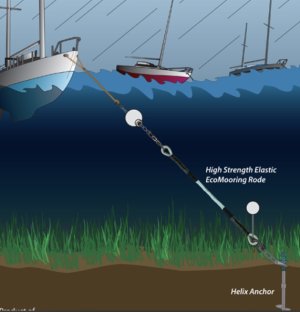
I don’t know everything, but I have studied the picture of the design and having always laid my own moorings for decades I think the design is awful; using rubber for goodness sake? Rubber that is constantly under tension and further stretched and released twice a day?

How about this: the picture kindly supplied shows a mooring at sea and on the quay.

It looks like the mooring buoy takes the weight and is submerged. The pick up strop is weird as there is no pick up buoy.

Now, why use rubber at all given that the mooring buoy is submerged and keeping the riser under constant tension?

Based upon that alone (and it falls apart here if that is not the case) the whole lot can be chain under tension at all states of the tide and no weak rubber needed.

Length of chain to buoy that is permanently submerged is not critical, but it is easy enough to make it a suitable length and weight to be permanently taut.

The strop from top of buoy is critical and NEEDS a very visible pick up buoy.

Ideally pick up buoy leaves just enough strop at extreme Springs HW to take aboard a variety of boats and no longer than that.

Results: Easier to examine strop than lower rubber.

Easier to replace strop than lower rubber.

Not rocket science .

That is my 2p worth.

Happy for others to discuss design or propose designs or tell me the rubber design is ok or not ok, preferably in a civil tone but that is up to the poster. Not being civil on forums simply reflects poorly upon the writer and they often will fade away based upon my experience from other forums I participate in.
 
Sorry perhaps I should have written all moorings should come with a warning, and most public moorings will have some form of warning, limit of liability, not our fault type message. If you didn’t install/maintain your mooring yourself, there’s a good chance that whoever did has some small print saying “warning: moorings can be damaged in use and may fail unexpectedly” or similar!

Yet you’ve described the design as “very poor”, “not very well thought out”, and suggested that they might be “awful”. And yet you don’t seem to have understood their design, nor have any actual evidence of the failure mode.

Probably! I’m sure you are aware (for despite being hundreds of miles away I certainly am) that these moorings are somewhat controversial, not just in their design but their very existence. The opponents are looking for reasons to get upset about them. I wouldn’t say I actually have a foot in either camp, but people who don’t understand the actual design throwing in their views actually doesn’t help either side - it stokes the flames for those who want rid of them without any proper basis and it gives those who don’t want to listen boaters concerns the easy brush off that boaters haven’t even bothered to get the basic facts right.
I disagree with a lot you have posted but I am not going to pick at all the points in your reply that I disagree with or consider inaccurate or enter an argument.

As to your excuse for being hostile (saying that the moorings are controversial and therefore I should simply not talk about it) I consider it a poor excuse and forums are where people can speak up if they wish even if you say they should not talk about a subject.
 
There is an approach used some places where a chain riser is kept of the seabed by a submersed float so that the slack is at the top. I’m not sure if this area is deep enough for that.
The submerged float sounds like the design that's been developing in my head since I started thinking about it. Tidal range at Studland at springs is about 2m so if the moorings are in about 1.5m at MLWS there should be enough depth for an adequate length of slack chain to hang clear of the bottom.
One possible problem with that design: maybe the slack loop could wrap itself around the tight lower section of chain.
 
Did this idea cost us taxpayers?
Directly? Yes. Indirectly? Also a resounding yes.
Many grants have been used in this debacle. First we paid for the “research” which was designed from the ground up to show a need for conservation. Next, we paid for the MCZ kerfuffle and committees to be formed and many meetings and expenses. Then we paid a grant for the actual moorings. Finally we also pay grants to the various eco-vampire companies whose only purpose is to accept government funding under the pretense of conservation. Finally finally, we all pay for the carbon credits, offsetting against doing nothing helpful (jet fuel, for instance). The carbon credits are cashed against…seagrass beds.
Or did you mean the cost we pay in loss of cruising and safe anchoring? We pay there too.
 
I don’t know everything, but I have studied the picture of the design and having always laid my own moorings for decades I think the design is awful; using rubber for goodness sake? Rubber that is constantly under tension and further stretched and released twice a day?

How about this: the picture kindly supplied shows a mooring at sea and on the quay.

It looks like the mooring buoy takes the weight and is submerged. The pick up strop is weird as there is no pick up buoy.
Are you looking at something different from me? The pictures I’ve seen don’t show a submerged bouy or a pick up - they show a small solid looking green and white bouy with a metal hoop in the top.
Now, why use rubber at all given that the mooring buoy is submerged and keeping the riser under constant tension?
Who knows exactly why they chose that design but since they seem to have highly publicised the approach any boater can make their own assessment of the risk and if it’s so obviously stupid they can chose to go elsewhere - just as there are mooring in places where it’s publicised that they are very overdue a service and people can decide not to use them.
 
The buoys at Studland seem to be a mix of the 2 'systems; shown. They nearly all have a pick up strop with small floats, that is attached to the underside of the buoy. The buoy does look like the one shown in the rya blurb.
It would be interesting to know how far out from the shore the failed one was. Being near a major boating centre, Poole, there are a lot of heavy shallow draft boats that like to be close to the beach for kids to swim and easy visits to the pub, so the 5 ton weight limit on those ones close in could easily be exceeded. My boat weighs around 4.5 tons and is one of the lighter ones in the yard I berth at.
 
But just as with anchor threads, boat weight is a stupid measure in the first place. The buoy isn't used to lift the boat. A raft with a 5 ton weight on it will have far less drag than a tall ship built from balsa.
 
But just as with anchor threads, boat weight is a stupid measure in the first place. The buoy isn't used to lift the boat. A raft with a 5 ton weight on it will have far less drag than a tall ship built from balsa.
And IIRC, there are quite a few big gin palaces based in Poole. Not very heavy for their size, compared to a yacht with a keel, but lots of windage, which is what would strain those moorings.
 
Published pictures as supplied by the manufacturer or distributor are clearly incorrect.

No wonder there is confusion.

017B2B74-0C70-4355-85DF-4F4F63ADF652.jpeg
 
I don’t know everything, but I have studied the picture of the design and having always laid my own moorings for decades I think the design is awful; using rubber for goodness sake? Rubber that is constantly under tension and further stretched and released twice a day?

How about this: the picture kindly supplied shows a mooring at sea and on the quay.

It looks like the mooring buoy takes the weight and is submerged. The pick up strop is weird as there is no pick up buoy.

Now, why use rubber at all given that the mooring buoy is submerged and keeping the riser under constant tension?

Based upon that alone (and it falls apart here if that is not the case) the whole lot can be chain under tension at all states of the tide and no weak rubber needed.

Length of chain to buoy that is permanently submerged is not critical, but it is easy enough to make it a suitable length and weight to be permanently taut.

The strop from top of buoy is critical and NEEDS a very visible pick up buoy.

Ideally pick up buoy leaves just enough strop at extreme Springs HW to take aboard a variety of boats and no longer than that.

Results: Easier to examine strop than lower rubber.

Easier to replace strop than lower rubber.

Not rocket science .

That is my 2p worth.

Happy for others to discuss design or propose designs or tell me the rubber design is ok or not ok, preferably in a civil tone but that is up to the poster. Not being civil on forums simply reflects poorly upon the writer and they often will fade away based upon my experience from other forums I participate in.
Totally agree that the studland moorings need a pickup buoy. Swmbo who is a very competent crew and perfectly capable of picking up a mooring got the boat hook between a couple of the floats where it jammed and bent the hook. You have to be careful to get hold of the loop on the strop itself. I believe the thinking is that because the strop is floating on the surface no pickup is needed but the current system is far from ideal.
 
Some now have an orange ‘Dan’ buoy rather than the ‘floats’.

When the first batch appeared one needed to take a line through the metal hoop at the top which could provide entertainment if there was much of a breeze.

It would be nice if the buoy itself wasn’t so hard as it makes while a noise if it bangs against the hull, usually when the wind drops at night!
 
"The yacht was retrieved and the owners who had been ashore were desperately rowing after it (out to sea in a strong wind!) were picked up and reunited with their boat by another nearby yacht that came to their rescue.
Would you row ashore and leave your boat unattended in strong offshore wind ?

Naa............ thought not .
 
"The yacht was retrieved and the owners who had been ashore were desperately rowing after it (out to sea in a strong wind!) were picked up and reunited with their boat by another nearby yacht that came to their rescue.
Would you row ashore and leave your boat unattended in strong offshore wind ?

Naa............ thought not .
Wind can funnel down off the Downs in Studland and calm weather can change quite quickly. Another reason why aprticualrly smaller boats need to be close inshore in the VNAZ area. Studland has had fatalities in the past when a change in weather with crew ashore has lead to dinghy accidents. I have more than once encountered F6 when the weather outside has been top end of F4
 
"The yacht was retrieved and the owners who had been ashore were desperately rowing after it (out to sea in a strong wind!) were picked up and reunited with their boat by another nearby yacht that came to their rescue.
Would you row ashore and leave your boat unattended in strong offshore wind ?

Naa............ thought not .
Some of us don't keep boats in marinas and leave them on buoys all year, so yes I would leave my boat on a mooring in strong wind. Would I row ashore against the wind, of course not, that's what an outboards for 😉
 
Some of us don't keep boats in marinas and leave them on buoys all year, so yes I would leave my boat on a mooring in strong wind. Would I row ashore against the wind, of course not, that's what an outboards for 😉
Why is the subject of ones home mooring even been mentioned.
Have moored on isolated tidal moorings, half tide river moorings and both in marinas and club pontoon moorings.
This location a day trip out for small craft and a trip ashore the choice icing on the cake.
Experienced folks will have had sharp eye out for any weather likely to cause problems going ashore and especially getting again.
Once is usually enuff for most.
Ignoring the location, leaving any boat unattended, a cautionary tale no matter what the method of mooring.
A recent trip locally revealed small yachts neaped high and dry on a local seawall after their chain risers had failed over the winter.
 
Last edited:
Top