X-split charge splitter wiring

Steve_N

Well-Known Member
Joined
31 May 2004
Messages
1,104
Location
Fife
Visit site
I picked-up on eBay a Driftgate X-split MOSFET charge splitter which, although a blast from the past, seems to be still marketed under the Durite banner.
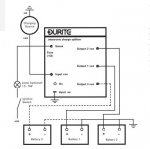
I'm not entirely sure what the 'sense' connection is for? - wiring diagram attached - so I'd welcome some help please. Thanks.
 

Attachments

  • CAPTURE.JPG
    CAPTURE.JPG
    27.4 KB · Views: 62
It looks as though it is where you can connect an optional warning lamp. Between that terminal and the switched side of the "ignition" switch.


The full instructions should be on-line . .... well they used to be!
 
Last edited:
My first guess was that it needs a +ve supply to the 'sense' terminal to turn the device on? However that is ruled out by the fact that the (optional) indicator bulb can vary from 1.5w - 5w.

Or is it just an indicator light that illuminates when the alternator is NOT charging ... just like you would normally have anyway?

Either way, the annotation "7.5A fuse" seems strange. Far too low to be protecting the charge circuit .....but oddly high if it is protecting the control circuitry.
 
Last edited:
I've got an X-split and this post has made me realise that Driftgate2000 is now non-existent, and their website has disappeared!
I did have some print outs when I wired it up, but seemingly no longer.
I think that the sense terminal is to connect to the excitation terminal of a battery sensed alternator, but I can't really be sure, and I'm over 100 miles from the boat.
I can't really explain the wiring shown for the Durite item in the OP. Not my recall at all.
Good bit of kit though.
 
Last edited:
I think that the sense terminal is to connect to the excitation terminal of a battery sensed alternator, but I can't really be sure, and I'm over 100 miles from the boat.
I can't really explain the wiring shown for the Durite item in the OP. Not my recall at all.
Good bit of kit though.

Yes, that was what I thought too until I found that rather confusing diagram.
 
I picked-up on eBay a Driftgate X-split MOSFET charge splitter which, although a blast from the past, seems to be still marketed under the Durite banner.
I'm not entirely sure what the 'sense' connection is for? - wiring diagram attached - so I'd welcome some help please. Thanks.

The "sense" connection indicates that it's a battery-sensed X-Split, ie one intended for use with battery-sensed alternators. The installation instructions on the old Driftgate website say "Where a battery sensed X-SPLIT is fitted, the small M4 terminal should be connected to the switched side of the ignition. i.e. only "live" when the ignition is on. On old units where a sense protection fuse is not included we recommend that a separate 7.5 amp fuse is connected into the battery sense lead OTHERWISE THE IN BUILT DIODE MAYBE DESTROYED."
 
Last edited:
Thanks for all the help, it's clearer now.
KevB's link suggests that I can just leave the 'sense' terminal unconnected with a machine-sensed alternator. Certainly all the current Durite products have a 'sense' terminal so it doesn't seem that are different versions for battery and machine-sensed any more, as suggested in pvb's extract from the old Driftgate site (the link for that would be good if you mean that you can still access it please, pvb).

I have an old alternator that I've spun up in the past using an angle grinder(!) and V belt and I have a couple of batteries in the shed so I think a bench test is in order before this goes anywhere near my new Beta.
 
Thanks for all the help, it's clearer now.
KevB's link suggests that I can just leave the 'sense' terminal unconnected with a machine-sensed alternator. Certainly all the current Durite products have a 'sense' terminal so it doesn't seem that are different versions for battery and machine-sensed any more, as suggested in pvb's extract from the old Driftgate site (the link for that would be good if you mean that you can still access it please, pvb.
Yes, you are correct about leaving the sense terminal unconnected for a machine sensed alternator.
When I replaced my old Beta for a new one in 2012, I had to rewire for the new battery sensed alternator. It was then that I had to investigate, (and subsequently forget about!), the sense connection.
The X-split, dating from 2004, had a sense terminal, not used for the old alternator.
With the demise of the website, I think that I will now make a decent diagram of the actual charging system wiring that I've got.
 
It's supplementary question time..

Just been researching what alternator is fitted to my Beta and I think it's an Iska/Letrika IA0566 which is 65A and not the 70A that is in the engine specification.
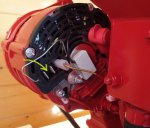
But before I stamp my feet and ask why I appear to be missing 5A, I notice that this 65A one has 2 additional B+ terminals (arrowed in pic) which the 70A model doesn't have.

So, any idea what these additonal B+ terminals are for and might they be useful and worth the trade-off for 5A?
 

Attachments

  • Iskra65.jpg
    Iskra65.jpg
    59.3 KB · Views: 13
If it's any help, I've compared your photo with the wiring diagrams in my Beta Operator's Manual.
Eg drawing 300-62210 shows Iskra 65 & 70 amp alternators, very similar to yours, without any distinction The "B+" connection is made by paralleling the two large spade terminals together, no other "B+" connection. The BR/Y wire is the charge light.
They also describe the alternators as machine sensed, which would make your X-split terminal redundant.
 
Thanks and my apologies for getting you to do the legwork when I must have that same manual somewhere - I must dig to the bottom of the boxes.
 
I decided to test this on the bench before going any further with the sense terminal unconnected and it worked perfectly and as expected.
I was using a regulated Gunson battery charger on its 14.5v seting and a couple of dissimilar leisure batteries.

However, finally I thought let's see what the voltage drop across the splitter is and I got a strange reading. Both batteries were showing charging at c. 14.5v yet the multimeter measured only 10.5v between the charger and the splitter's input terminals.. Any ideas why that would be the case?
 
. the multimeter measured only 10.5v between the charger and the splitter's input terminals.. Any ideas why that would be the case?

Am I reading your post correctly? I would have expected zero volts between the charger output and the X-split input, apart from insignificant drop along the connecting wire. Do you mean X-split output?
The drop across the splitter will be the reading between its input to output +ve terminals. Should be only a few mV. depending on charge current.
Further thought, (guess) on the unexpected voltages. The charger is delivering unsmoothed rectified AC. to the splitter. The multimeter is showing DC as smoothed by the battery at 14.5v. 10.5v is the metered rms value of the unsmoothed 14.5v peak to zero which the splitter input is receiving.
 
Last edited:
Am I reading your post correctly? I would have expected zero volts between the charger output and the X-split input, apart from insignificant drop along the connecting wire. Do you mean X-split output?
The drop across the splitter will be the reading between its input to output +ve terminals. Should be only a few mV. depending on charge current.

Sorry, my fault for not explaining it very well..

The charger should be outputting 14.5v and the batteries connected to the X-split's 2 outputs are reading c. 14.5v as expected so all appears fine.
But if I measure the voltage at the +/- chocolate block connector which I used to connect the charger's output to the X-split's input it reads 10.52v
 
OK, to clarify my suggestion:- the charger is outputting rectified ac at 14.5v zero to peak. This would normally be smoothed to 14.5 v DC at the battery connections, and the meter would read this figure. The batteries act as enormous smoothing capacitors.
At the splitter input however, the waveform is shielded from the smoothing effect of the batteries by the splitter circuitry and so is a zero to peak form.
The typical multimeter set to DC range will measure this waveform as an intermediate, (rms?) figure, not the peak of 14.5 v.
Over to the electrical boffins!.
 
Last edited:
Top