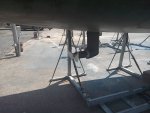
Wrong saildrive anti fouling used last year

MagicalArmchair

Well-Known Member
Joined
11 Jan 2013
Messages
1,540
Location
Kings Hill, Chatham Marina
Visit site
Before we got the boat back we paid the yard ion Poole to anti-foul her and just purchased a job lot of of International Cruiser 250, and they slapped it onto the bottom, saildrive, prop and rudder collar and off we went.

Having never had a boat with an (aluminium) sail drive, I didn't give this a second thought.

Before lifting out last week, I was researching into what to use - when I discovered that, as it contained copper, Cruiser 250 was a very bad idea. I had visions of lifting out the boat to find my sail drive and the collar from the rudder (also aluminium I think) eaten away. Thankfully, when she lifted, after a year and two weeks in the water the saildrive was still there! No signs at all of galvanic corrosion anywhere.

Should I strip the saildrive of the Cruiser and reapply Trilux? Or just rub down as usual (which, to be honest, will probably remove most of the old Cruiser anyway) and reapply Trilux "over the top" safe in the knowledge it wasn't a problem last season, so won't be a problem this season (this is, clearly, my preference).
 
I guess the amount of Cu in the grade of paint you used was not significant. But best to remove and go for the approved a/f. S legs cost a bob or two, as you know.

PWG
 
How annoying. We had this done to our boat by a yard in Germany (particularly infuriating as had informed them their quote was too expensive and arrived to do it myself!).

I carefully and gently sanded off as much as I could, without going through the base layer. The big issue is that some paint inevitably runs inside through the water inlet holes. No way to remove that paint, and will not know if it is causing any harm till too late.

Just need to do best and go sailing.
 
Now is a good opportunity to take your prop back to the basic coating and apply Velox

antifoulingpaint.net

This is the US site which has detailed application instructions but the paint is readily available - I got mine from Force4. It really works. You could do the same on the saildrive housing but that is a lot of work and I find Trilx works OK on that but was not good on the prop.
 
My keel was a mess of rust when I pulled her out this year too, so I am flappy grinding disc that back, rust treating, and then applying three coats of Interprotect before I antifoul (I know, it'll all probably come off again! :D - I'll see what my efforts reap next year, and then shot blast and do it 'right' then if this method doesn't work as well as hoped).

I presume as the prop is aluminium, I could also InterProtect that, and the sail drive, and the collar, before applying a top coat? I have just ordered Trilux :D Damn it!
 
Before we got the boat back we paid the yard ion Poole to anti-foul her and just purchased a job lot of of International Cruiser 250, and they slapped it onto the bottom, saildrive, prop and rudder collar and off we went.

The idiot "Bavaria dealership" I bought my new boat from did this - ordinary antifoul everywhere. When I had the boat lifted a few months later, I was able to remove the stuff on the saildrive and rudder stock area, and apply some Trilux instead.
 
The idiot "Bavaria dealership" I bought my new boat from did this - ordinary antifoul everywhere. When I had the boat lifted a few months later, I was able to remove the stuff on the saildrive and rudder stock area, and apply some Trilux instead.
Is there any copper in current antifoul? I thought the EU banned copper for leisure boats a few years back.

As a Newb I also Antifouled the sail drive with a copper based paint, but no damage. I later primed over and applied trilux or prop o drive.

No issues since. I think one year it jet washed back to the original volvo base layer, so happy days. No stripping, no sanding, just reapplied.

When the boat was based on an industrial port river mooring it ate 2 sets of volvo hub anodes in 6 months. But since moving to a coastal harbour its not been an issue.
 
My keel was a mess of rust when I pulled her out this year too, so I am flappy grinding disc that back, rust treating, and then applying three coats of Interprotect before I antifoul (I know, it'll all probably come off again! :D - I'll see what my efforts reap next year, and then shot blast and do it 'right' then if this method doesn't work as well as hoped).

I presume as the prop is aluminium, I could also InterProtect that, and the sail drive, and the collar, before applying a top coat? I have just ordered Trilux :D Damn it!
If it is a standard fixed blade prop then it is aluminium which is originally coated with an epoxy coating. As you see in the Velox instructions, you apply the primer then top coat on this. If the original coating has gone (unlikely) then back to aluminium , then epoxy, then Velox. It really is worth it on the prop as I found that Trilux did not last a season before little barnacles grew, but less so on the drive. I wish Velox had been around when the boat was new. My prop is bronze and I did the blades but not the hub as again Trilux lasts on that and the odd barnacle does not have the same negative impact as on the blades.
 
Don't get too excited about Velox, its not cheap. But any and all AF need to be applied to a surface that moves - if you do not use your vessel then it will develop growth, Velox or not.

The secret is use your boat regularly.

Veleox has a similar chemistry to Trilux - its just that Velox is a more concentrated formulation. An alternative to Velox is PropSpeed (totally different mechanism).

Jonathan
 
Last edited:
To get maximum benefit from Velox the primer coat has to be carefully applied, Hammerite Special Metals primer seems to adhere better than Velox's own primer and I am convinced that its tenacity helps prolong anode life on a normal 'prop shaft' boat, I accept that there are more variables in play with a sail drive.
 
I have always used Trilux on the leg, and never seem to have any growth other than some slime, generally in better state than the hull.
 
Don't get too excited about Velox, its not cheap. But any and all AF need to be applied to a surface that moves - if you do not use your vessel then it will develop growth, Velox or not.

The secret is use your boat regularly.

Veleox has a similar chemistry to Trilux - its just that Velox is a more concentrated formulation. An alternative to Velox is PropSpeed (totally different mechanism).

Jonathan
The reason I am enthusiastic is that on my boat, which sails typically 100-150 hours a year and motors 50, otherwise stationary in the marina there was nothing except for a light slime on the prop after more than a year. The blades are bronze which i prepared according to the instructions. The paint has suck except for a small chip, which I touched up. will be lifting soon after another 9 months in so will report further.
 
Top