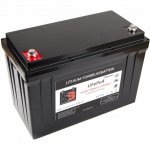
Would you install this Lithium battery?

I feel like throwing in a few words here. Not because I have experience with LiFePo4 myself, but because I think the market has evolved a bit further here in Norway than in the UK... LiFePo4 is the safe version of Lithium batteries. They come either as battery packs with (133) cylindrical cells, or as packs with (4) prismatic cells. I would prefer the prismatic cells myself as they are bolted together and can be taken apart if one cell quits.
The most important issue is that any LiFePo4 battery needs a BATTERY MANAGMENT SYSTEM, or BMS. This can be an internal affair, which is common in the batteries sold here. Or it can be a more advanced external system, like the ones provided by Victron. -But this is absolutely necessary. You cannot operate a LiFePo4 battery safely WITHOUT a BMS. It will protect the battery against overcharge, low voltage, high voltage etc. It simply disconnects the battery if something is wrong.
Also, you shoud have a monitoring system. This can either be an internal Bluetooth variant that transfers data to you cellphone. Or, again, a more sophisticated system like the ones from Victron.
There are plenty of battery packs sold without a BMS. And the knowledge is still not adequate with all of those who market LiFePo4. You need to read up on this yourself.
Here in Norway we have a mandatory 5 year "warranty" on most products that are supposed to last that long. It's a "protection" against over-pretentious marketing indeed, which you don't have on eBay. Or, I suppose, in Britain, at all. But I still suggest you do you shopping with a well known supplier rather than shopping LiFePo4 on eBay. -Unless you're an expert. Which I'm not. So I won't...
 
Last edited:
Full kit available here:

https://www.ev-power.eu/Sinopoly-40...lls-BMS-mobile-monitoring-and-protection.html

I think for now I'll stick to a couple of hundred quid's worth of old tecnhology and change them every 8-10 years. Maybe by the next time they need changing the price of the above will have come down, or maybe there are other cheaper solutions.

User vasko on the Jeanneau forums (jeanneau.proboards.com) is something of a guru on LiFePO4 batteries and an early adopter - he's been using one of these as a starter battery for over 2 seasons and is very happy with it: https://www.ev-power.eu/LiFeYPO4-batteries-12V-1-1/Lithium-Battery-LiFePO4-12V-20Ah.html

I have no connection with the above seller or any battery companies, I'm just pointing in the direction of some potentially useful information.
 
There's no doubt that eventually most of us will be using some form of Li batteries in place of the old lead acid technology. In the meantime what is required is a few early adopters who can wrestle with the teething problems and learn to manage these batteries safely. So I'd say to the OP, go for it. Like whoever it was who sailed the first fibre-glass boat you'll never be forgotten. I believe you can get explosion proof bags and even with oodles of fire cladding the overall weight is likely to be less than that of Lead Acid batteries. Of course the cost will be higher initially, not to mention the cost of liferaft, exra fire extinguishers, survival suits etc, but I'm sure in the end it'll be worth it.
 
Calculating total costs over a life span, I'm certain a LiFePo4 battery is actually cheaper than your el-cheapo Lead-Acid. They last longer. It's as simple as that. And they don't explode or start burning. That's the Li-Ion batteries, if you are not careful.

What I am less exited about is that they shouldn't be left with a float charge, without any consumers, for any longer periods, like when you leave everything to your mains charger during the week. Not good for it. And you really don't want to break it. Because THAT'S expensive...

What I am really exited about is how good they take charging. One hour of motoring with a 115A generator and you have filled a 100Ah LiFePo4 from 20% to 100%. Try the same with the equvalent 200Ah lead battery, and you have at the best gone from 40% to 60%, with hours and hours before you get to 100%...

Here in Norway I would have to pay £800 for a drop in 100Ah LiFePo4 incl a Bluetooth monitor, and the built in BMS of course. A bit more than the occasional buy on eBay. But then you don't get a 5 year warranty on eBay, which is an economic safety factor.

12100b150blue_1_1.jpg
 
You won't see explosive fire from a LiFePO4, that's LiPo and Li-ion, used in phones, tablets, laptops.
 
Sorry, didn't make my point very well. They may say they're one thing but what's inside the package is anyone's guess unless you cut it open and even then the cells may have no markings or be marked in Chinese as I found on the last battery I changed. They had also substituted 50% of the cells with cardboard tubes to pack it out thereby reducing the capacity by 50%. No wonder they are cheap. This has been the problem with the hoverboard batteries. Anyway, explosive or not, any sort of fire is not welcome on my boat.
 
Quite a few misconceptions here. The battery in the link contains a charge controller which cuts off charge when full and also ensures balance of each of the 3 cells. It also contains a discharge controller which cuts off discharge to protect the battery from excessively deep discharge. This means that the battery could be charged from a medium sized solar panel without any other controller.
Now OP says it is for a trailer sailer. Just how much battery capacity does he need? If just for lights (LED of course) and radio then possibly much less capacity would be OK. If he wants to run a fridge TV or computer then he needs more capacity.
OP or anyone else might like to try 3 or multiples of 3 of these 18650 cells. https://www.ebay.com/sch/i.html?_fr...A0.H0.X18650.TRS0&_nkw=18650+battery&_sacat=0
Along with one of these https://www.ebay.com/sch/i.html?_od...tery.TRS0&_nkw=3s+battery+protection&_sacat=0

The 18650 cells it seems can be doubled up in parallel but be a bit sceptical about AH claims.
3 cells in series will give a voltage between about 9v and 12v depending on charge state. hopefully this is enough voltage to run lights and radio. You could go for 4 cells which gives between 12.4 volts and 16.4 volts. You could then use a buck regulator if you wanted exactly 12v or 13v. You would need a 4S controller.
Solar panels should give enough volts to charge 4 cells and certainly enough for 3 cells.
So yes I think well worth trying for a trailer sailer especially as so easy to remove for charging and light weight. good luck olewill
 
Sorry, didn't make my point very well. They may say they're one thing but what's inside the package is anyone's guess unless you cut it open and even then the cells may have no markings or be marked in Chinese as I found on the last battery I changed. They had also substituted 50% of the cells with cardboard tubes to pack it out thereby reducing the capacity by 50%. No wonder they are cheap. This has been the problem with the hoverboard batteries. Anyway, explosive or not, any sort of fire is not welcome on my boat.

Obviously I would only buy from a trusted source, with warranty. A Winston from a reputable retailer is such an option, a 90Ah@12V Winston costs around 700€ in Europe, weighs ~20kg/40lbs. Expensive, but getting close to realistic values: if your consumption is just a meager ~10Amps this battery lasts for ~8 hours. To get the same 10A@8 hours from a lead bank, it has to be around 150Ah (Peukert's law), which costs ~400€ and weighs ~50kg/100lbs. If you draw more, that'll tax the lead bank significantly more thus you have to massively oversize your lead bank.
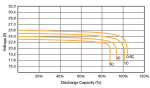
Lithum discharge curves:
Lithium.png
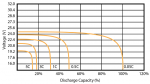
Lead AGM discharge curves:
Lead_Acid.png

On the fire part we are on the same page, however lead-acid might also ignite due to manufacturing faults, probably not less than a good brand LiFeYPO4.

I am thinking on using a combination of lead and LiFeYPO4: lead providing a continuous 5Amp (probably all eaten by the fridge), while lithium takes care of everything above that (radar, SSB, etc.). Downside I'd need wire two separate chargers and have a charging schedule if only one source of power generation is available.
 
Top