Worth rigging an inner forestay

wanzap1

Well-Known Member
Joined
18 Sep 2018
Messages
87
Visit site
Hi Forum,

From this season's sailing there have been quite a number of times when I feel that a number 4 jib would have proven more useful than the heavily furled genoa.

Admittedly I am probably overly conservative with my reefing due to my inexperience, but when the wind is gusting above 15knts the Bolero heels heavy and my wife and I don't find the level of heel comfortable for a 2 or 3-hour cruise. Therefore we are reefing down (roller furling). Worth noting, to the boats praise, even when the genoa is rolled away to a hankerchief we can still make good progress but its is overtly obvious that the sail isn't set well and isnt happy.

The boat will be undergoing a minor refit at the end of season and I am wondering if it is wirth the expense and hassle of rigging an inner forestay what can accommodate a hanked on jib?
 
You didn't mention the boat or rig type, so just generic advice:

It's probably cheaper to add a foam luff to the existing furling Genoa, which will improve its set when partially furled. It's more likely to get used than a hanked on jib. It also won't interfere with tacking (the Genoa) like an inner forestay will. A removable one is an option, but even more expensive and even less likely to get us
 
Hi, its fractional rigged.

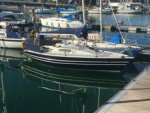
With regards to the two pictures, I mean toe rail amidships well dug-in. Its not a safety concern, its a comfort issue.
 
Both pics are Boleros :)
It's not too expensive to add a removable forestay if you DIY
With a fractional rig, I would consider adding a forestay just forward of your existing one, it might be easier than behind, but only close up pics of existing mast and stemhead fittings would tell.
 
Ha, got you now... in that case its the second one, Bolero 25.5.

It was just a thought. This season I'm am finding so many little things that I'd like to change and improve - mostly just to increase comfort for cruising!
 
We carry a furling genoa for general use and a furling working jib made from stronger material, for heavier weather.

Weather forecasting is now much more accurate than it was a few years ago so we decide which foresail we are going to use before we leave port. Generally anything above F4 gets the smaller sail and anything below gets the genoa.

When I set the boat up for living aboard, and more adventurous cruising, I fitted a 2nd forestay which is generally just tied back to the shrouds but which can be rapidly set up with a Highfield lever mechanism to take a hanked on storm jib. I have to admit that I have never used it because we found that the working jib is perfectly usable up to F9. Hey, ho - one lives and learns.
 
it's a fractional rigged boat - it looks like 3/4 so the genny is going to be small in comparison to the main I guess?

in which case I'd have thought that you won't benefit from another fore-stay - it's better making sure you have a decent quality furling genny on the stay that you have - which will set nicely when reefed.

it may be that you would be better reefing the main first and keeping the genny fairly large as it's smallish anyway.

overall if your genny is sort of 135% ish then i think a removable forestay will be a wasted effort (happy to be corrected); focus on good sailcloth and trimming the sails to remove heel/sail the boat well perhaps

you mention being fairly new to this - have a look at some mainsail trimming videos to get used to depowering the main/dropping it down the track to reduce heel etc :)

anyway that's my five pennyworth


N
 
From my experience with fractional rig boats, I would consider getting a smaller jib to go on the furler.
Maybe whatever coms youe way secondhand, maybe get something made.
I'd be looking for a 'blade jib' which more or less fills the foretriangle but has no or negligible overlap with the main.
You might need additional sheet tracks for this.
But any smaller sail on the roller would be a good thing to try.

If you can get a half-decent club racing person to come out with you and give you feedback on your sail trim, that can be very valuable. Or go crewing on their boat and observe!
 
We have an inner forestay on our Deb but we are set up the opposite way round to most people. The roller furler carries a self tacking blade jib, and the removable fs can be used for a storm jib (never been used) or a hank on huge lightweight overlapping genoa, which gets a lot of use.

Not really applicable to the OP but just thought I would mention that an inner fs can be very handy.
 
You didn't mention the boat or rig type, so just generic advice:

It's probably cheaper to add a foam luff to the existing furling Genoa, which will improve its set when partially furled. It's more likely to get used than a hanked on jib. It also won't interfere with tacking (the Genoa) like an inner forestay will. A removable one is an option, but even more expensive and even less likely to get us

Absolutely. A good quality genoa/jib with a foam luff is what you need. And in our case transformed our previous boat in winds above 20 knots (true) wind speed upwind. Goes faster and heels less.
Avoid extra inner forestay unless doing long distance ocean sailing, as makes tacking a nightmare.
 
Absolutely. A good quality genoa/jib with a foam luff is what you need. And in our case transformed our previous boat in winds above 20 knots (true) wind speed upwind. Goes faster and heels less.
Avoid extra inner forestay unless doing long distance ocean sailing, as makes tacking a nightmare.

We have a solent rig. This has two furlers set about 2ft apart. The outer furler has a 135% genoa. The inner furler has a working jib. In winds up to about 15/20 kts upwind, the genoa is the chosen sail. Above about 20kts the working jib is king. You don't need to go on the foredeck as weather and seas deteriorate. Both sails have foam luffs but in my experience heading up wind in stronger conditions you cant beat the smaller sail. Its triple stitched, heavy cloth and designed for the job. A foam luff in an overlapping genoa just doesnt compare. The smaller sail points higher, gives less heal and tacks easily. We have flown the working jib in winds up to 40kts with no problems.
 
Also consider using more backstay adjustment in heavy airs - depowers the main a bit and probably tightens the forestay which in turn will give you a flatter genoa.
Last suggestion : can you move the genoa sheet cars position? Bring aft to depower the top of the genoa and reduce heeling.
 
I think much depends on the choice of the OP. As suggested if it is not too much trouble to change the jib on the furler a smaller flatter jib might best be fitted before departure if wind is expected. I think performance and comfort up wind is the critical factor. So a smaller jib will work much better with less or no rolls and correct sheeting position. I presume OP has optimised the sheeting position. ie forward for more rolls. Even so IMHO it is difficult to get a jib well reefed to perform up wind.
If he considers it too much trouble to change jibs or wants to be able to change with conditions while out on the water then the removable inner forestay with smaller jib might be the answer. Still needs a new (or s/h smaller) jib.
So sailing is all about experimentation. good luck. ol'will
 
Hence my suggestion in #5 to put a removable stay just forward of the forestay.

I can't picture what happens then, when you tack? The sail on the additional stay must go over and rest on the original forestay, which may not matter?

Also, what's a Solent stay?
Thanks
 
Top