Wood identification

KAM

Well-Known Member
Joined
6 Jun 2005
Messages
1,356
Visit site
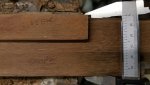
Looks like teak, exactly the same colour and grain. Smells like teak but it's very much harder and denser than any teak I've used before. Oily surface and very straight grain and definately not iroko as it's non interlocking and planes easily. Seems to have been used in a marine environment if not a ship then maybe a pier or dock. The planks are 220mm x 70 mm and have been dowelled together edgewise at some stage. Any experts out there who might have an idea what it might be.
 
Might be "real old teak", not the modern grown stuff. I once had a large chunk of 100-year old 2" thick scrapped teak chemistry bench that was so dense it barely floated: on the surface it was blackened, stained, scratched but planed about 1mm down was golden, perfect. And the plank was almost a yard wide....

Unfortunately I lost it when I flew to Hong Kong for a few years work that turned into 20, but I'm sure the rudder blade and other bits I made from it are still perfect 40 years on.
 
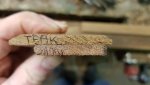
I've attached 2 pictures. The one labelled teak is known pre 1950s burmese. I wonder if the white flecks are unique to teak ive certainly seen it quite often before. Any comments much appreciated.
 

Attachments

  • teak1.jpg
    teak1.jpg
    525.6 KB · Views: 1
  • teak2.jpg
    teak2.jpg
    489.5 KB · Views: 1
Thumbnail wont display for me but white flecks could be calcium deposits which are quite common in teak and iroko
 
I think it is the silica. It is common in iroko as well. Both iroko and teak, if old, can be very, very hard. I put two planks of iroko in the transom in 1991; the timber had been stored for years in the Stoke Newington General Hardmongers Store. It blunted two saws. Also, I removed in 1994, a piece of iroko under the cockpit floor upon which the gear change assembly was bolted. I still have the iroko with the bolts 'fused' together with the bolts impossible to move. The socket broke first!
 
The sample smells fruitier and more aromatic but not as strong as the one labelled teak.
 
I have some old Burmese teak, from old 1930's lab benches which had been chucked in a skip many years ago, fortunately a friend worked there and I collected a car full which on my Peugeot 306 estate practically lifted the front wheels off the ground! - I had to drive carefully home as the steering was very light... Made some lovely kitchen worktops, and of course lots used on the boat. Years ago when I worked for a company selling sawmills I often had to go to Nigeria and Ghana and there were lots of hardwoods similar to teak and often sold as alternatives. One sawmill I visited they put a log on and it was so hard the bandsaw only managed a cut of about 6" before it stalled the 80hp motor... I used to have some samples but all been used by now.
 
Just found a faint stamp KERUING on one of the pieces. So it's not teak despite appearances. Seems to have similar properties. Has anyone used this on a boat.
 
The sample in the pics has much quicker growth bands and does not seem so closely interlocked as the teak. Can you see any resin ducts in the sample ?


EDIT If Keruing it's an industrial boat building wood not really suitable for smooth work as it tends to splinter. I have never put any through the saw mill and I'd be relucatant to expose modern high speed machinery to it.
 
Last edited:
Keruing has a peppery smell and is a dark red or pink. Very difficult to work and not very attractive when finished for varnishing. Not very pliable and quite heavy. The silica adds to the difficulty working it and really is not very useful on yachts and boats.. Surprisingly it is not that durable given its weight. There are much better timbers, for boats. Keruing often used for gardening in 30mm square sticks and plant supports etc.
 
Looks like plan B then. I can just scrape together enough teak and iroko to redo my cockpit if I use the coffee table top I made from an old lab bench. Not sure how to broach the subject with my wife though. Maybe if I swap the coffee table top for keuring she won't notice. The iroko I have is a nice colour and a decent match for the teak. Anyone any ideas on its weathering properties. Is it likely to weather in a similar way to teak.
 
Top