Wansworth
Well-Known Member
Our star signs are not compatibleThe pair of you should go together....get it out of your systems


Our star signs are not compatibleThe pair of you should go together....get it out of your systems

All that’s required is one of you be awake at all timesOur star signs are not compatible
that you both share...He has to do it on his own it’s part of it a latent desire…..

Many 'ports' were small fishing ports some now host marinas and others, marinas, appear to have been built in the best anchorage(s). If you source the relevant Admiralty Pilot there is chapter and verse on every port or you will find the marina will offer links to their facilities and how to enter. If you do access the Pilots they also define entry into larger ports like Hong Kong or Southampton. Your chart will define all the lights. You can supplement the information with screen shots of Google Maps or Earth.I find the stressful part is making port. Particularly a new to me, unknown, port.
26I have done it SH twice & if it had not been for covid it would have been thrice. It gets addictive. A friend of mine agrees. He went round the top but I cheated & went via the Cally canal. But I made up for it by going round Guernsey on the way ( that is my excuse).personally I think you have to be prepared for trips much longer than 30miles.
there is a book by - I think- Roger Taylor about sailing round the U.K. it shows his 2 routes gives details of how he prepared his Sadler 29 or 26 I forget which sorry do not have book to hand.
someone on the forum will have the title & I found it an excellent source of info

Horses, courses. For me one of the great parts of travelling under sail is the chance to discover new ports, harbours and anchorages. We are all different!I find the stressful part is making port. Particularly a new to me, unknown, port.
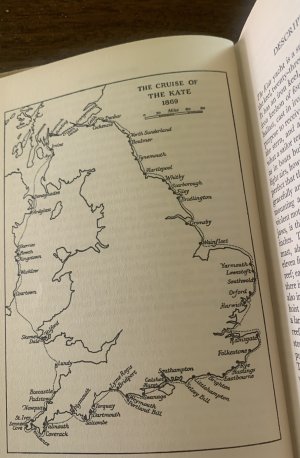 )
)
I don't think that's necessary. I've done it twice, tiller pilot both times. It's not crossing an ocean, it's 2k miles of coastal sailing. If a tiller pilot goes wrong then at the next harbour you order a new one & get DHL to deliver it the next day.If it was me I'd want well run-in wind vane self-steering for a trip like that.
Agree. And in practice for most people doing a “round Britain” it seems to turn into a delivery trip to maintain the schedule, so huge mileage under engine rather than sail. Hence for a solo trip a really good electronic autopilot is near essential (and vane steering gear not good for motoring, plus another hazard for mooring up in strange harbours)I don't think that's necessary. I've done it twice, tiller pilot both times. It's not crossing an ocean, it's 2k miles of coastal sailing. If a tiller pilot goes wrong then at the next harbour you order a new one & get DHL to deliver it the next day.

How often did you adjust the autopilot settings ? On mine it is the Response level and I adjust down to 3 for most sailing and motoring, which avoids any “almost constant auto course corrections”, but adjust to 4 or 5 if going fast downwind in waves.Yes I know you can get by with an autopilot and many people do but personally I do not like the constant whiring noise they make with their almost constant auto course corrections and of course the drain on the batteries they make . Yes ok a windvane self steering is no good when you are motoring so I reckon you need an autopilot as well.
LOTS of boats with south of England owners (and further afield) winter in Scotland, both afloat and on shore. Some to extend a cruise round the British coast, some kept longer term. Lots of options, with the Clyde and around Oban area the most popular.Related question - how hard is it to leave the boat in Scotland?
Really easy, you don't even have to wave goodbye.Related question - how hard is it to leave the boat in Scotland?
