Wiring advice, please

Not sure what the "current "thinking is, but I put my VHF and Blige pump on a separate feed directly from the House battery (fused and switched). The blige pump is left on auto when I leave the boat. It's not effected by the Isolator switch. The VHF is emergency equipment and I want as simple a power route to it as possible in case everything else goes to pooh.
 
The 250 Amps to the Thruster will require very heavy cables. Take a look at the Physical Distance from the Domestic Battery to the Thruster. On my boat the 3 Kw Thruster is powered from a battery up at the bow. The heavy Supply cables to the Thruster are only a few feet in length. The battery is continuously charged from the alternator when running the engine , at much lower currents than the Thruster draws , thus the cabling charging the Thruster battery can be much lighter. Its important to size it correctly though. So you add a battery but greatly reduce the copper required. At 250A the losses in a long cable run will be high, another good reason the keep it as short as possible. Kinsale 373
 

Thanks for the link, Vic. I was worried, though, that it looked rather cheap and nasty, and couldn't believe even the Chinese could build and ship something of suitable quality and 300 amps for £10. Sure enough, I found this vid of someone dismantling an identical looking one he'd bought and which had quickly failed. I don't know what a pukka breaker looks like inside, but this one looks rather mickey mouse to me for handling 300A. A previous vid by the same chap shows him unwrapping it when he first got it. The terminals are just 6mm, which seems small to me for 300A.

I have subsequently found this one from Photonic Universe, which, unlike the one above, is advertised with detailed specs including dimensions. ratings, and a couple of graphs showing performance, etc. Though similar to the one you linked to, it does look a bit more nicely detailed, and has 10mm terminals.
12V solar panels charging kits for caravans, motorhomes, boats, yachts, marine
 
The 250 Amps to the Thruster will require very heavy cables. Take a look at the Physical Distance from the Domestic Battery to the Thruster. On my boat the 3 Kw Thruster is powered from a battery up at the bow. The heavy Supply cables to the Thruster are only a few feet in length. The battery is continuously charged from the alternator when running the engine , at much lower currents than the Thruster draws , thus the cabling charging the Thruster battery can be much lighter. Its important to size it correctly though. So you add a battery but greatly reduce the copper required. At 250A the losses in a long cable run will be high, another good reason the keep it as short as possible. Kinsale 373

Thanks, Kinsale. I am aware of the option of having a battery at the bow, but consciously decided to go down the heavy cables route (though I'm open to persuasion!).

One factor is simplicity. If I had a bow battery as you are suggesting then I would also need some arrangement - diodes, relays, separate charger or whatever - to provide charging to the bow battery without allowing the thruster to draw current from the engine or domestic batteries which would exceed the capacity of the lightweight charging cables to the bow.

The main thing, though, is that it's quite a small boat - just over 27ft. I don't want to lose any more of the limited storage space in the bow: I'm already losing the largest forecabin locker to the thruster. The remaining two under berth lockers are an awkward shape and would not easily accommodate a normal sized battery. The cables can be run without losing any significant locker space. The distance for the cables is not great - under 5m from 'aft' battery to thruster (<10m total cable run). The cost of the heavy cables is significant, but probably not very different from that for an additional battery, platform and fixings for it, 'separated' charging system, charging cables, etc.

Thanks for your input, though.
 
27ft boat. Do you even need a Thruster?
An extra pair of fenders and a little more time would to me be a more elegant solution.

Nobody 'needs' a thruster (or even a boat!).

I'm not sure how much length has to do with it: much longer fin keelers are generally easier to manoeuvre than my long-keeler, and smaller boats are more often assigned to awkward tight spaces in marinas, etc.

Having managed various long-keelers, including this one, without a thruster for years, I agree I don't 'need' it. I will probably not use it a great deal, but I am hoping it will make tight spaces manoeuvring, especially in high winds and single-handed, less nerve-wracking, and compensate to a degree for my declining agility.

If that is inelegant, then so be it.
 
Nobody 'needs' a thruster (or even a boat!).

I'm not sure how much length has to do with it: much longer fin keelers are generally easier to manoeuvre than my long-keeler, and smaller boats are more often assigned to awkward tight spaces in marinas, etc.

Having managed various long-keelers, including this one, without a thruster for years, I agree I don't 'need' it. I will probably not use it a great deal, but I am hoping it will make tight spaces manoeuvring, especially in high winds and single-handed, less nerve-wracking, and compensate to a degree for my declining agility.

If that is inelegant, then so be it.
Didn't mean to cause offence. As a twister owner I'm well aware of the struggle and I'm sure I would be envious watching you nudge the bow left and right while I fended off. Just seems like a great deal of effort and expense to my mind.
Trolling motor and a couple of long lines back to the cockpit is probably what I would do when it all gets too much. Leaves the boat essentially unmodified too. but good luck with the project. On the electrical side i would go with long cables rather than adding another battery. If there is space maybe upgrade the current house battery If you feel the need.
 
VSRs are normally connected directly to the battery +ve terminals so that they continue to control the charging from a battery charger, solar etc with the isolator switches both off. If you will be adding other charging sources this is how the VSR is best wired .... then a disabling switch becomes relevant. As you have drawn it it would be irrelevant.
Don't use fuses for Thruster or windlass, these should be thermal breakers.
You might want to add a fuse where the domestic loads connect to the fat cable around the VSR?
Also perhaps a fuse in series with the VSR?

Likewise, I'd add a fuse and breaker for an 'always on' branch, for e.g. Navtex, alarms, bilge pumps if you must,....?
There certainly should be a fuse in series with the VSR... equal to the max current rating of the VSR
(some makers recommend two, one close to each battery connection,in order to protect the wiring as well as the VSR)

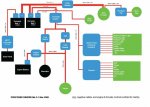
OK, any further comments on the revised schematic attached below, which takes on board various suggestions/comments (for which thanks again), including -

1) I have now found a suitable breaker for the thruster, and show this in the diagram;
2) Breaker also added in series with VSR (in case, e.g., thruster draws big amps from engine battery, as well as domestic);
3) Solar power supply (to be added later in practice) added to diagram, fused both ends;
4) 'Always on' circuit (fused) added - shown here as only bilge pump, but other items could be added later;
5) I dithered about putting engine and domestic isolators the 'other side' so that the solar power could charge engine battery via VSR, but seems to me that all this does is isolates the main loads, not the power supply, from most of the wiring (and hence risks) so I have reverted to the original. I wouldn't normally need engine battery topping up by solar, but if engine battery was flat I could just use the fully charged domestic batteries via the link switch.
6) Cable sizes added. Note (a) the 35mm is a guess, and (b) lengths only shown where over 1m.
7) Note the domestic batteries have double terminals. I intend to fit both batteries with a big fuse (is 200A enough?) for general and thruster/windlass wiring on the big terminal of each, and a small fuse (5A? for 'always on' bilge pump, 20A for solar supply) on the small terminals.
8) Not sure whether engine battery should have a fuse, or if so how big? (Starter is rated as 1kW, which IIRC is only 83A).
9) There is a risk of the boat sinking under the weight of all the fuses, breakers and switches!

Comments/suggestions welcome!


Sula Proposed Wiring Diagram Mk 3 Mar 2020.jpg
 
Last edited:
Top