Wiring advice for a Southerly 115

My tuppence worth. Newer versions of 1/2/B/Off now have 4 terminals. Legacy switches have 3 terminals. These newer switches also act as the domestic supply on/off switch. In the first position the house supply is switched on. The next position turns on the engine battery. So now domestic and engine are live. 3rd position is both paralleled together
 
Last edited:
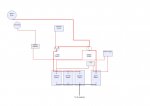
Assuming the Op has a split charge diode and it's wired as per his first sketch, the diagram below allows a reasonable solution without the need to buy and new equipment, save maybe the odd cable, which should be easy to get.

This is not my favourite method, i prefer three separate switches, but this gives the OP a vastly better system than he has, taking into account his situation.

The engine switch is already in situ and wired correctly, leave it alone.

The 1-2-B switch is there, but not sure how it's wired, it looks messy as it is. In my diagram the batteries are connected to the common terminal and the domestic circuits to the 1 terminal, with a battery sized cable going from the 2 terminal to the load terminal on the engine isolator.

In normal use turn the engine switch on and the 1-2-B switch to the 1 position. This gives two separate circuits and the diode charges all batteries.

Emergency engine starting is possible by switching the 1-2-B to Both.

Failed engine battery, turn the engine isolator off and set the 1-2-B to both.

Failed domestic battery, spanners out and disconnect the domestic bank positive from the batteries and turn the 1-2-B to both.

Most negatives and windlass etc left off of the diagram for clarity (and less work for me :))

OP, note the way the domestic batteries are connected together.

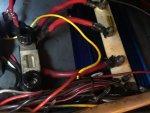
Thank you so much for this. Making things a lot clearer. As for the regulator / charge diode, see the images below:

20181015_113902.jpg
This is what it looks like from the front.

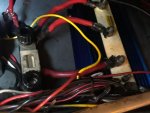
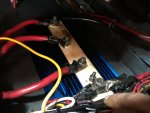
20181015_114010.jpg
This is what it looks like from the back, a big heat sink with four terminals and a little sticker saying SOLARA

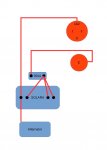
As for how it is wired, here is a diagram showing the current wiring:
SOLARA.jpg

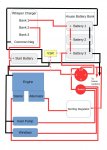
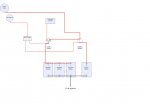
And here, after looking at PVB's diagram is a revised diagram for my proposed system I have included the VSR if I can find one, though I also have an old mobitronic charge controller which is currently directly connected to the batteries (not in the diagram as it just connects directly to the batteries.
Wiring_update_VSR.jpg

Thanks again for all the input and advice. I appreciate it is painful dealing with a novice with so many silly questions, I guess we all have to learn somehow.
 
My tuppence worth. Newer versions of 1/2/B/Off now have 4 terminals. Legacy switches have 3 terminals. These newer switches also act as the domestic supply on/off switch. In the first position the house supply is switched on. The next position turns on the engine battery. So now domestic and engine are live. 3rd position is both paralleled together

Surely that's not a 1/2/Both/Off switch at all, rather a pair of separate isolators controlled by one handle, plus an additional switch to link the two sides.

Pete
 
My tuppence worth. Newer versions of 1/2/B/Off now have 4 terminals. Legacy switches have 3 terminals. These newer switches also act as the domestic supply on/off switch. In the first position the house supply is switched on. The next position turns on the engine battery. So now domestic and engine are live. 3rd position is both paralleled together

Could you post a link to one of these switches please ?
 
Thank you so much for this. Making things a lot clearer. As for the regulator / charge diode, see the images below.

I've failed to make it any clearer :(


I'm afraid i can't make any sense of that.

And here, after looking at PVB's diagram is a revised diagram for my proposed system I have included the VSR if I can find one, though I also have an old mobitronic charge controller which is currently directly connected to the batteries (not in the diagram as it just connects directly to the batteries.
View attachment 73649

Thanks again for all the input and advice. I appreciate it is painful dealing with a novice with so many silly questions, I guess we all have to learn somehow.

I posted a diagram showing how to connect the batteries and switches together. It's a proper, working diagram that i did specifically for your installation. I'm at a loss as to why you would then propose the above ?

PVBs diagram is perfectly correct for the installation it was designed for, it's not suitable for you unless you follow it precisely.

As your Sterling regulator isn't what i expected, i've revised my schematic to reflect that and have included a VSR for split charging. I have again omitted the negative cables for clarity. I've also left the keel pump and windlass off of the drawing, these connect to the engine switch, as they presently do. The switching works as i previously described it.

Please note the way the batteries are connected.


Attachments

  • Charging Schematic  VSR and 1-2-B.jpg
    Charging Schematic VSR and 1-2-B.jpg
    67.8 KB · Views: 1
Last edited:
Thank you Paul, my system is now wired as in your diagram... I took a few more shots of the diode, see below, but there is no more naming on it. All I can tell is that it has 4 large terminals and one small one.
20181015_114010.jpg
20181017_162821.jpg
The 3 terminals on the right are all wired into the right terminal on the 300A fuse. The left terminal of the fuse then connects into the single isolator switch, which the starter battery connects to. The terminal on the left has two red cables connecting to it, one coming from the alternator and the other from the 1,2,both switch. If I could read German, page 31 on this document would probably shed some light as the previous owner was German and I think he probably followed this with the wiring of the Sterling, https://cdn.shopify.com/s/files/1/0658/7343/files/PDAR.pdf?484

So assuming it is a diode, I have now followed this diagram:
Charging Schematic  Diode and 1-2-B.jpg

Having followed Paul's diagram above I thought everything was solved... though there is something odd, at least to me it is odd. The engine start is always connected. Even if I disconnect the start battery and have the 1,2,both switch in 0/off position, if i turn the start battery isolator switch on, the ignition has power. I would have expected in the off position it to have no power given the start battery is disconnected. My understanding was:
1,2,both switched to 0 = nothing connected -- in the setup I have this would still allow me to start the engine using only the starter battery, by turning the starter isolator switch to on - this would only be done if the domestic bank was dead.
1,2,both switched to 1 = 1 and Common connected - in the setup I have this would be used when not running the engine, to use the domestic batteries to run the house systems. The starter battery would still be separate with no drain on it. Even if the starter isolator switch is on, it will still not connect to the domestic bank and systems as the 1,2,both switch would be acting as an isolator.
1,2,both switched to 2 = 2 and Common connected - in the setup I have this would be used to start the engine with the domestic bank. The starter isolator will remain off in this case. With the starter isolator turned on it would connect the domestic and the start battery to the starter, only to be used in case of emergency when both batteries are low.
1,2,both switched to both = 1 & 2 and Common connected - in the setup I have this would be used with the engine running to charge both batteries. The start isolator switch would remain off in this case.

I like this as the starter battery is always kept as a reserve.

Though it does not seem to work like that as I stated, even with the 1,2,both in the off position and the starter battery physically disconnected at the terminal, with the start isolator switched to on, the ignition still gets power, which means somehow it is getting it from the domestic bats. I wouldn't mind this if I was 100% sure the starter bat was properly isolated. More investigation is needed...

I have also read:
http://www.ybw.com/forums/showthread.php?509128-dual-battery-solar-charging-and-1-2-both-switch/ - Which I also have and seems to add another layer of complexity.
http://www.ybw.com/forums/showthread.php?401492-1-2-both-battery-switch-query and https://forums.sailboatowners.com/index.php?threads/1-both-2-off-switches-thoughts-musings.137615/- helping understand 1,2, both

Could it be the 1,2, both switch that is faulty? Or could it be the diode that is wired wrong?
 
Last edited:
That certainly does look like a diode and you chose the correct wiring schematic. The reason the engine is always live is that the diode is wired incorrectly. The cable from the 1-2-B switch is connected to the diode input and will therefore pass current to the output terminal, even with both switches in the off position.

Remove the fuse and the wires that go from the fuse to the diode. The fuse is not necessary and is vastly overrated for the cable anyway. I think the alternator terminal is on the correct stud, if you have a multimeter you can check it, you should have continuity between that stud and each of the other three studs, but no continuity between the other three studs, measuring between them as pairs. If you don't have a multimeter, about the best you can do is connect a bulb between each of the three studs in turn, it should light up on all three.

Remove the cable from the 1-2-B switch from the input terminal and connect it to one of the output terminals. Connect the wire from the engine isolator switch to one of the other output terminals. The third output terminal will be left unused, which is fine.
 
Regarding the switches ;

In normal use turn the engine switch on when you want to use the engine. Turn the 1-2-B switch to the 1 position if want the domestic circuits on. You can use one without the other or both at the same time This gives two separate circuits and the diode charges all batteries.

Switching the 1-2-B to Both is for emergency engine starting. Do not use it in normal use.

Failed engine battery, turn the engine isolator off and set the 1-2-B to both.

Position 2 on the 1-2-B switch is unused.

Think of the two switches as having different purposes. The engine isolator is for turning the engine battery on/off, nothing else and is the normal way of turning the battery on.

The 1-2-B switch is for turning the domestics on via the 1 terminal. It is not for routine engine starting. the Both setting is for emergency use, nothing else. Position 2 is redundant.
 
Regarding the switches ;

In normal use turn the engine switch on when you want to use the engine. Turn the 1-2-B switch to the 1 position if want the domestic circuits on. You can use one without the other or both at the same time This gives two separate circuits and the diode charges all batteries.

Switching the 1-2-B to Both is for emergency engine starting. Do not use it in normal use.

Failed engine battery, turn the engine isolator off and set the 1-2-B to both.

Position 2 on the 1-2-B switch is unused.

Think of the two switches as having different purposes. The engine isolator is for turning the engine battery on/off, nothing else and is the normal way of turning the battery on.

The 1-2-B switch is for turning the domestics on via the 1 terminal. It is not for routine engine starting. the Both setting is for emergency use, nothing else. Position 2 is redundant.

Thank you, thank you thank you Paul. I'd be only too happy if I could get it to work like this. I'd be happy to get it to work in any manner I've rewired the diode as you suggest and have tested everything. Though it doesn't quite work as intended if wired as the diagram.

When wired as per the diagram, With terminal 1 (left side) wired to domestic circuits, center to the domestic battery bank and diode and terminal 2 (right side) to the engine isolator switch:
With Engine Isolator OFF
When switched to 1, nothing. The domestics NOT connect. Ignition not connected
When switched to both. Domestics ARE connected and Ignition IS connected
When switched to 2. Domestics NOT connected and Ignition IS connected

With Engine Isolator ON
When switched to 1. The domestics ARE connect. Ignition IS connected
When switched to both. Domestics ARE connected and Ignition IS connected
When switched to 2. Domestics NOT connected and Ignition IS connected


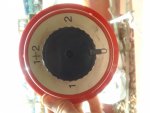
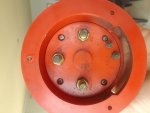
This has me thinking my 1,2,both switch is different or not functioning as intended. Which me being ignorant in such matters, I should have started this discussion with pictures of...
It would appear that it is of the plastimo type:
20181019_133308.jpg
20181019_133327.jpg
Which has a bat 1 connection on the right, a bat 2 connection on the top and a feeder connection on the left, with two field connectors which I believe are to act as an alternator isolation.

Does this mean that feed should act as common? I've tried this and the results are not as expected...

The closest I get to as intended is if I swap 1 and 2 terminals around. i.e.
With terminal 1 (left side) wired to engine isolator switch, center to the domestic battery bank and diode and terminal 2 (right side) to the domestic systems:
With Engine Isolator OFF
When switched to 1, nothing. The domestics NOT connect. Ignition not connected
When switched to both. Domestics ARE connected and Ignition IS connected
When switched to 2. Domestics ARE connected and Ignition NOT connected

With Engine Isolator ON
When switched to 1. The domestics ARE connect. Ignition IS connected
When switched to both. Domestics ARE connected and Ignition IS connected
When switched to 2. Domestics ARE connected and Ignition IS connected

One might ask well why not just use it like this. Well when I then run the engine with the domestics on, the depth meter will show abnormally high numbers, and irratic numbers like 100 to 50 when it should be 4, which (based on the fact that low numbers means it is getting to low a current) is an indication of an overly high current.

Once I finish banging my head on the chart table out of frustration, I might take apart the 1,2,both switch for further investigation. I seem to be regressing, I can't understand how something seemingly so simple has to be so complicated?
 
Last edited:
Thank you, thank you thank you Paul. I'd be only too happy if I could get it to work like this. I'd be happy to get it to work in any manner I've rewired the diode as you suggest and have tested everything. Though it doesn't quite work as intended if wired as the diagram.

When wired as per the diagram, With terminal 1 (left side) wired to domestic circuits, center to the domestic battery bank and diode and terminal 2 (right side) to the engine isolator switch:

That is wrong.

Feeder : Domestic bank and diode.
Batt 1 : Domestic circuits.
Batt 2 : Engine isolator (load terminal, not the battery connection.)
 
Top