Windlass Wiring - Checking for Safety.

SiteSurfer

Well-Known Member
Joined
18 Jun 2015
Messages
1,262
Visit site
Hi all again, back with another sanity check before installing.

I'm replacing the windlass wiring on a B32 2002 which has a South Pacific 900 Express installed which, due to age, has needed the wiring removed and new stuff put in by me.

My plan is thus:

Using the engine battery (rather than the house bank) install a Blue Sea 80A breaker with a direct to battery connection.
Situate the breaker close to the battery (within 2m) to nav station.
https://www.force4.co.uk/blue-sea-circuit-breakers.html

Using 16mm Cable from the battery, and then onwards to a winch solenoid (rated at 400 amps and suitable for use with windlass) situated in the bow area.
https://www.ebay.co.uk/itm/Marine-Tinned-16mm-Flexi-Battery-Cable-110-amps-All-Lengths-Red-or-Black/253142191377?hash=item3af0734d11:m:mmBbRxeTmwHahdrsEAUgbYQ

Using same 16mm tinned cable from solenoid to windlass.
Using twin core 21 amp cable for manual switch to solenoid.
I also have a 2.4Ghz remote control purchased, but this fits to the solenoid like the switch so thats not an issue.

My 3 questions are:
1) Cable size from battery -> thermal breaker -> solenoid -> winch - 16mm2 ok? Cable run approx 6 metres max.
2) Situation of solenoid, closer to breaker or winch (ie: which end of the circuit)?
3) Should I also fuse the battery connection and if so with what?

I will use a hydraulic press to make up the lugs and fittings.

For reference : here's where I established the concepts.

South Pacific data sheet for control systems: (wire size)
http://www.southpacific.com.tw/in_index/technical-support.html

Windlass Page (scroll to bottom) 900 Express
http://www.southpacific.com.tw/in_index/horizontal-windlasses.html
 
My 3 questions are:
1) Cable size from battery -> thermal breaker -> solenoid -> winch - 16mm2 ok? Cable run approx 6 metres max.

I would not fit 16mm cable. 25mm would be better.

2) Situation of solenoid, closer to breaker or winch (ie: which end of the circuit)?

Normally mounted at the windless end. If all cables (all the way to the motor) were suitably rated it wouldn't make much difference though.

3) Should I also fuse the battery connection and if so with what?

If there is a chance that the cable from the battery to to windlass could short, then it must be fused. If you fuse it, fit a fuse that is rated for the max rating for the cable. The fuse is only there to protect that short length of cable, so a high fuse rating will mean the breaker will trip if the windlass is overloaded, rather than the fuse. Note that the breaker is there to protect the wiring all the way to the windlass, but is also there to protect the windlass against overloading, so it is not unheard of for the breaker to trip without there being a fault, fit is somewhere sensibly accessible. If you ensure the cable cannot be chafed or shorted, no need for a fuse. Suitable conduit around the cable would suffice.

That said, i would not fit the windlass cable directly to the batteries. There should be an isolator switch. If the breaker is fitted in an easily reached location you could manually trip that, rather than fit a dedicated switch.
 
I fitted my breaker near the helm position, just inside the cockpit locker, if I trip the breaker because of overloading, I can remain at the helm and re-set it.
 
That said, i would not fit the windlass cable directly to the batteries. There should be an isolator switch. If the breaker is fitted in an easily reached location you could manually trip that, rather than fit a dedicated switch.

Thanks Paul, most appreciated and taken on board.

With regard to the breaker, I wanted to use that particular one as our practice is to have it switched off at all times, except when about to use the windlass - so we treat it like a master switch in that sense. I would imagine that this is what you meant above?

I think you are suggesting that it would be a safe and sensible thing to place an inline fuse on the battery terminal prior to the breaker/switch and have a fuse rated somewhere in the 170A area for the 25mm cable.

https://www.12voltplanet.co.uk/midi-link-fuses.html + a nice holder for it seems a good idea allthough that leaves me with a small stub on the battery. I'm a bit concerned about displacing the leads to the engine hence looking for something I can bolt on :)

The solenoid can be located inside the anchor locker in a semi sealed box made for the purpose and all the cables run neatly to that box.

Many thanks for the steer.
 
The solenoid can be located inside the anchor locker in a semi sealed box made for the purpose and all the cables run neatly to that box.

Many thanks for the steer.

For what it’s worth, I’d put the solenoid at the battery end rather than in the anchor locker in a semi sealed box. I’ve had to deal with corroded terminals on one too many solenoids in a similar location. The wireless remote will work nicely wherever you locate it and the additional control wire run will not be costly or add much in terms of difficulty when you also install the main cable run. Alternatively, look to install it in the fore cabin rather than the locker itself.
 
I've just located a very neat IP67 box and a bunch of glands, the very reason for doing this was as a result of having to angle grind corroded wires this weekend.. However - fore cabin is a winner.
 
I've just located a very neat IP67 box and a bunch of glands, the very reason for doing this was as a result of having to angle grind corroded wires this weekend.. However - fore cabin is a winner.

As your windlass is a 2-wire model (rather than a 3-wire), there's effectively no difference in the amount of cable needed wherever you fit the solenoid. So putting it somewhere dry and protected should be a priority.
 
Thanks Paul, most appreciated and taken on board.

With regard to the breaker, I wanted to use that particular one as our practice is to have it switched off at all times, except when about to use the windlass - so we treat it like a master switch in that sense. I would imagine that this is what you meant above?

Yes, exactly that. If you can use the breaker as an isolator, that's fine.

I think you are suggesting that it would be a safe and sensible thing to place an inline fuse on the battery terminal prior to the breaker/switch and have a fuse rated somewhere in the 170A area for the 25mm cable.

I'm saying you must protect the length of cable from the battery to the breaker, from anything that could lead to a short. This can be done by enclosing the cable in ducting, or by fitting a fuse. A fuse of 170a would ensure the breaker always trips rather than blowing the fuse (unless the fault is a shorted cable from the battery to the breaker).

+ a nice holder for it seems a good idea allthough that leaves me with a small stub on the battery. I'm a bit concerned about displacing the leads to the engine hence looking for something I can bolt on :)

The midi fuses are to small, the holders take max 16mm cable and the retaining bolts are only 5mm. Use the maxi fuses, these can take 25mm cable and use 8mm bolts. If your battery has studs and a post, perhaps a cube fuse could be used ? https://www.12voltplanet.co.uk/battery-terminal-cube-fuses-50-300a.html
 
If 25mm2 cable between the battery and winch circuit breaker is overloaded, it would start to get very hot before a 170A maxi fuse blows!

It's not going to get overloaded by the winch, so the only other likely possibility is a short circuit, in which case the maxi fuse would blow instantly!
 
If 25mm2 cable between the battery and winch circuit breaker is overloaded, it would start to get very hot before a 170A maxi fuse blows!

I didn't suggest a maxi fuse, they are only available to 100a. I suggested a mega fuse, available to 500a, completely different beast to a maxi blade fuse.

Overloaded by what, how ?

FYI i am fully aware of the cable rating and the fuse ratings.
 
Last edited:
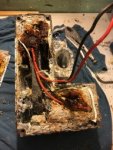
I brought the windlass home to clean it up and to replace the dodgy looking wires coming out of the bottom, it had corroded a bit but I didn't really worry too much, what I really wanted to do was to run 12V through it to make sure it was working and clean it up a bit.

Did I mention that the terminals on the actuator switch were corroded and all the wiring stiff as anything? The plyboard base had rotted away and fell apart in my hands...

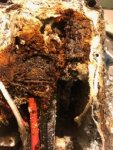
What I didn't expect was this:

IMG_4839.jpgIMG_4840.jpg

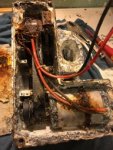
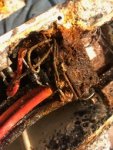
Full of salt and muck, some hoovering shows the full extent of the damage:

IMG_4842.jpgIMG_4843.jpg

Looks like I'm about to purchase a new windlass, I like the Lewmar 1000 series - ouch though..
 
It's not going to get overloaded by the winch, so the only other likely possibility is a short circuit, in which case the maxi fuse would blow instantly!

It may not get overloaded immediately but say in the future, someone innocently uses it as a sub branch to feed additional 12v circuits forwards, it could end up overloading the 25mm cable. The fuse won’t blow until it sees around DOUBLE the stamped value. The number on the maxi and mega fuses among others are the running rating... not the blow rating.

Also in the event of a partial short circuit, i.e a partially severed cable or torn insulation, you could draw enough to burn the cables but not actually set the fuse off.

As mentioned in this thread, the large fuse is protecting the cable but correct design specification will mean that the cable is protected under all circumstances. Putting a fuse with a running current of 170A on a 25mm2 cable (170A battery cable or 136A tri rated) would mean the cable is not correctly protected as the fuse will happily pass approx 340A before popping.
 
I brought the windlass home to clean it up and to replace the dodgy looking wires coming out of the bottom, it had corroded a bit but I didn't really worry too much, what I really wanted to do was to run 12V through it to make sure it was working and clean it up a bit.

Did I mention that the terminals on the actuator switch were corroded and all the wiring stiff as anything? The plyboard base had rotted away and fell apart in my hands...

What I didn't expect was this:

View attachment 73396View attachment 73397

Full of salt and muck, some hoovering shows the full extent of the damage:

View attachment 73398View attachment 73399

Looks like I'm about to purchase a new windlass, I like the Lewmar 1000 series - ouch though..

That is politely poo pooed!! :disgust:

There is a hydraulic winch in our workshop that filled up with water over the years and looks similar inside the gearbox!
 
It may not get overloaded immediately but say in the future, someone innocently uses it as a sub branch to feed additional 12v circuits forwards, it could end up overloading the 25mm cable. The fuse won’t blow until it sees around DOUBLE the stamped value. The number on the maxi and mega fuses among others are the running rating... not the blow rating.

Also in the event of a partial short circuit, i.e a partially severed cable or torn insulation, you could draw enough to burn the cables but not actually set the fuse off.

As mentioned in this thread, the large fuse is protecting the cable but correct design specification will mean that the cable is protected under all circumstances. Putting a fuse with a running current of 170A on a 25mm2 cable (170A battery cable or 136A tri rated) would mean the cable is not correctly protected as the fuse will happily pass approx 340A before popping.

Well, nobody can predict what idiotic things someone might do at some point in the future; we don't design circuits for that.

You talk of a "partial short circuit", isn't that a bit like being "a little bit pregnant"? If there's a short, it's a short.

For many years, I've used MegaFuses, which I reckon are good quality. Once, I foolishly replaced the wires wrongly on my alternator. When I turned the battery switch on, there was a "pffft" sound and the 250A MegaFuse protecting the battery circuit had blown, instantly. A 170A fuse will protect a 25mm2 cable adequately in the event of a short circuit.
 
Well, nobody can predict what idiotic things someone might do at some point in the future; we don't design circuits for that.

You talk of a "partial short circuit", isn't that a bit like being "a little bit pregnant"? If there's a short, it's a short.

For many years, I've used MegaFuses, which I reckon are good quality. Once, I foolishly replaced the wires wrongly on my alternator. When I turned the battery switch on, there was a "pffft" sound and the 250A MegaFuse protecting the battery circuit had blown, instantly. A 170A fuse will protect a 25mm2 cable adequately in the event of a short circuit.


It went pfffft because it was a dead short and an "unlimited" current (for an easy example) would have tried to flow. Make a partial short circuit to negative and there could be a good amount of current flow to warm the cable but not enough to pop the fuse. Ordinarily the installed circuit would be fairly low resistance, should that resistance increase through cable degradation for example or due to a loose terminal on the windlass circuit breaker, it could lead to an over current situation because of increased resistance.


Correct fuse rating is covered on the BMET electrical course.

Look at a Max Power bow thruster, as I installed this morning. Quoted current draw... 330A at 12v. Fuse specified 160A. Cable used 95mm2 on an 8 meter run there and 8 meter run back.
 
Look at a Max Power bow thruster, as I installed this morning. Quoted current draw... 330A at 12v. Fuse specified 160A. Cable used 95mm2 on an 8 meter run there and 8 meter run back.

Presumably that was a CT60. Interesting that you only used 95mm2 cable when the installation manual specifies 120mm2.
 
As the fuse was a good meter from the protected positive bus bar by the time it had gone though a fuse holder, isolator, etc this is fine as the total round trip did not warrant the upgrade. You guessed correctly, was it you visiting today? I must credit your Google skills :encouragement:

Presumably that was a CT60. Interesting that you only used 95mm2 cable when the installation manual specifies 120mm2.
 
Correct fuse rating is covered on the BMET electrical course.

What does an industrial course have to do with marine electrics ?

Nothing. !

Look at a Max Power bow thruster, as I installed this morning. Quoted current draw... 330A at 12v. Fuse specified 160A. Cable used 95mm2 on an 8 meter run there and 8 meter run back.

The fuse ratings for the bow thruster are for over current protection, not cable protection. The OP has already covered that with his thermal breaker, all he's doing with the additional fuse is protecting the short length of cable from the breaker to the battery.

Forget about your BMET nonsense, which relates to industrial electrics, the standards for marine installations, which become regulations for new build leisure vessels allow battery cables to be unfused, so a 170a fuse here is perfectly acceptable. Besides, if you read up on your mega fuse ratings, they won't sustain double the amps (which you quoted) for more than seconds without blowing.

Talk of hanging additional equipment off of the cables is utterly ridiculous. You don't design systems to protect against someone coming along later and wiring things up to inappropriate circuits. What about the owner that decides to wire the 12v cig lighter socket directly to the batteries, using speaker wire, without fitting a fuse ?

Just trying to get my head around a "partial short circuit", is that a BMET thing ?
 
Top