
Windlass Cutting out !!

From memory our windlass, Maxwell, recommends an annual service. Primarily cleaning, oiling (check gearbox - accessed through a sight glass) and greasing shaft. I don't recall any special mention of the electric motor. The electric motor is housed in a mild steel case, prone to corrosion, the casing merits as much protection as you can possibly apply - mild steel and seawater are a bad mix :(

An important omission, mentioned also by others, when you take the windlass apart - commonly necessary to conduct the service then ensure you isolate with Duralac or similar any possibility of future corrosion by coating the stainless bolts and studs that might fit into an aluminium casting.

All of this is easy, on a nice warm summers day - but as oldgit mentions in Post No 17 windlass are installed without any consideration for servicing, the location for the windlass is usually cramped and you need much patience and ingenuity to extract the device to conduct the very simple and menial tasks needed to service.

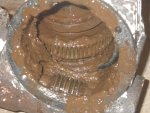
Windlass are amazingly forgiving. This is one I helped remove - with an angle grinder. It was still working prior to cutting it out but it appeared to be lubricated with seawater, mud, various abraded components and some iron oxide. I don't know how much longer it would have lasted.

IMGP4771.jpeg

Jonathan
 
From memory our windlass, Maxwell, recommends an annual service. Primarily cleaning, oiling (check gearbox - accessed through a sight glass) and greasing shaft. I don't recall any special mention of the electric motor. The electric motor is housed in a mild steel case, prone to corrosion, the casing merits as much protection as you can possibly apply - mild steel and seawater are a bad mix :(

An important omission, mentioned also by others, when you take the windlass apart - commonly necessary to conduct the service then ensure you isolate with Duralac or similar any possibility of future corrosion by coating the stainless bolts and studs that might fit into an aluminium casting.

All of this is easy, on a nice warm summers day - but as oldgit mentions in Post No 17 windlass are installed without any consideration for servicing, the location for the windlass is usually cramped and you need much patience and ingenuity to extract the device to conduct the very simple and menial tasks needed to service.

Windlass are amazingly forgiving. This is one I helped remove - with an angle grinder. It was still working prior to cutting it out but it appeared to be lubricated with seawater, mud, various abraded components and some iron oxide. I don't know how much longer it would have lasted.


View attachment 130210

Jonathan

mine didn't look far from that tbh when I removed it, restored it at the cost of around 20euro and it's working fine for 6seasons now! They are indeed v.hard and simple devices.

V.
 
mine didn't look far from that tbh when I removed it, restored it at the cost of around 20euro and it's working fine for 6seasons now! They are indeed v.hard and simple devices.

V.

The problem with the one in the picture was that when it was installed no Duralac was used. It was 25 years old and the owner had never serviced it (and neither had the previous own by the look of it). The stainless bolts had fused to the aluminium casting and the only way to actually remove it was to cut it up in situ. From memory it necessitated cutting out the 4 bolts that held it to the yacht itself.

The part at the top of image contains the ball bearings, you can see them just protruding to right of centre, and even they were badly pitted. The motor still worked (as did the windlass).

They are simple but will withstand abuse - but I'd not suggest ignoring them - servicing is really not difficult.

If you have a new yacht I'd strongly recommend taking the windlass out as soon as possible - simply to ensure the stainless bolts have a Duralac (or equivalent) coating. I find it odd that Duralac is not mentioned in the installation instructions. Its the perfect environment for corrosion.

I get involved in a number of windlass removals and corrosion of the bolts to an aluminium casting is the primary problem.

I spoke with Maxwell and primary failures are not greasing the shaft, not replacing the oil in the gearbox and power cables coming loose. The devices suffer a lot of vibration and tightening the power cables is a common quick fix.

Jonathan
 
yep, my Lofrans Tigres issues were mainly caused by the ss stripper bolted with ss bolts into the aluminum casing.
Electrolysis ended up creating a hole to the g/b behind and all the oil slowly leaking out.
Filled it, rebuilt it, initially didn't have duralac, so put it back together and was doing undoing the stripper bolts annually, eventually managed to get hold of duralac, now it's fine.
Need to now install the freshwash for the bow deck so that I can wash it off salty water regularly.
 
Not finding fault here but the manual for my windlass suggests maintenance of certain parts every 3 months and every year that the motor should be serviced by a qualified technician (they would say that wouldn't they - substitute competent person/skipper/owner). I wonder how many people do that ? I don't although I do try!! It is regular maintenance that keeps things going - don't fit and forget.


Eyes on stalks , articulated arms and a desire to have back pain for a day or two helps along with Elastoplast .
The urge to fix is in direct relation as to how may times you have manually hauled a muddy anchor and 20 metres of chain aboard ?
 
Last edited:
The most important aspect is to keep salt water away from the windlass. Often salt water from the chain can drip over the windlass. Install a pipe or deflection plate that ensures no salt water can drip on the motor or gearbox.

It is also helpful to coat the motor and/or the gearbox with a corrosion resistant product.

Denso tape or wax products such as CRC Longlife are common choices.

However, the problems reported in this thread are more likely to be electrical rather than mechanical. I think the first step is to evaluate the electrical supply. This is easy to check with a simple multimeter. If the electrical system passes these checks the next step is start the more difficult steps to evaluate the potential mechanical problems.
 
The most important aspect is to keep salt water away from the windlass. Often salt water from the chain can drip over the windlass. Install a pipe or deflection plate that ensures no salt water can drip on the motor or gearbox.

It is also helpful to coat the motor and/or the gearbox with a corrosion resistant product.

Denso tape or wax products such as CRC Longlife are common choices.

However, the problems reported in this thread are more likely to be electrical rather than mechanical. I think the first step is to evaluate the electrical supply. This is easy to check with a simple multimeter. If the electrical system passes these checks the next step is start the more difficult steps to evaluate the potential mechanical problems.
I'm still laughing at the idea of keeping salt water away from a windlass. It's mounted up on the exposed bow of a boat. I can only assume that you mean keeping water away from the motor of a vertical shaft windlass, where the motor is under the deck. I have a conventional electric horizontal shaft windlass, a Lowrance Tigres, which is frequently washed by the sea when sailing, and frequently washed with the (salt) deckwash hose, when lifting the anchor. Have I been doing it wrong for all these years? ?
 
I can only assume that you mean keeping water away from the motor of a vertical shaft windlass, where the motor is under the deck.

Yes, keeping salt water away from the windlass motor and gearbox is more important for a vertical windlass. Often with this type of windlass the salt water brought in with the chain is free to drip or spray on the motor/gearbox. A pipe or deflection plate will eliminate this problem. This is worth installing.

Protecting the windlass motor/gearbox with products such as Denso tape or one of the wax sealants is equally valuable for vertical or horizontal windlasses.

However, I think the intermittent problem reported by the OP is more likely to be an electrical rather than a mechanical/corrosion issue on the motor/gearbox. I would focus my initial troubleshooting on the potential electrical problems.
 
Last edited:
Top