Wind Generation vs solar panels

Obviously everyone's circumstances are unique, and what works for some might not work for others. If you're marina hopping, and plugging in to shore facilities, power generation isn't a problem for you. If like us, who tend to be away for periods of up to six weeks at a time, with no shore power, it's a different story.
We sail in the NW Highlands and Islands of Scotland, at a latitude of roughly 59°. Yes, it can be windy, and we've tried wind generators, and our experience has been firmly negative. We had various issues, from burnt out voltage regulators, brush gear unable to take the generated current, noise being transmitted down the mast, into our sleeping cabin, to name some. Our experience of wind generators culminated in an occasion when the whole thing disintegrated in a severe gale, causing some damage to the boat, but thankfully no personal injury.
We have moved over to solar panels, and they have been wonderful. We started with a single rigid panel of 100 watts, and soon added another two of 40 watts. For next year we'll have another pair of 50 watt panels, which will be slung over the mizzen boom, when at anchor. PV panels, provided that you can find space for them, are wonderful. Simple to install, no moving parts, unobtrusive, and relatively as cheap as chips. (We have them mounted on the roof of the deck saloon, and having in-mast furling, we don't need to dance about on the roof to reef 😀).
We score from our sailing locality. In mid summer, sunrise is before 0500, and sunset is after 2200, so at least potentially there are lots of useful generating hours. Apparently PV panels work better at lower temperatures, so we also have an advantage there.
We don't have freezers, washing machines, water makers, to consume lots of power. We do have a fridge, and indeed it's our biggest user of power. Between the solar panels, and whatever the alternator produces if we're motoring, and with a 500 amp/hour battery bank, we manage very well.

Its interesting that you are living off the output of solar panels offering 280 watts and cannot easily fit more. I suspect your situation is 'more' normal.

Jonathan
 
Its interesting that you are living off the output of solar panels offering 280 watts and cannot easily fit more. I suspect your situation is 'more' normal.

Jonathan
Sorry, but I don't understand what you mean by "more" normal.
I'm sure that I could, if necessary fit more panels. I did contemplate having two 100w panels hinged on the guardrails, but so far, haven't done anything about it. If I found that I needed more power, I would find a way of doing it, but it wouldn't involve a wind generator. 😀
 
Our view, from sunny Australia, was that if you want to have energy 365 you cannot rely on solar alone. You simply cannot have a large enough solar display and battery bank - even on a 38' cat - to be self sufficient, live in the 21st Century and cater for 3 or 4 days of overcast skies.
To which Noelex replied.

"That has not been my experience."

The reality for sunny Sydney is:

The forecast for the next week is rain every day for the next week, excepting next Wednesday. If you have 500 watts of solar you are not likely to harvest very much. 3 or 4 days of cloud is one thing - a week is a lot.

I stand by my original statement - you cannot rely on solar - even in sunny Australia.

The rain is welcome - its been dry the last month, if you rely on harvesting rainwater you would have another disappointment (and/or need monster rainwater tanks - more weight)
Sorry, but I don't understand what you mean by "more" normal.
I'm sure that I could, if necessary fit more panels. I did contemplate having two 100w panels hinged on the guardrails, but so far, haven't done anything about it. If I found that I needed more power, I would find a way of doing it, but it wouldn't involve a wind generator. 😀

Sorry but you said:

'provided that you can find space for them'

and I assumed you could not easily fit more. No negativity intended.

Jonathan
 
A boat that consumes 200Ahrs a day @12v would replace all this energy with around a one hour run time of an alternator outputting 2.5kW. This would cost £2 extra in fuel per day on your figures.

Only on paper. There is zero chance of being able to do that in the real World with a lead acid bank. If you have to install a Lithium bank to be able to even come close, the cost rises significantly.
Not as cheap as the low or, non existent running costs of solar, but the costs are not unreasonable if you do not want, or cannot install any solar. This system especially suits those that would be running their engine for this period anyway to provide propulsion.

Once the battery is full, the alternator output will drop and there will be no (or a negligible) effect on fuel consumption. The extra fuel cost is only when generating the high electrical output.
You would need to run the engine for hours to fully charge a lead acid bank and this thread is not about adding a lithium installation. Real World figures posted by Bergie clearly show this.
 
Last edited:
....

You would need to run the engine four hours to fully charge a lead acid bank and this thread is not about adding a lithium installation. Real World figures posted by Bergie clearly show this.
If you add the constraint of not being willing to discuss modern batteries, it does shut down the discussion a fair amount.

People seem to have opposing views about the usefulness of wind generators, based on different use cases.
Personally, I'm not seeing any benefit in wind generation in the context of wanting to use my boat more in the Autumn when solar falls short. If I wanted to chuck a couple of hundred pounds at the problem, it looks like some lifepo4 batteries and some DC/DC charging would be the best VFM.
 
If you add the constraint of not being willing to discuss modern batteries, it does shut down the discussion a fair amount.
Not a case of that. The thread is primarily about wind v solar. Alternator charging has been introduced, probably rightly so, but the figures of alternator output don't bear any relationship to the real World. You simply cannot stuff 200ah of power into a bank of lead acid batteries in an hour, no matter how high the alternator output is rated at.
People seem to have opposing views about the usefulness of wind generators, based on different use cases.
Personally, I'm not seeing any benefit in wind generation in the context of wanting to use my boat more in the Autumn when solar falls short. If I wanted to chuck a couple of hundred pounds at the problem, it looks like some lifepo4 batteries and some DC/DC charging would be the best VFM.
You still need to consider how you will get the charge back into the batteries.

You've previously said you only use 24ah in 24 hours. With a 100ah battery you have 2 days of usable power, with zero charging. Add a second battery and you have 4 days with zero charging and your charge acceptance is doubled so they charge twice as fast. A solar panel will extend that time and will charge the batteries when the boat is on the mooring and you are at home.

You can, of course, add a lithium bank and a B2B (this was discussed at length in your other threads). The cost of this will be relatively significant. You will then be limited by the output of the B2B, a 30a one will take at least an hour of engine running to replace your 24ah.
 
Last edited:
You can, of course, add a lithium bank and a B2B (this was discussed at length in your other threads). The cost of this will be relatively significant. You will then be limited by the output of the B2B, a 30a one will take at least an hour of engine running to replace your 24ah.

Instead of a B2B charger, you could of course get a LiFePO4 capable alternator and controller and charge them fast, but that’s quite expensive setup already.

Lithium batteries bring their own problems to the wind generator (or hydrogenerator) setup as well. I think Superwind is the only one where a BMS charge cut-off won’t fry the controller (as the Superwind controller is powered by the wind generator, not the battery). You can either be very proactive in shutting down wind charging when batteries are near full, or go the ”alternator-style” route of charging your starter battery with the wind gen and then B2B. But then you’re again losing a lot of potential…

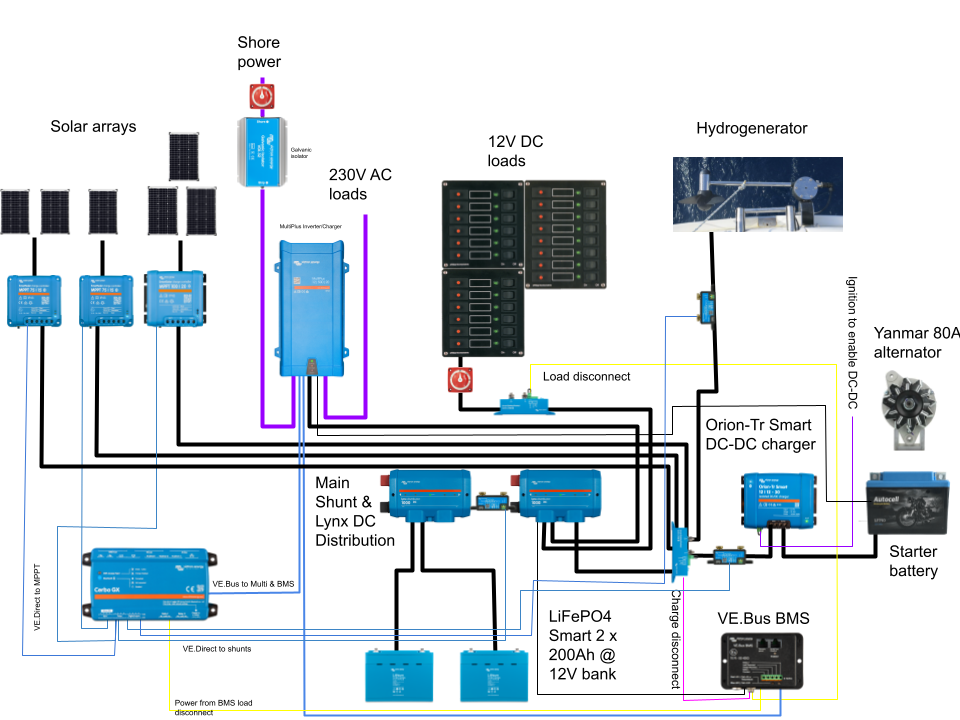
For clarity, here is how our system is set up:
electrical-diagram.png
 
Only on paper. There is zero chance of being able to do that in the real World with a lead acid bank. If you have to install a Lithium bank to be able to even come close, the cost rises significantly.
I think we are are in agreement that if engine charging via a high output alternator is a primary means of charging, a lithium battery bank is the sensible choice. There is no reason why Bergie cannot do this (I suspect he switch to lithium in the future anyway). I also agree that no matter how this is done it is an expensive option, especially if you have a 12v house system. High output 12v alternators are expensive, as are the various kits to implement a dual alternator set up. The required battery bank will also be expensive (a smaller lithium bank will be better and probably cheaper these days than a large lead acid bank).

If you want to consistently use significant energy from a high output alternator then lead acid is not a sensible choice, but it is not accurate to say that with lead acid there is zero chance of being able to do this if for some strange reason you wanted to implement this rather than changing to lithium. I know because we can do this in practice. This is less than 90A into our 24v battery bank and our 600Ahr lead acid battery bank will accept more than this for at least an hour at a lower SOC.

Not many boats have an alternator that can consistently deliver 2.5kW or a suitable battery bank (preferably lithium or at least a large lead acid bank) so they will need a significant and expensive upgrade, but most boats can fit such system if they desire. Some cruising boats are using this as a primary means of battery charging. It is not my preferred option, but it is possible and can work well.
 
Last edited:
,
I think we are are in agreement that if engine charging via a high output alternator is a primary means of charging, a lithium battery bank is the sensible choice. There is no reason why Bergie cannot do this. I also agree that no matter how this is done it is an expensive option, especially if you have a 12v house system.
Oh sure, I absolutely could. The battery manufacturer says (for each battery in the parallel bank) that maximum charge current is 400A, and recommended <100A. So I could go up to 2.5kW and be quite safe.

This would require major re-engineering of the engine compartment, and getting a fancy big alternator that is compatible with our Victron gear.
There is no way we could fit a genset on this boat, so if we had any inclination towards burning dead dinos for electricity, it would probably be the right way forward.

However, I see having a diesel auxiliary on board a temporary situation at best. Whenever this (still somewhat low hours) Yanmar is done, it’ll be replaced with electric propulsion. So no sense to build our electrical setup on the basis of a diesel engine.
 
If you want to consistently use significant energy from a high output alternator then lead acid is not a sensible choice, but it is not accurate to say that with lead acid there is zero chance of being able to do this if for some strange reason you wanted to implement this rather than changing to lithium. I know because we can do this in practice. This is less than 90A into our 24v battery bank and our 600Ahr lead acid battery bank will accept more than this for at least an hour at a lower SOC.
If you can get 200ah into a 12v LA battery bank in an hour the bank is either very, very large or very depleted. No way can you put 200ah in and have the batteries fully charged, which would be the aim.
 
Last edited:
I had a 200a alternator on my previous car which was water cooled. The car had a12v heating element for the cooling system aiding cold start. You really knew when that was on by the tone and loading on the 150hp engine ! Not sure how a smaller boat engine would cope with that sized alternator.

Currently my wind turbine is completely putting the solar to shame ;)
 
Following with interest. A quick question on LiPOFe battery banks and non alternator charging:

If you are sailing on the perfect day, plenty of wind so sailing and getting maximum benefit from hydro generation and the solar panels soaking up photons and the battery bank full, what happens to all the spare watts? Do you have to switch it all off/done automatically or could you say heat water in the calorifier or electric heating/cooling etc?
 
If you are sailing on the perfect day, plenty of wind so sailing and getting maximum benefit from hydro generation and the solar panels soaking up photons and the battery bank full, what happens to all the spare watts? Do you have to switch it all off/done automatically or could you say heat water in the calorifier or electric heating/cooling etc?
We had that situation happen a lot last summer when we were around 65°N and the panels were producing almost around the clock. No automation, as the hydrogenerator needs to be physically lifted up from the water. BMS controls the solar chargers, so no need to worry about those.

What we did whenever we had spare electricity was to make water. We have a small watermaker that draws 4A. For next year‘s cruise we bought an ice cube maker as the planned second “extra electricity sink”.

Hot water heater would indeed be another good place to divert those extra amps. We were at some point seriously considering the Bobil system, as that would work with both our diesel heater, and with our 12V system whenever there is extra power.
 
Not many yachts need 2.4kWh per day.
There is a whole spectrum between what you can get out of a typical alternator into a small LA bank, and 2.4kWh per day.

A lot of people don't need either/or solutions, some people just want to augment their solar with whatever suits them and is cost-effective.
 
I had a 200a alternator on my previous car which was water cooled. The car had a12v heating element for the cooling system aiding cold start. You really knew when that was on by the tone and loading on the 150hp engine ! Not sure how a smaller boat engine would cope with that sized alternator.
;)
A large alternator does draw significant power from the engine. If you are implementing a high alternator upgrade then it is important to be able to switch the alternator off if maximum engine power is needed in an emergency.

We have a simple switch, but I believe some alternator regulators will even do this automatically.

The other requirement is a "soft start" feature where on engine start up the alternator does not output anything for the first few minutes while the engine warms up and then the power is gradually ramps up rather than cutting in abruptly. These features are available in the advanced alternator regulators which are needed with these high outputs.

There are other user adjustable settings that are important. We normally have excess solar power and our engine run times are short so the bulk setting on our regulator is set to a very low value (27.3v). This means the alternator will not kick in with any significant power unless there is a very high load such as the anchor windlass or bow thruster. This can also be changed with a simple button push to restore the high output option.
 
Following with interest. A quick question on LiPOFe battery banks and non alternator charging:

If you are sailing on the perfect day, plenty of wind so sailing and getting maximum benefit from hydro generation and the solar panels soaking up photons and the battery bank full, what happens to all the spare watts? Do you have to switch it all off/done automatically or could you say heat water in the calorifier or electric heating/cooling etc?
My understanding is that the BMS, battery management system, which is either a separate unit or built into many LiPOFe batteries closes off the input of 'spare' amps or watts and ensures the battery is not overcharged. Wind generators, or some, used a heat sink - a big coil - it was part of the wind gen controller system.

I wonder - how do you know the BMS is doing what its meant to do and not allowing amps being pushed into an already full battery - does your battery monitor offer any warnings.....

I am sure I will be corrected if I am wrong.

However maybe that is not your question.

I have wondered what happens to the amps produced by the solar that are now excess - where do they go? Even if you have a solar panel but nothing connected the panel is still producing amps - where do they go? I know they go to waste (its frustrating - wish we had a bigger battery) but how, where.....?

When we had Lead we would do what Bergie suggest and once we were near full battery capacity we would run the desalinator - but we would do this if we were charging from solar or alternator (or wind). The other soak was the bread maker. Its mentioned earlier but as your Lead banks nears full the ability of the battery to soak up all the potential amps available drops of - if you are motoring we would run the Desalinator, bake bread etc just to use the potential amps.

It all became part of a routine - watching the battery capacity and steadily increasing the number of units needing spare amps, recharge all the batteries - lap top, phone, drill, run washing machine, run fridges colder, freeze more ice (and use the ice to keep the fridge cool) - never a chance to be bored!

Life became managed by electrons!

There was always room in a water tank for more water! and there was always a use for fresh water!

But that does not answer - what happens to all those amps NOT used from solar.

Jonathan
 
The BMS’s most important function is a last ditch system to protect the battery if the voltage becomes too high or too low on any of the cells inside the battery. This should not be used to regulate the battery voltage. This is a job for the charge controllers.

This should never be activated on a yacht. If it is activated the battery will be disconnected. Some consideration needs to given what will happen if this does occur. Ideally there is an alternative that will prevent the yacht losing all electronics and/or damage to systems such as the alternator.

The second function of the BMS is to balance the cells.

The third function is to disconnect (especially the charging) at low temperatures and if the battery or BMS becomes too hot.

Finally (ideally) the BMS should communicate to the operator parameters such as the individual cell voltages, overall state of charge etc.

Not all BMS units will perform all the functions. The most common omissions are low voltage disconnect and communication with the operator.
 
But that does not answer - what happens to all those amps NOT used from solar.

Jonathan
Nothing, the solar controller does what it says on the tin, it controls the solar. If there is no demand for charging or loads there will be no output from the solar controller. the panels cannot produce power if there is nowhere for it to go. If you have a good controller, with monitoring (such as Victron), you can see exactly what's going on. With no loads and minimal charging you would see a small output from the controller and low watts from the panels. Turn something on and you see the current from the controller increase to match the load and a corresponding increase in watts from the panels. All subject to sufficient Sunshine, of course.
 
The BMS’s most important function is a last ditch system to protect the battery if the voltage becomes too high or too low on any of the cells inside the battery. This should not be used to regulate the battery voltage. This is a job for the charge controllers.

This should never be activated on a yacht. If it is activated the battery will be disconnected. Some consideration needs to given what will happen if this does occur. Ideally there is an alternative that will prevent the yacht losing all electronics and/or damage to systems such as the alternator.

The second function of the BMS is to balance the cells.

The third function is to disconnect (especially the charging) at low temperatures and if the battery or BMS becomes too hot.

Finally (ideally) the BMS should communicate to the operator parameters such as the individual cell voltages, overall state of charge etc.

Not all BMS units will perform all the functions. The most common omissions are low voltage disconnect and communication with the operator.
This would be a poorly designed installation. The charge disconnect should not disconnect the loads, see post #67. The consideration with the charge disconnect is what happens to the alternator if it's being used for charging, when the disconnect occurs.
 
Nothing, the solar controller does what it says on the tin, it controls the solar. If there is no demand for charging or loads there will be no output from the solar controller. the panels cannot produce power if there is nowhere for it to go. If you have a good controller, with monitoring (such as Victron), you can see exactly what's going on. With no loads and minimal charging you would see a small output from the controller and low watts from the panels. Turn something on and you see the current from the controller increase to match the load and a corresponding increase in watts from the panels. All subject to sufficient Sunshine, of course.
Thanks Paul

It would give me something educational to do tomorrow - except we are not to have any sunshine - so it will wait till later next week.

Jonathan
 
Top