Wind Generation vs solar panels

Most of the long-term cruising sailors I've known get through enough diesel for propulsion that diesel-generating enough electricity to run a fridge won't make much difference. Look at your diesel litres per day on board, take say 15% of that and it's an awful lot of wind and solar in many cases!
We might think we're all 'alternative' and green and off-grid Good Life characters, but let's face it, there's a lot of embedded carbon in a cruising yacht.
Solar can do a lot for many/most boats, I think the question is where do the 'diminishing returns' kick in, and what are the choices beyond that point?
 
Where to start? I have a smallish trimmable solar array on a 39 ft mono - 120 watts. I also have a Honda 1 KVA gen set, an LVM aqua4aero generator, and of course the alternator.
I have no freezer just a fridge , no watermaker. I cook with LPG.

I could fit 2 larger solar panels and I may do that one day. I don't have a bimini or anywhere else that I could mount more solar.

Typically 'off the grid' for between 6 and 8 weeks at a time.

On two passages from NZ to Chile the solar and towed gen delivered all the power we required for the entire passages.
Ditto on offshore passages in the more tropical bits.

In Patagonia I don't bother with the towed gen for two reasons. One is that it doesn't lend itself to day sailing which is what you do a lot of down there. Second reason - you do a lot of motoring due to lack of wind and that means the batts are fine overnight. May sound odd but when there is enough wind in the channeles to be worthwhile for a wind gen you tend to stay under the blankets.

Solar works well down there in winter when there are often clear days, unless you are moored up surrounded by high ground.

When you are holed up somewhere for 3 or 4 days with no sun and no wind you use the gen set. Typically in the evening when running the heater, lighting, watching movies etc.

Mind you the wind gen did manage a steady 20 amps for a few hours once when running down the Beagle.

Only place I have known wind to be a reliable power source was in the Falklands

If I had to get rid of one of my systems wind would be the one to go.
 
I could fit 2 larger solar panels and I may do that one day. I don't have a bimini or anywhere else that I could mount more solar.
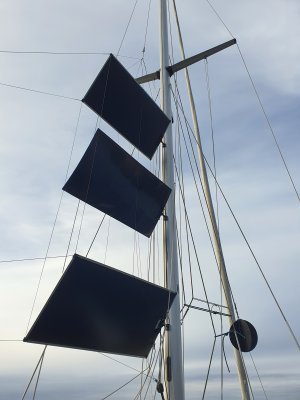
That’s where the FLINsail comes into the picture for us. 300W of solar that we pull up the mast like a mainsail when anchored. Pricey, but for us it enabled remote working from the archipelago for the whole summer, so money wasn’t such a big question. And I suppose something similar could be DIYd with some panels, dyneema, and batten cars.

20220122_111543_Original.jpeg

However, if you want to cruise areas of very poor solar insolation ( this is not anywhere in Australia) such as Scotland in winter, firstly you are a little mad :) and also understand that alternative energy sources such as solar and wind are not enough to support all electric cooking.
At least for us at 52°N, solar doesn’t do much anything in the winter. For our winter cruising we’re resigned to needing shore power every few days.

Heating already consumes so much diesel that I wouldn’t want to see what running (and maintaining) a genset on top of that would cost - if we even could fit one on our 31ft boat!
 
That’s where the FLINsail comes into the picture for us. 300W of solar that we pull up the mast like a mainsail when anchored. Pricey, but for us it enabled remote working from the archipelago for the whole summer, so money wasn’t such a big question. And I suppose something similar could be DIYd with some panels, dyneema, and batten cars.

View attachment 166975


At least for us at 52°N, solar doesn’t do much anything in the winter. For our winter cruising we’re resigned to needing shore power every few days.

Heating already consumes so much diesel that I wouldn’t want to see what running (and maintaining) a genset on top of that would cost - if we even could fit one on our 31ft boat!
How do you store those panels on a small boat?

It's not hard to work out how much diesel you'd use generating a few kWh of power.
And at the same time, you'd be generating heat and/or hot water.

Then again, shorepower exists and not everyone wants to be isolated up a creek in the winter.

If you don't have a problem with the way things are, there's no solution...
 
How do you store those panels on a small boat?
At least on our boat they fit nicely in a cockpit locker. And the same locker still also holds our dinghy oars, spinnaker, and bunch of smaller things.

It's not hard to work out how much diesel you'd use generating a few kWh of power.
And at the same time, you'd be generating heat and/or hot water.
Once at temperature, we get about 200W out of our alternator. At cruise speed, the Yanmar uses 1.8l of diesel per hour.

To generate our full daily power usage, this would mean running the engine for 6.5h, burning 8.3l of diesel, which at current prices would be ~17€ per day, or ~500€ per month. Not to mention the additional wear and tear on the engine.

No, we don't consider the engine to be a power source. The alternator is there so we get something out of the times we need to motor, not for really charging the battery.
 
Once at temperature, we get about 200W out of our alternator. At cruise speed, the Yanmar uses 1.8l of diesel per hour.
It is not the answer for everyone, but with the right technology alternators can produce high outputs, which makes the cost equation much more realistic.

2.5kw is achievable for a medium sized engine.

Personally, I don’t like the noise, heat, maintenance and vibration so solar is a more preferable primary source in my view, but it is an option to consider, especially if you are running the main engine frequently for propulsion and you plan to cruise areas of poor solar insolation.
 
It is not the answer for everyone, but with the right technology alternators can produce high outputs, which makes the cost equation much more realistic.

2.5kw is achievable for a medium sized engine.

Personally, I don’t like the noise, heat, maintenance and vibration so solar is a more preferable primary source in my view, but it is an option to consider, especially if you are running the main engine frequently for propulsion and you plan to cruise areas of poor solar insolation.
Doesn't matter how much you get out of the alternator you're still limited to what the lead acid batteries will accept. Besides, if you increase alternator output you proportionately increase the HP needed to maintain that output, so the cost also increases roughly proportionately, the only thing you save is time.
 
2.5kW is 200 Amps at 12.5V.
Not hard to do with two alternators.
Not off the scale for automotive, if you look at 24V it's unexceptional?
If you were looking to optimise alternator use, then lead/acid is not the ideal battery tech.
But then LiFePO4 batteries and BMS's don't seem to be ideal 'off the shelf' either.

Theres a world of hybrid cars where several kW frequently get shoved into various mid-sized Lithium batteries.
Some of the stuff from 'mild hybrid' cars might be applicable. 48V commonly I think?


There's other options, like 230V alternators sandwiched between engine and gearbox (I think Yanmar dabbled in this?) and adding a 230V alternator, which I'm sure Beta mention for canal boats at least?

Cars have moved on over the last 20 years, people's expectations of the alternator on a yacht seem to be stuck in the 1990s.
While solar and lithium are tacked on to the boat as an afterthought.

Obviously, diesel and alternator charging lacks the potential to greenwash your boating.
 
Doesn't matter how much you get out of the alternator you're still limited to what the lead acid batteries will accept.
True, so you need a large lead acid bank and you need to stop alternator charging when around 80% SOC, or much better again use a lithium bank. If this is going to be a primary charging method then lithium is the only real answer. Lithium cells will basically accept everything you can produce until almost 100% full.


Besides, if you increase alternator output you proportionately increase the HP needed to maintain that output, so the cost also increases roughly proportionately, the only thing you save is time.

The difference in main engine consumption between say a 0.4kW load (a 50% efficient alternator putting out 200w) and a 5kW load (a 50% efficient alternator putting out 2.5kW) will only be slight. So if we take Burgie’s calculations below :
To generate our full daily power usage, this would mean running the engine for 6.5h, burning 8.3l of diesel, which at current prices would be ~17€ per day, or ~500€ per month. Not to mention the additional wear and tear on the engine.

The increase in consumption and therefore running costs incurred by higher energy production would only be slight. The cost per kWhr will be much lower with the larger alternator.
 
The difference in main engine consumption between say a 0.4kW load (a 50% efficient alternator putting out 200w) and a 5kW load (a 50% efficient alternator putting out 2.5kW) will only be slight. So if we take Burgie’s calculations below :

The difference between your 200w alternator and a 2500w one is about 184a. It requires 1hp to generate 25amps, so that's an extra 7.3hp. Online tables suggest that's about an extra 1.5l of diesel. At UK prices that's about £2 an hour.
 
Any figures to support this please ?
We only have a basic dual alternator system. The main house alternator is a reasonably inexpensive industrial one. It has been derated in the interests of reliability, but will produce over 100A at 28v (2.8kW) all day long (it is rated at 4.2 kW). The second alternator is the stock one, very optimistically rated as a 1.2kW model. Its contribution is minimal.

Unfortunately, we motor little so its contribution to our total energy budget is small, but this is not the same for everyone.

It is more expensive to do this for a 12v house system, but it is possible. In this case I would be tempted to also replace the stock alternator. A pair of these may be a good solution:

Balmar XT-VT-170 Alternator - RJS Marine

The total of the two alternators is rated at 4kW.

If you want the very best, I have seen a couple of installations with these brushless alternators. They have remote diode packs (this greatly reduces the heat produced). Unfortunately, they are expensive and the installation is complex, but very high outputs can be achieved especially at higher voltages.

Electrodyne | Brushless Automotive Alternators

For a long time yachts have put up with a dismal output from their alternators, but there are now high output alternatives. When combined with lithium batteries the daily consumption can be replaced with short engine run times. Personally, I prefer quiet, reliable and simple solar, but this does not suit everyone so it is nice to have alternatives.
 
The difference between your 200w alternator and a 2500w one is about 184a. It requires 1hp to generate 25amps, so that's an extra 7.3hp. Online tables suggest that's about an extra 1.5l of diesel. At UK prices that's about £2 an hour.
On paper our alternator is rated at 80A. However, shunt tells me that we get only ~200W out of it once motor is up to temperature.
 
The difference between your 200w alternator and a 2500w one is about 184a. It requires 1hp to generate 25amps, so that's an extra 7.3hp. Online tables suggest that's about an extra 1.5l of diesel. At UK prices that's about £2 an hour.
Larger, higher voltage alternators can be much more efficient.
Assuming the engine is running for propulsion anyway.
You might get that down to more like £1.20 for 2.5kWh.

So one would have to do the maths for a particular use case of how many kWh per season or whatever.

If it saves a few marina nights, the diesel looks cheap.

Capital cost of all these toys will probably dominate.
 
On paper our alternator is rated at 80A. However, shunt tells me that we get only ~200W out of it once motor is up to temperature.
What you get out of it depends on what loads you present to it.
It will probably do 80A when something like a windlass is loading it down to 12V, or when presented with a very big, very flat battery bank. It will have amps/volts curve at a given RPM

It may be throttling itself due to temperature build up in the engine box, but if that's the cause of it 'only doing 200W' then the volts will be down.
 
It may be throttling itself due to temperature build up in the engine box, but if that's the cause of it 'only doing 200W' then the volts will be down.
I know we could likely drive it a little bit harder than we do, but I'm reluctant to do this without proper external regulator etc.
It's already better than the original alternator was - now our house bank is no longer discharging when we motor!

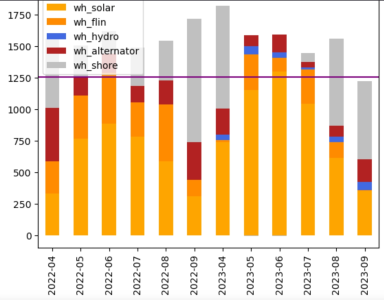
BTW, I found the time to run the numbers on the energy mix from this summer's cruise (average Wh per day per month):
1000001961.png
Lille Ø 2023 Energy Mix
 
The difference between your 200w alternator and a 2500w one is about 184a. It requires 1hp to generate 25amps, so that's an extra 7.3hp. Online tables suggest that's about an extra 1.5l of diesel. At UK prices that's about £2 an hour.
A boat that consumes 200Ahrs a day @12v would replace all this energy with around a one hour run time of an alternator outputting 2.5kW. This would cost £2 extra in fuel per day on your figures.

Not as cheap as the low or, non existent running costs of solar, but the costs are not unreasonable if you do not want, or cannot install any solar. This system especially suits those that would be running their engine for this period anyway to provide propulsion.

Once the battery is full, the alternator output will drop and there will be no (or a negligible) effect on fuel consumption. The extra fuel cost is only when generating the high electrical output.
 
Last edited:
I am based in the Scottish west coast, and was asking myself the same wind vs solar question. I found this from Nigel Calder online ( I have posted this before on other similar threads) which I found surprising but very helpful:

See 54 mins 40 sec onwards.

Quick summary, after a few seasons cruising in Scotland with both solar and wind genny on board, he found the solar outperformed the wind genny 2:1. And this in a part of the world not renowned for ideal solar conditions but certainly renowned for wind!
 
I am based in the Scottish west coast, and was asking myself the same wind vs solar question. I found this from Nigel Calder online ( I have posted this before on other similar threads) which I found surprising but very helpful:

See 54 mins 40 sec onwards.

Quick summary, after a few seasons cruising in Scotland with both solar and wind genny on board, he found the solar outperformed the wind genny 2:1. And this in a part of the world not renowned for ideal solar conditions but certainly renowned for wind!
There should be no argument that solar is a better investment than a wind gen, especially as solar has reduced in price over the last 2 or 3 decades. However unless you have a large yacht you cannot have a massive solar display without compromising the sailing ability of your yacht.

If you want to increase your ability to farm 'free' energy how are you going to increase your yield. A wind gen is one option, as are gen sets and your engine alternator.

If you don't actually settle down for a long period in an anchorage but sail a lot then a hydro-generator also enters the equation. A highbrid device, like the one from Ecletric (I think that is the name, but I have no experience of same) or the trailed log by the now defunct LVM the Aqua4 (which was marvellous) is/was good and there are now at least a couple of dedicated hydro generators, see earlier posts.


Currently in sunny Oz, Sydney specifically, it is a glorious spring day, 9am. Havesting amps will be easy. The forecast for:

Friday. Cloudy, 1mm of rain
Saturday. Showers increasing 10mm of rain
Sunday. Showers 15mm of rain
Monday. shower or 2, 7mm of rain
Tues and Wed. showers 1mm of rain, cloudy

Not a forecast to fill one with confidence that your solar harvest will be good. The poor weather is caused by a series of fronts resulting in some wind. A wind gen might be of some value (and 2 even better :) ).

Sadly wind gens and hydro gens are not cheap - the equation comes down to the annoyance of using diesel to produce power or the relative silence, and cost, of a wind or hydro gen.

Jonathan
 
Obviously everyone's circumstances are unique, and what works for some might not work for others. If you're marina hopping, and plugging in to shore facilities, power generation isn't a problem for you. If like us, who tend to be away for periods of up to six weeks at a time, with no shore power, it's a different story.
We sail in the NW Highlands and Islands of Scotland, at a latitude of roughly 59°. Yes, it can be windy, and we've tried wind generators, and our experience has been firmly negative. We had various issues, from burnt out voltage regulators, brush gear unable to take the generated current, noise being transmitted down the mast, into our sleeping cabin, to name some. Our experience of wind generators culminated in an occasion when the whole thing disintegrated in a severe gale, causing some damage to the boat, but thankfully no personal injury.
We have moved over to solar panels, and they have been wonderful. We started with a single rigid panel of 100 watts, and soon added another two of 40 watts. For next year we'll have another pair of 50 watt panels, which will be slung over the mizzen boom, when at anchor. PV panels, provided that you can find space for them, are wonderful. Simple to install, no moving parts, unobtrusive, and relatively as cheap as chips. (We have them mounted on the roof of the deck saloon, and having in-mast furling, we don't need to dance about on the roof to reef 😀).
We score from our sailing locality. In mid summer, sunrise is before 0500, and sunset is after 2200, so at least potentially there are lots of useful generating hours. Apparently PV panels work better at lower temperatures, so we also have an advantage there.
We don't have freezers, washing machines, water makers, to consume lots of power. We do have a fridge, and indeed it's our biggest user of power. Between the solar panels, and whatever the alternator produces if we're motoring, and with a 500 amp/hour battery bank, we manage very well.
 
Top