Wind Generation vs solar panels

I think the link says the wind generator should give 25Wh per 24h, or less, on over 90+% of days?
That's for a mix of sailing and non-sailing days?
The calculations were made by applying Superwind’s output curve to the actual AWS from a whole summer of cruising. So yes, mix of sailing and anchoring.

Note that the graphs are daily averages for each month. So for wind that’s somewhere around 200-300Wh per day (or about 15% of our daily power consumption).

In the Baltic you usually “Scandinavian moor” with stern anchor and bow tied to land, so anchorages tend to be very protected. And much of the sailing was downwind (so AWS lower than true wind speed, but AWS used as that’s what the wind generator would have to work with).

I totally should re-run these simulations with the 2023 data, and with actual production numbers from our hydrogenerator.
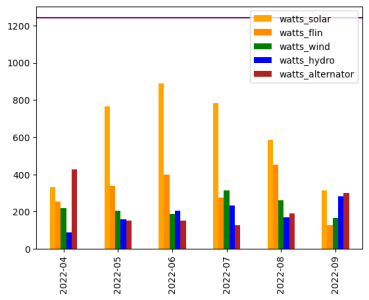
1698691441613.png
 
The problem is often that 'daily averages' are not enough info on their own.

Averages are easily skewed by a couple of windy days in a month and don't really go far toward answering questions about 'keeping the lights on'.

Different people will have different ways of framing the questions about how useful a wind gen is.

When I'm actively cruising my boat I guess I might be asking 'how often will having a wind gen make the difference between being short of power or not? How often will it mean I can keep running my fridge without running the engine?'

When my boat is moored up and I'm not on it, the question might be 'how often will solar fail to keep my batteries charged, and how many of those times will a wind gen help?' Or maybe how much will it help battery life by getting the batteries recharged quicker after a cruise?

It's pretty clear a wind gen won't offer me great value for money, and to be honest, I'm struggling to see a problem or scenario on a cruising yacht where it's a great solution.
 
Most here would not consider wind generation, at all. ITT bought LVM (aka Aerogen) transferred production to China and then closed it all down, presumably because they could not generate sufficient sales. Anecdotally it was said they tried to sell the business and had no takers. Yet at almost the same time a German start up was developing and releasing an updated version of the wind gen. They are now claiming interesting sales numbers (though glancing through the website - no mention of yachts nor marine applications - but I only skimmed through).

Product | SkyWind Energy Inc.

The sales are even more interesting when you consider the price - its not cheap.

I'm sitting at breakfast, there is a brilliant blue sky...... and no, or little, wind. :(

As a complete aside I have been quoted US $0.15/wp for container loads of 500w solar panels, standard framed panels ex China. I assume a 500w panel is a fairly standard size for a domestic or even large scale array. I further assuming panels for 'our' size are smaller and cost more. I shudder to think how many panels you need to buy to fill a container.

I always rated our Aerogen as it did work 24/7 and often when there was little sun there was wind. However in terms of output it generated more than enough in hydro mode, with a trailing impeller - but of course you did need to be sailing - then a WattnSea enters the equation (also not cheap)

Jonathan.


Yes. Aerogens were very nice things, almost silent at sensible wind speeds, and robust. I used the a small one for decades and it was perfect at keeping batteries up on a swinging mooring. It didn't care if the boat swung in the tide or the sun was absent or low in the sky. Hard on the wind it belted out an excellent charge often running all my basic electronics.

I spend more time in sheltered marinas now and the tables are turned. A small panel is better, the boat is fixed and I can align the thing to catch the best sun, when away from the boat. So, as they say, horses for courses.
However I got this nagging feeling that some people are lumbering their boats with ugly amounts of unnecessary panel capacity and structures which will cripple it's performance under sail.

.

.
 
Australia has very good solar insolation. Even Tasmania at a latitude of 44° degrees is not a long way from the equator compared to many cruising grounds. For example, the Shetland Islands are around 60° N as is most of Norway. We have cruised these areas generating virtually all our electrical power via solar, so it is possible. The exception was Scotland in winter (but few cruise Scotland or even Tasmania during winter). This has been the only time we occasionally needed some supplemental charging (via a high output alternator).

We cruise full time, averaging over 300 days a year at anchor and have done so for the last 17 years. We currently have a 49 foot monohull with just over a 1000w of rigid solar panels and a 600Ahrs @24v battery bank. As we cruise full time, we have all the "essential " electrical luxuries you mention (fridge, freezer, watermaker) plus a washing machine. In areas of reasonable solar insolation we do all electric cooking, and use electric heating for shower water. In areas of poor solar insolation we switch over partially or wholly to a combination propane and diesel for these functions. We do not have a generator.

Designing a self sufficient electrical system is complex, but it would have certainly been possible to update your catamaran’s electrical system to achieve this goal with solar alone when cruising any part of Australia and without skipping any of your requirements. The photos you have posted show only a minimal amount of solar (and much of this in shade prone locations), but you have indicated this was subsequently increased. How much solar did it have when you sold it?

One important element often overlooked is installing electrically efficient appliances. For example, you mention:


This need not be the case. If relying on solar you really need to fit an energy recovery watermaker unless you have a large catamaran with loads of room for solar. These watermakers use a fraction of the energy. A rainwater collection system is also a big help. We installed a rainwater collection system primary as backup in the event of watermaker failure, but in climates like Scotland it provided us with all the water we could use without any electrical consumption.

The bottom line is that if you ever buy another 38 foot catamaran in Australia and want to run all your electrical systems from solar this is not difficult goal to achieve.
You confirm the issue. You have 1000w of rigid panels, and 600a/hrs @24 volts of battery on a 49' monohull, collect rainwater but you are not fully 'off grid' as you use propane and diesel. Not many have the room for 1000w of a solar display - you need a 50'yacht and the same 50' yacht allows the large battery bank - essential for the consecutive days of no sun.

For you to live truly off grid you would need to sacrifice some of the 'essentials' of 21st century demands, reduce the hot showers, or you need a bigger yacht to allow more solar and more battery reserves.

Wind is not the answer, though maybe 2 wind gens (+ a WattnSea) would help, but your experience is that living truly off grid is 'difficult' and in your case - not possible.
That has not been my experience.

And your statement is misleading, as I suspected.

In order to use the large area available on a catamaran for a solar display you either need to sacrifice sailing convenience with rigid panels, how are you going to make any adjustments to the main unless you can access the roof, or use flexible panels. The use of flexible panels is the obvious route but they cost - as they only last 5-7 years. Life expectancy of 5 years starts to alter the balance between the high cost, and efficiency, of solar and moves the equation to make wind look more interesting. Replacement of solar seldom comes into the equation in these threads (our wind gen lasted 25 years and is still running).

I do note that hydro generation (earlier post on this thread), as we found, is marvellous, we farmed 10 amps at 10 knots, but in order to achieve that you need to sail - many live-aboard don't actually sail much (only from one idyllic location to another one not so far way) and 'having' to sail to have a hot shower seems to contradict the sailing lifestyle.

The new owners of our cat installed 2 x 500 watt domestic (house) panels, rigid, on the roof. As far as I could ascertain reefing became almost impossible and there would be the constant danger of accidentally being thrown onto a panel. Crippling sailing performance was in my mind. :)

Compromises, compromises.

Jonathan

The thread seems to have migrated to a better theme where owners are defining their energy requirements - which I find more useful than the repetitive denegration of wind. In the future, based on 25 years of development, we would along with everyone else, favour solar - but we would still want wind, and probably 2 units, and hydro. We would also have the benefit, now, of Lithium - which extends the days of no solar - because you can use more of the stored energy (than from the same capacity as Lead).

Jonathan
 
Last edited:
The calculations were made by applying Superwind’s output curve to the actual AWS from a whole summer of cruising. So yes, mix of sailing and anchoring.

Note that the graphs are daily averages for each month. So for wind that’s somewhere around 200-300Wh per day (or about 15% of our daily power consumption).

In the Baltic you usually “Scandinavian moor” with stern anchor and bow tied to land, so anchorages tend to be very protected. And much of the sailing was downwind (so AWS lower than true wind speed, but AWS used as that’s what the wind generator would have to work with).

I totally should re-run these simulations with the 2023 data, and with actual production numbers from our hydrogenerator.
View attachment 166918
Its interesting that 'watts hydro' is really unremarkable - yet racing yachts rely on it (WattnSea - again). A lot of this is due to speed - but weigh your yacht down with a huge bank of lead batteries, overweight rigid solar panels, oversized anchors and large link chain for an over long, all chain, rode - is another way to ensure your sailing performance is compromised.

Jonathan
 
Its interesting that 'watts hydro' is really unremarkable - yet racing yachts rely on it (WattnSea - again). A lot of this is due to speed - but weigh your yacht down with a huge bank of lead batteries, overweight rigid solar panels, oversized anchors and large link chain for an over long, all chain, rode - is another way to ensure your sailing performance is compromised.

Our boat is a traditional heavy full keel double ender in the Colin Archer tradition. The hydrogenerator starts producing a bit at 4kt boat speed, roughly covers our consumption at 5.5kt. When we sail over 6kt it produces about as much as our alternator does.

So absolutely not a silver bullet on this sort of a boat. On a faster boat I’d say it is a no-brainer - assuming that you like to go sailing often.

On ours it does its job of helping solar when overcast or night sailing. We had a good fast night run from off Bornholm to Swinoujscie in September, and it was a joy to see battery 5% higher in the end of it than what it was at start!
 
Our boat is a traditional heavy full keel double ender in the Colin Archer tradition. The hydrogenerator starts producing a bit at 4kt boat speed, roughly covers our consumption at 5.5kt. When we sail over 6kt it produces about as much as our alternator does.

So absolutely not a silver bullet on this sort of a boat. On a faster boat I’d say it is a no-brainer - assuming that you like to go sailing often.

On ours it does its job of helping solar when overcast or night sailing. We had a good fast night run from off Bornholm to Swinoujscie in September, and it was a joy to see battery 5% higher in the end of it than what it was at start!
Thank you for the input.

What sort, make, of hydro generator do you use.

Jonathan
 
What sort, make, of hydro generator do you use.
We have a SailingGen, chosen primarily because it could be mounted under our windvane in the same bracket.

PXL_20230410_115351304.jpg


Though it has to be said the price is also a lot more attractive than on a Watt&Sea.
 
You confirm the issue. You have 1000w of rigid panels, and 600a/hrs @24 volts of battery on a 49' monohull, collect rainwater but you are not fully 'off grid' as you use propane and diesel. ....

Jonathan
If you want to reduce the debate to people who don't have engines, let alone gas cookers, you are reducing it to a very small congregation of the devout and special cases.

It seems to me, most of us use an engine for several hours on a typical cycle of a few days boat use, and alternator power is readily available. It does look like there is a case for moving on from the traditional yacht alternator to something more optimised for modern batteries.
 
If you want to reduce the debate to people who don't have engines, let alone gas cookers, you are reducing it to a very small congregation of the devout and special cases.

It seems to me, most of us use an engine for several hours on a typical cycle of a few days boat use, and alternator power is readily available. It does look like there is a case for moving on from the traditional yacht alternator to something more optimised for modern batteries.
I would not, cannot, restrict the people who reply - but all replies would be of interest to some, or many.

The danger is that people, including me, miss out salient detail - 'I'm self sufficient but, omit to mention, I use a gen set - Bergie has offered some real detail, which overlaps with what some are doing with Lithium.

I am well aware that most yachts sold today are equipped with gas cooking facilities but am equally aware that some have dispensed with gas, for them it is dangerous, inconvenient etc, and are all electric. Equally an alternator, on virtually all yachts, is a grossly inefficient way of producing electricity particularly if you really want to sail (or stay at anchor) and not push around a floating caravan. If you are in Caribbean solar seems to offer a realistic alternative - but in our experience is not THE answer - because sometimes the sun does not shine (for a few days) in many places. So being reliant on solar is not for everyone.

Again Bergie has offered detail - which may provoke some thoughts and ideas.

Jonathan
 
Most here would not consider wind generation, at all. ITT bought LVM (aka Aerogen) transferred production to China and then closed it all down, presumably because they could not generate sufficient sales. Anecdotally it was said they tried to sell the business and had no takers. Yet at almost the same time a German start up was developing and releasing an updated version of the wind gen. They are now claiming interesting sales numbers (though glancing through the website - no mention of yachts nor marine applications - but I only skimmed through).

Product | SkyWind Energy Inc.

The sales are even more interesting when you consider the price - its not cheap.

I'm sitting at breakfast, there is a brilliant blue sky...... and no, or little, wind. :(

As a complete aside I have been quoted US $0.15/wp for container loads of 500w solar panels, standard framed panels ex China. I assume a 500w panel is a fairly standard size for a domestic or even large scale array. I further assuming panels for 'our' size are smaller and cost more. I shudder to think how many panels you need to buy to fill a container.

I always rated our Aerogen as it did work 24/7 and often when there was little sun there was wind. However in terms of output it generated more than enough in hydro mode, with a trailing impeller - but of course you did need to be sailing - then a WattnSea enters the equation (also not cheap)

Jonathan.
Had both on my last boat. The wind generator worked fine if it was blowing more than 20kn which is not what you want in an anchorage or mooring. It was noise with noise being transmitted through the grp hull and being mechanical there were repair issues. The solar panels only worked in daytime but that apart were IMO much better.

The engine alternator wasnt a lot of use in the sense that you had to run it for hours to recharge fully even a half cischarged batter back. The only real answer, allowing luxuries like microwave and electric blankets and breakfast toast was a built in generator.
 
You confirm the issue. You have 1000w of rigid panels, and 600a/hrs @24 volts of battery on a 49' monohull, collect rainwater but you are not fully 'off grid' as you use propane and diesel.


Jonathan
You are misunderstanding the term ”off grid". It refers to being unconnected to the electrical grid, or sometimes other household utilities.

We were last connected to shore power when on the hardstand in Scotland 18 months ago. Since then we have been at anchor and unconnected to the electrical grid, so for what its worth I think we qualify as "off grid" the majority of the time.

We have no generator and use all electric cooking unless in areas of very poor solar insolation.
 
The new owners of our cat installed 2 x 500 watt domestic (house) panels, rigid, on the roof. As far as I could ascertain reefing became almost impossible and there would be the constant danger of accidentally being thrown onto a panel.
I can understand the new owners of your catamaran taking the opportunity to increase the amount of solar, but this sounds very strange. There should be plenty of room to fit well over 1000w of solar on a 38 foot catamaran without making reefing "almost impossible".
 
I'll challenge you, define your usage, including desal, electric cooking, running the marine systems, fridge, deep freeze, hot water for showers.

How many solar panels do you need, what capacity? Recall Australia covers from the chilly south to the tropics and I suggested 365.

No data? - just talk? and talk is cheap.

Frankly if you want to remain in the 21st Century - its difficult to rely on solar (unless you have a very larger vessel with lots of room for solar (harvesting both good and bad days) - without making sacrifices (like disowning the grand daughters - and that is not an option, hot showers are a birthright).

Basically if you take any responsibility for grandchildren you need to be near fresh water - as de sal is a massive user of amps - even just the 2 of us - SW Tasmania (which is truly off grid) is a real challenge .

So ..... let's see the numbers

There are enough members here who live off grid - I am sure they will be interested in your reply - but take your time. It will be educating for us all and I for one will be happy to see what size of a solar display you need covering 44 degrees south to the, almost, equator, 365 and no recourse to 'camping'.

Jonathan
I was told that 55 degrees was optimal angle for UK latitudes?

I also have some in garden power battery bank for decorative lights, fountain, flood lights etc
 
I was told that 55 degrees was optimal angle for UK latitudes?
The optimum solar panel angle for a fixed installation is roughly the latitude, adding 15 degrees during winter, and subtracting 15 degrees during summer.

The latitude of the middle of the UK is around 55°N, hence this average recommendation.

Unfortunately yachts swing around significantly at anchor.
 
The optimum solar panel angle for a fixed installation is roughly the latitude, adding 15 degrees during winter, and subtracting 15 degrees during summer.

The latitude of the middle of the UK is around 55°N, hence this average recommendation.

Unfortunately yachts swing around significantly at anchor.
Thanks.

On by boat I had port and stbd approx 55deg. Forward, horizontal, aft locker horizontal and one on twin back stays at ‘who knows what angle, then two wind turbines.
 
I can understand the new owners of your catamaran taking the opportunity to increase the amount of solar, but this sounds very strange. There should be plenty of room to fit well over 1000w of solar on a 38 foot catamaran without making reefing "almost impossible".
Then you need to trust the actual experience of someone who had one.

Yes you can smother the fore or side deck with flexible panels - but then you cannot walk on them when they are wet. You can build a new construction on the transom but then you add weight in the transom. If you smother the roof with flexible panels, they don't last long, 5 years...? they are an expensive version of panels (rigid are much cheaper and flexible don't last). Of course you can smother the flat spaces - but there are dangers.

In terms of reefing - if you set up the reefing system you can obviously reef - but a catamaran is a yacht and things go wrong - and when its wrong the last place you want to be is dancing around on a roof in 55 knots sorting out the the problem that would easily be fixed in a marina. But maybe you have not sailed in a catamaran in short seas in 55 knots.

Jonathan

Jonathan
 
You are misunderstanding the term ”off grid". It refers to being unconnected to the electrical grid, or sometimes other household utilities.

We were last connected to shore power when on the hardstand in Scotland 18 months ago. Since then we have been at anchor and unconnected to the electrical grid, so for what its worth I think we qualify as "off grid" the majority of the time.

We have no generator and use all electric cooking unless in areas of very poor solar insolation.
Not at all but most smaller yachts do not have room for a gas galley and electric galley nor want the expense of both.

And you did say something like 'in your experience solar was sufficient' - omitting to mention 'except in areas of poor solar'.

You do underline that even with 1,000 watts of rigid solar - its simply not enough - you freely admit the need to revert to diesel. 1,000 watts of solar is but a dream to owners of a 35' yacht - and if you need to supplement your solar they would simply find their display inadequate .... big time.

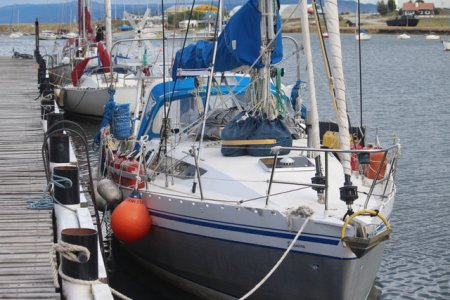
These are 2 yachts in Patagonia, I think the first one is registered in Malta but is a typical size of cruising yacht. The 2 yachts behind this one were a similar size. Where exactly are they going to instal 1,000 watts of solar.
IMG_6374.jpeg
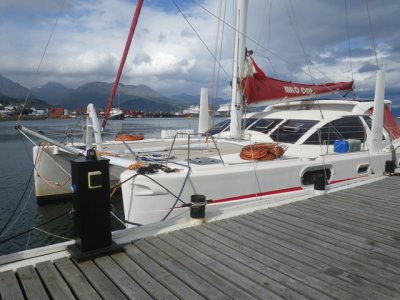
The cat is out of Tahiti, but also in Patagonia. They have a decent solar display on the aft section of the saloon roof, but not 1,000 watt. They have left the forward section of the roof to allow, safe, access to the boom and mast. - where are they going to install further panels and not destroyed their sailing ability.
IMGP5637.jpeg

The common location for solars would be aft, as part of a real estate investment, the Bimini - weight in the ends on a small yacht, or any yacht seriously impacts sailing performance.

Interestingly in all of these Patagonia located yachts - solar was minimalist, jerry cans were lined up on the side decks, shore lines packed were everywhere - actual deck space was limited.

But it may illustrate why the Caribbean is a more popular destination. :)

Jonathan
 
Last edited:
In terms of reefing - if you set up the reefing system you can obviously reef - but a catamaran is a yacht and things go wrong - and when its wrong the last place you want to be is dancing around on a roof in 55 knots sorting out the the problem that would easily be fixed in a marina. But maybe you have not sailed in a catamaran in short seas in 55 knots.

Jonathan

Jonathan
If you want to be self sufficient using solar alone I think you have missed some opportunities with the catamaran you sold.

One advantage of catamarans is they can fit a large solar array.

It sounds like the new owners have sensibly tried to increase the solar output by utilising the available space. On a cruising boat this is what I would do in their position.

If the new owners can no longer reef they have implemented this change extremely badly, but there is no need for this poor engineering, a 38 foot catamaran has plenty of room for a significant solar array.
 
Not at all but most smaller yachts do not have room for a gas galley and electric galley nor want the expense of both.
The space taken and the cost of an electrical galley on a yacht is not a significant factor. Portable induction cooktops are around £30. Microwaves and electric kettles are similarly not expensive and can be packed away when electric cooking is not needed or viable. Electric cooking can be added for minimal cost.

I agree on small yacht electric cooking is not usually viable, at least not full time. It can still be a useful supplement to minimise propane usage for those with a reasonable solar array. Forum members such as Pete7 (all electric cooking on a 31 foot yacht in the UK ) have shown what is possible.

However, if you want to cruise areas of very poor solar insolation ( this is not anywhere in Australia) such as Scotland in winter, firstly you are a little mad :) and also understand that alternative energy sources such as solar and wind are not enough to support all electric cooking. This is why Ithink the best solution for a long distance cruising yachts is to have available both alternative energy (solar, wind etc) and fossil fuel (propane, diesel) options for cooking. This is how we have set up our yacht.
 
Last edited:
Top