Wind Farms, Yes or No?

Why don't the media (OK, Beeb would never kick against the reins) have a real go at getting answers to these points. This simple fact is a plain as the nose on your face, but every time some tries to bring it up industry spokes(wo)men, or junior Ministers, shoot them down with smoke and mirrors.
A BBC4 "investigation", which means a cursory google scan prior to interview, asked a professor whether it was wise to have so much gas power generation and he replied that we had more gas than we knew what to do with [I paraphrase]. I couldn't believe what I was hearing whilst yelling "wharraboot Young Lady?". In an earlier post, mention was made of ships crashing into a wind farm; the damage would have been piddling to what the 100,000t crude tanker the Young Lady did to the gas CATS pipeline off the Tees estuary in June 2007. She, the tanker, came within a whisker of rupturing the pipe when her anchor dragged over the pipe in heavy weather. It was shut for 2 months to repair and which shut off 20% of the UK *demand*.
 
Sensible suggestion. I found this.
I may be a bit dim when it comes to these things but it seems that the windfarm misses the mark in this instance by nearly 100%.

That could well be spot on, hence the massive subsidies.

A local enterprise putting up an 850KW turbine told me that around 50% of their income will come from ROCs, with the other 50% from actual sale of electricity at market rates. They project a £50K/year profit for the first 10 years while the finance is paid off, followed by £150K/year.

Assuming ROCs pay £45 per MWH, and 30% production, they will receive a subsidy of around £100K / year, so clearly it would be loss making if relying just on the value of the electricity.
 
Like most things.. there are huge efficiencies in centralised bulk production.

But in the case of thermal electricity generation there are huge inefficiencies too, because of all teh wasted heat. We didn't care about that, and tended to put power stations near fuel sources. Other countries without our indigenous fossil fuel supplies put their power stations in areas of population so waste heat could be used for district heating ... as a result, their power stations are, overall, around twice as efficient as ours.
 
Assuming ROCs pay £45 per MWH, and 30% production, they will receive a subsidy of around £100K / year, so clearly it would be loss making if relying just on the value of the electricity.

As long as coal is relatively cheap, alternatives of any sort are going to need some sort of cross-subsidy. That includes nuclear: private finance isn't going to go anywhere near it unless the government underwrites decommissioning and reprocessing costs. In that case the subsidy comes during/after the generatiom while for wind it comes up front. However, there is no doubt that we are going to have to stop much of our coal generating capacity: the cost of electricity is going to rise substantially and any sensible government will make sure that alternative capacity is in place well in advance.
 
As long as coal is relatively cheap, alternatives of any sort are going to need some sort of cross-subsidy. That includes nuclear: private finance isn't going to go anywhere near it unless the government underwrites decommissioning and reprocessing costs. In that case the subsidy comes during/after the generatiom while for wind it comes up front. However, there is no doubt that we are going to have to stop much of our coal generating capacity: the cost of electricity is going to rise substantially and any sensible government will make sure that alternative capacity is in place well in advance.
This is specious. Wind subsidies are, principally, paid after generation although some of the earlier farms received an upfront construction subsidy. The reprocessing costs of the French stations adds 3% to the cost which is £0.00135 per kwhr - their base cost [to a domestic supply] is half what mine is; never forgetting that if it wasn't for the 2GW the French supply us with every day, we'd have run out of the stuff. There is utterly no reason that the cost of electricity should rise substantially with the demise of the coal stations which have opted out of the EU emissions requirement; other than by the inability of this government to plan in a competent and timeous manner.
 
This is specious. Wind subsidies are, principally, paid after generation although some of the earlier farms received an upfront construction subsidy. The reprocessing costs of the French stations adds 3% to the cost which is £0.00135 per kwhr - their base cost [to a domestic supply] is half what mine is; never forgetting that if it wasn't for the 2GW the French supply us with every day, we'd have run out of the stuff. There is utterly no reason that the cost of electricity should rise substantially with the demise of the coal stations which have opted out of the EU emissions requirement; other than by the inability of this government to plan in a competent and timeous manner.

But the government is planning in a timely manner. They are ensuring that it is economically viable to start building now the type of generating station which will be economically viable to operate in ten years' time.
 
No, No, No,! All new build developments, Blocks of flats, Factories, Offices etc, should each have their own individual windmills, should be an integral part of the planning process.

Nooo. Big health and safety issue.

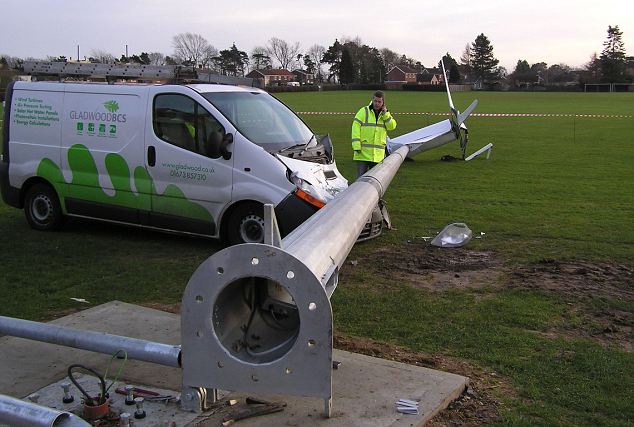
Privately erected individual windmills are (probably) hazardous.

article-1232540-076E050E000005DC-775_634x427.jpg


article-1232540-076E0519000005DC-459_634x434.jpg


Courtesy http://www.dailymail.co.uk/news/art...urbine-collapses-crushes-contractors-van.html
 
Privately erected individual windmills are (probably) hazardous.

If you're going to condemn a whole industry on the basis of one accident, then I vote to shut down commercial wind turbines as well ..

turbine1.jpg

turbine4.jpg


By the way, I wonder what did happen to the school turbine (a Proven 6000?). Looks like its pivots weren't properly connected, or maybe failed. There are a lot of those turbines in service, some in some very wild places.
 
By the way, I wonder what did happen to the school turbine (a Proven 6000?). Looks like its pivots weren't properly connected, or maybe failed.

That's my guess. Some sort of A-frame on the ground to hoist it up by two pivot bolts, one of them came out, broke or was forgotten, column rotated through 90 degrees, crunch. Mind you, why were the bolts in the base in place? Surely they would have been in the way as the thing came upright?
 
Energy cost of wind turbines

I am reserving judgement until someone can tell me how long it takes for a wind turbine to repay the energy cost of building (and dismantling).
Figures I have heard bandied about seem to estimate a payback time in terms of energy used in construction and commissioning at around 8 months. I doubt if dismantling costs would add a lot to that. I would imagine that the figure for offshore wind would be significantly higher due to higher commissioning costs.

BishopT
 
In 2000 we stopped in Borkum very close to a wind turbine. It had a claimed output of 1.8 Megawatts. That seem to me to be a worthwhile contribution from one device

Remember the scale of the problem though. You'd need four thousand of those to replace the annual output of one coal station, and you'd need to arrange them to make sure they aren't all becalmed at the same time.
 
Remember the scale of the problem though. You'd need four thousand of those to replace the annual output of one coal station, and you'd need to arrange them to make sure they aren't all becalmed at the same time.

four THOUSAND? that is 7.2 Gigawatts!! Given a typical generator might be 40-90Mwatts then you need 25-50 x 1.8 Mw turbines at nominal ouptputs to replace a generator. Maybe 6 generators to a station - but still not all in service all the time anyway. I agree that wind doesn't blow all the time, but it would still significantly reduce our use of fossil fuels.
 
four THOUSAND? that is 7.2 Gigawatts!! Given a typical generator might be 40-90Mwatts then you need 25-50 x 1.8 Mw turbines at nominal ouptputs to replace a generator. Maybe 6 generators to a station - but still not all in service all the time anyway. I agree that wind doesn't blow all the time, but it would still significantly reduce our use of fossil fuels.
A 40MW generator is tiny. Longannet, for example, is rated at 2300MW "sent out" (ie net generation after all the power it consumes itself). Four 660MW units if I remember right.

Lets assume 30% utilisation of the wind turbines, which is a typical Aberdeenshire figure so probably pretty over optimistic for a UK average ...

1.8 x 0.3 x 4000 = 2160MW
 
Top