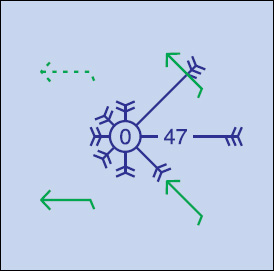
Wind Arrow/Vector Direction Conventions

Hi all,

This one is always a point of confusion at Weather School.

By international agreement wind directions should always point in the direction from which the wind is coming from. But then the BBC used to break convention by going with the flow (don't think they do any more).

Animating vectors tend to be with the flow.

However, I always stick to the rule that wind direction must point to the direction the wind is coming from.

There, it's as clear as...well....errrr..... ;)

Simon
 
Hi all,

This one is always a point of confusion at Weather School.

By international agreement wind directions should always point in the direction from which the wind is coming from. But then the BBC used to break convention by going with the flow (don't think they do any more).

Animating vectors tend to be with the flow.

However, I always stick to the rule that wind direction must point to the direction the wind is coming from.

There, it's as clear as...well....errrr..... ;)

Simon

It's an interesting subject and this thread has made me think about it for the first time.

How does this sound ........ as a sailor, historically, when thinking about the wind, what is important is where the wind is coming from. Not only is that vital because going into the wind is the one direction which is "forbidden" to you so it's the most critical for route planning. Also, knowing where the wind is coming from will help you understand where the weather is coming from and what kind of weather it is likely to be as that is likely to also be a critical issue when route planning.

But with tidal streams, a sailor is not really interested in where the stream is coming from ..... what you are interested in is where it's going as that is the direction which is going to carry your boat and impact on your route planning.

In conclusion, for sea folk: WIND - where's it coming from. STREAM - where's it going to.

I just thought all that up so I'm just running it up the flag pole to see who salutes it! :)

Richard
 
Most of the traditional names for winds in, European languages at least, relate to the direction the wind is coming from. I have always understood this to be because the languages were developed on land, where what was important was what the wind was bringing, e.g. heat, cold, rain etc., and it was of no interest to early farmers where the wind went next. Of course, once people started going out in boats they were concerned where the wind or the current might take them, but by then the winds already had names so they could only give names to the currents, based on the direction they would carry them, so we end up with a northerly wind and a southerly current both going the same way.
 
This avoids confusion:

wind-rose.jpg

Not for me!"!!

Just to be clear

The long vector on the right with 47 on it denotes an easterly wind ie one from blowing east to west

correct???

If not I am even more confused.

and the greeen vectors are w/nw current flows - ie flowing to w/nw
 
Last edited:
Hi all,

This one is always a point of confusion at Weather School.

By international agreement wind directions should always point in the direction from which the wind is coming from. But then the BBC used to break convention by going with the flow (don't think they do any more).

Animating vectors tend to be with the flow.

However, I always stick to the rule that wind direction must point to the direction the wind is coming from.

There, it's as clear as...well....errrr..... ;)

Simon

Its those pesky feathered things you use for plotting wind direction on cahrts that confuse me. They seem to point inthe wrong direction to my way of thinking

I want this to represent a NW wind but it doesn't!

stationreport.jpg
 
Its those pesky feathered things you use for plotting wind direction on cahrts that confuse me. They seem to point inthe wrong direction to my way of thinking

I want this to represent a NW wind but it doesn't!

stationreport.jpg

I always assumed "From" only applied when it was shown inside a compass rose.
 
Most of the traditional names for winds in, European languages at least, relate to the direction the wind is coming from. I have always understood this to be because the languages were developed on land, where what was important was what the wind was bringing, e.g. heat, cold, rain etc., and it was of no interest to early farmers where the wind went next. Of course, once people started going out in boats they were concerned where the wind or the current might take them, but by then the winds already had names so they could only give names to the currents, based on the direction they would carry them, so we end up with a northerly wind and a southerly current both going the same way.
Just to put a spanner in...

Leeway ?
 
Top