Winch socket specification ?

sarabande

Well-Known Member
Joined
6 May 2005
Messages
36,182
Visit site
I can't find the proper size spec for the standard winch socket, and want to put an 'adapter' into a drill for an experiment.


Suggestions please for details, and a source.
 
I made a 5/8 " drive socket to fit my drill to drive the jib sheet winch like the winch bit. It only needs to be square

You ould also file down a 3/4 square socket extension to fit.
 
11/16" Bi-Square is the sort of adopted standard....with different takes on tolerance from that nominal specification, depending on manufacturer.

As others have said, a square will do.
 
The motor in a cordless drill is tiny compared to a winch motor. The cordless gearbox casing will probably self destruct by either melting the plastic casing or just burn out the cordless
I have the makita with a metal gearbox and casing with high torque. I once connected it to one of those hand turned propellors for a dingy, it destroyed the propeller gearbox within 30 secs.
Power is not the problem but heat is. The plastic mountings holding the motor in place just melt as the cordless heats up in seconds due to extremely high loads.
My winches are hard work and could probably do with bigger ones but the cost :oops:. I couldnt see my drill lasting more than a minute or two if i tried it on mine..
If yours have a very light load then maybe it will work for you and would imagine it will be fast.
 
Comparing the drill motor to the size of an electric winch motor is not a fair comparison....the electric winches do not drive the motor through the same gearing as the manual winch handle , and thus the drill would be (in order to achieve greater sheeting speed)...therefore proper electric winch motors need to be bigger to cope.
 
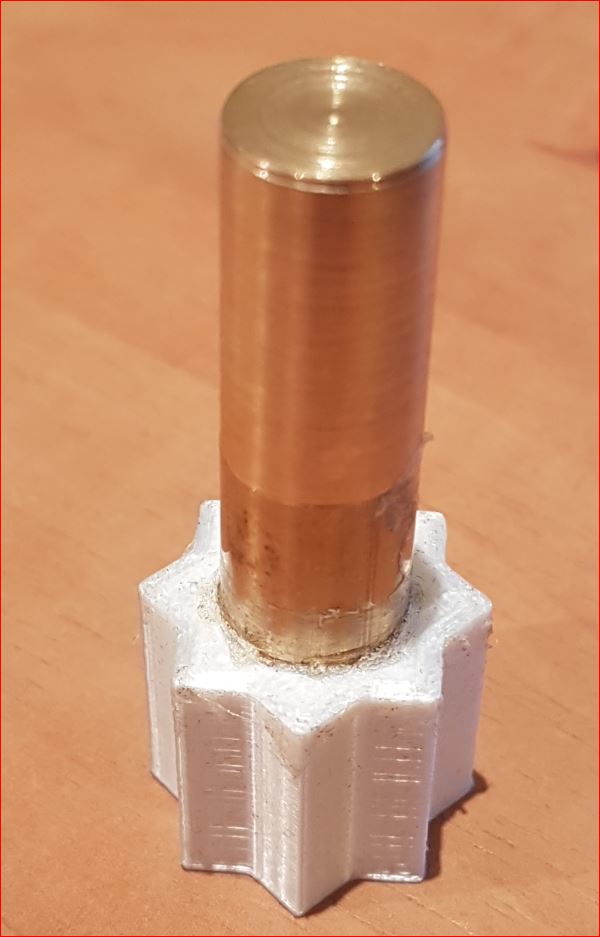
Just a note for anyone thinking of making their own iWinch. I made a version has a plastic end printed on my 3D printer. The end is an 11/16 b-square. A friend took it down to his boat last week-end and reports that the adapter fits nicely into his bigger Harken winches but not his smaller Harken winches. He tested on a neighbour's Lewmar winches and the adapter fitted all sizes.
So if you have Harken winches you may wish to undersize a smidge. If you have Lewmar then 11/16 is fine

TudorSailor
 
Just a note for anyone thinking of making their own iWinch. I made a version has a plastic end printed on my 3D printer. The end is an 11/16 b-square. A friend took it down to his boat last week-end and reports that the adapter fits nicely into his bigger Harken winches but not his smaller Harken winches. He tested on a neighbour's Lewmar winches and the adapter fitted all sizes.
So if you have Harken winches you may wish to undersize a smidge. If you have Lewmar then 11/16 is fine

TudorSailor
A square bit works fine as mentioned above. I’ve had one for years. Much easier to machine in steel if that’s the end game of making a plastic printed part.
 
True, orientation to 3D print either a bi-square or simple square adaptor for a drill would dictate that the layer lines would be parallel to the load applied. I would have thought at any kind of input load, the print will snap quite quickly along a layer line at the point it narrows down to suit the drill chuck.
 
True, orientation to 3D print either a bi-square or simple square adaptor for a drill would dictate that the layer lines would be parallel to the load applied. I would have thought at any kind of input load, the print will snap quite quickly along a layer line at the point it narrows down to suit the drill chuck.

Yes I thought that too, so had a friend machined a brass rod with a bisquare end to go inside the socket. His mill had difficult accurately machining something 20mm "deep" and 11/16 across but could cope with the insert

whatsapp%20image%202020-02-02%20at%2012.14.13.jpeg
winch%20adapter.jpg


If the adapter works with my 18v drill then I can buy an off the shelf version. My aim was to test the concept first

TS
 
Last edited:
Aah, that makes sense..in this format it'll be pretty strong I guess. Are you printing in ASA or similar?
I printed the socket in PLA but have also printed a spare in ASA in case the PLA disintegrates. But I suspect it will be pretty robust. ASA is UV resistant but the adapter is not going to live outdoors. I just happen to have both.
I am like a man with a hammer - to whom everything looks like a nail. I have a 3D printer so every problem can be solved with a widget printed on my printer!
TS
 
Top