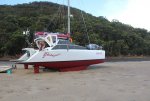
Why would anyone get a twin keel if they could have a fin?

There's always legs, though I haven't used them to fully dry out yet they are handy in spots where you are going to end up possibly wonky at low tide. It's a grand's worth of stuff taking up locker space if you don't use them though.
 
As Dutch 01527 #18, says it depends a lot on where you sail, in fact where you want to go.
Our first mooring was on the South Coast in Mudeford where we certainly couldn’t have moored a fin keel on the swinging mooring or managed to cross the mud bank to the channel.
Here on the West Coast of Wales à fin keel again causes difficulties in that many of the possible destinations are drying with only a few widely spaced marina options for non-drying harbours. I recently changed my long keel Invicta 26 for a Sadler 25 bilge keel so that I could visit many of the harbours/moorings in the area which I avoided in the Invicta because of the drying out. (The Invicta did have yacht legs, but even these have their limitations).
Sailing wise, yes I notice a difference in the sailing, but not to such a degree that n this area I would go back to a single keel option and the cost of keeping the boat on a marina.
 
Horses for courses, IMO.
.

If you're going to the Med, unless I already had one that suited me, I wouldn't consider a twin keel, unless that means one on each hull, which definitely has advantages for a liveaboard.

We don't have a timetable and thus have no need to sail to windward. I get my adrenaline rush from reaching at speed but have never breached 20 knots - though that target is now receding from my bucket list.

Twin keels have a lot to commend them but might not always be welcome on a French canal :(. If all you want to do is clean down then a 300mm tide would suffice (we draw 1m) and if you want to stay awhiles then 3 anchors works well. (Just another lesson into how to introduce anchors into diverse threads :) )

IMG_4753.jpeg

Jonathan
 
There's always legs, though I haven't used them to fully dry out yet they are handy in spots where you are going to end up possibly wonky at low tide. It's a grand's worth of stuff taking up locker space if you don't use them though.
I looked at them for my current boat and came to the conclusion I could get a lot of nights in a marina for the cost of them.
 
My first proper boat was a mirage 28 twin keeler and I found it ideal for my drying mooring and plenty roomy enough for a couple with occasional guests. The sailing performance was more than adequate and handled rough conditions comfortably. My sailing base was Cardigan Bay.
However, Mirages are getting long in the tooth nowadays and will need substantial upgrading but the basics are still good. If you're intending to go to the med, a bilge keeler would allow you to go via the French canals which is an adventure in itself. However, there are boats better suited to med conditions so for that reason I would buy locally for sunny sailing. There are many Mirages in the med especially Greece where they were popular as flotilla boats (mostly fin keels).
 
My first proper boat was a mirage 28 twin keeler and I found it ideal for my drying mooring and plenty roomy enough for a couple with occasional guests. The sailing performance was more than adequate and handled rough conditions comfortably. My sailing base was Cardigan Bay.
However, Mirages are getting long in the tooth nowadays and will need substantial upgrading but the basics are still good. If you're intending to go to the med, a bilge keeler would allow you to go via the French canals which is an adventure in itself. However, there are boats better suited to med conditions so for that reason I would buy locally for sunny sailing. There are many Mirages in the med particularly in Greece where they were popular flotilla boats (fin keeled version).
 
As always, yachts designs have compromises, advantages and limitations. I have been racing on fin keels and later in life I owned a Bruce Roberts deep fin keel. The latter was comfortable in the open sea but it was a pain for shallow waters of the East cost of England. Since then I had twin keel boats and I can not see me getting a fin keel again. I can dry out anytime I want and go into shallow waters without too much of a worry. I can go close to the wind; do I want to beat very close against the wind?, no I don't. When the wind is just behind the beam, the boat takes off. In rough weather, the twin keel, being shallow draft, will "slip" rather than "grip" and hence much less heeling. So, which is better, fin or twin keel? The are both great fun to sail.
 
Anything is possible with twin keels and twin keels are not restricted to older models. The deciding factor on what use is made of twin keel, or single keel, yachts is the owners - not by what they look like. I suspect this twin keel yacht will outsail many single keel yachts - even some slightly longer. Most single keel yachts are never, ever, sailed to their potential - this one seems to have been sailed well beyond what the builder imagined - anything is possible.

Open your mind, think outside the box

Take care, stay safe

Jonathan

I think this may be one of these ?

2 keel.jpg
 
Are there any advantages except for the drying out bit that it can stand up?

It slows the boat down and they don't point so well, they also have a deeper draft. There is a boat close by that looks nice, but it's atwin keel and I am not sure if this boat could be the boat for me. I intend to sail to the meds with it, and live on it, too. So it doesn't have to be a racer, but performance towards windwards might come in handy for longer tacking sessions?

Also I am not sure if Fin Keels are more stable or not thatTwin Keels? Especially at sea.

Boat in question is a Mirage 28, but I am also asking in general because I have seen a few Twin Keelers now.
Short answer
They vary a lot in performance .
And I know not of the Mirage 28.

I think you are on the money though in not being too fussed about having a luxury boat if you just like sailing and adventure ..
Soooo…. bearing in mind that any bigger boat will generally outperform a smaller one , in all conditions, then if you are going to go anywhere at all tidal then a decent and big enough twin keeler, coupled with a willingness to do your own scrubbing off and park far from the madding crowds , will save you a ton of money..Sometimes when cruising that is good foresight imho.

And they roll a bit less downwind . But in the Mediterranean , trying to sail upwind across lumpy seas I would want a decent diesel to assist forward motion!

I have owned both and sailed distances in em
 
I’m not overly convinced by most of the arguments in favour of twin keels, with the exception of access to cheaper or more remote moorings. I have never owned such a boat bit have sailed on one or two, but without much pleasure, though these were older designs such as a Trapper 501. I can believe that modern designs are much better, although it is hard to see how they could actually match a fin. As I understand it, bilge keels will point as well as fins, but with much more leeway. There is also the problem of waves slapping inside in some conditions and usually less directional stability. In spite of this, it would be a shame if they weren’t still available for those who want them, though I don’t agree with the idea of those new to the game that bilge keels will keep them out of trouble.
 
Space is nice, but it's not such a big difference between 40 foot and 30 foot on the inside

Got to totally disagree with you on that one. You might not consider an extra 10 foot as being significant, but as the length increases you get a squared increase in the volume. This is what Isambard Brunel realised when justifying the economics of the Great Britain.
 
Got to totally disagree with you on that one. You might not consider an extra 10 foot as being significant, but as the length increases you get a squared increase in the volume. This is what Isambard Brunel realised when justifying the economics of the Great Britain.
And that's before you consider twin heads with showers, space light and ventilation.
 
And that's before you consider twin heads with showers, space light and ventilation.

And larger water tanks so longer between needing to fill up, more space for toy storage and then the most important one - it being more attractive a proposition to prospective partners you can "keep each other warm" of an evening.
 
Pointing ability and sea motion are what I am curious about really
In principle fin keels are capable of pointing higher, but there is no clear difference in motion based on keel configuration. What is more important for the type of use you envisage is passage making and for this the difference between fin and twin on otherwise identical boats is neither here nor there. Other factors such as sails, weight, windage, engine and ability of helm have far more influence over the capability of the boat to make good passage times.

However, remember if you are living on board you spend more than 90% of your time not moving and of the time moving at least half will be under motor, particularly in the Med. Of the time stationary a fair proportion will be spent fixing the boat - the old saw that living on an old sailing boat is all about fixing things in nice places has more than a grain of truth.

You are right that one person can live fairly comfortably in a limited way on a sub 30' boat - I spent a year in my younger days living on a 26' boat. However I much preferred living on my later 37', not least because everything worked and the time spent fixing things was relatively small.

As I suggested earlier, priorities for choosing an old cheap boat are usable space and condition plus a really good engine if you are going south. You will also quickly find that boats designed and used in northern climates are unsuited to hotter climates so pay attention to water capacity, power supplies, cooling, fuel capacity and means of getting out of the hot sun.

Should also add that the romantic idea of wandering down Europe to the Med rather belongs in the past for most UK citizens given the travel constraints and for those on a budget the high costs of anything connected with boats.
 
We had a bilge keel Fulmar for 10 years and sailed it a lot on the southcoast and over to Britany and the channel Islands, only upgrading the boat to a bigger fin keel last year. It suited us well for the following reasons:
Sailed very well in a wide range of conditions, great shallow draft in Chichester Harbour (our base), good for exploring and creek crawling, Winter layup was a doddle with no cradle required, youg kids loved being on the beach at various places we went to, drying out 2 or 3 times a year on average, much more in the early years. Scrubed down and changed anodes on the beach many times, in fact changed to a folding prop on the beach, and new cutlas bearing on year. We found that off the wind reaching and running she had a significantly more damped motion than fin keels, not sure why.
Points that were less favourable but no a big issue, Slapping/ Thud in 3 foot chop going to windward, Antifouling between the keels required a bit of uncomfortable crouching.
Note that some of the 70's designs,( Centuars, Snap dragons and others) bilge keelers really did not sail well to windward in my opinion, and its failry ovious if you look at them out of the water.
We enjoyed beating much bigger BEN JAV BAV's around the place but that's largely because we sailed well being keen dinghy sailors as well. ;-)
 
From the previous posts it's about what you want to do with the boat.

Given how busy many anchorages are I think the possibility of touching the ground safely at LW might be valuable. My experience around Scotland is that twin keels offer more choice of anchorages and harbours. I recall sheltering from a gale in the tiny harbour opposite Dounreay reactor in Scotland - not one for a fin keel. No worries in bad weather and they do roll less off the wind.

That said, I chose a long keel (and legs) because I like the feel of a long keel under way (motion, self steering).

But for a cheap to run long term liveaboard I can see the mooring choice and underwater cleaning without liftouts could be attractive.
 
Top