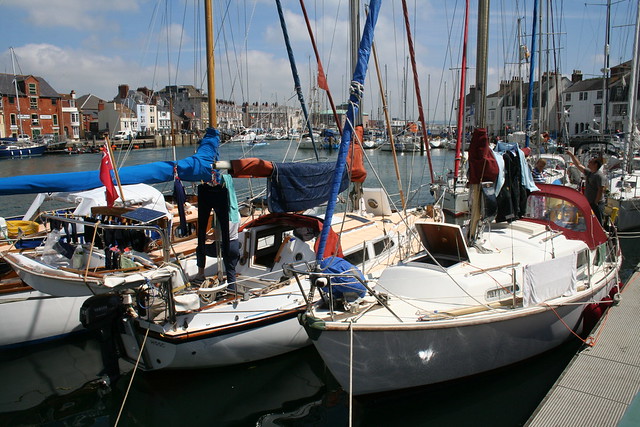
Why the Welly Centaur will be better and safer than a donkey Centaur

Dylan, correcting my earlier post, it was an MD1B, supposed to be 9hp IIRC.
Not enough really,she would stop dead in a big trough and be slow to get going again.
 
I have

Dylan
Have you considered the effect on boat balance by removing the inboard & putting an outboard further aft?
Or is that not a problem on outboard driven centaurs

the well will lose me 28kg of boyancy

the engine weighs 40 kg

the old engine is 250 kg

so the boat will be quite a bit lighter

but I will have a nice big cupboard under the cockpit

so I can re-trim the boat - with bags of gravel if necessary

however,the yanks who put an outboard on the back of their Centaur built a double berth there

so we shall see

I am also not sure that centaurs are big on trim

by my calculations she will float about 1.5 cm higher when averaged over the whole boat

..... there is a lot to play for

Dylan

old Centaur sought

dylan.winter@virgin.net
 
Dylan

I've checked again and the engine on Ken Endean's Sabre is a 9.9 so I'm wrong on the 15hp being needed. I've found the article in the association handbook, photographed it, and I'm about to send it to you, however I'm sure there was another article about re-engining but I can't find it in any of the association magazines I have. However I'm pretty much positive that Ken has re-engined at some point (ie onto his second outboard) so it's possible he went bigger on engine number 2?He does present a very balanced view on the merits of both types of power source...happy reading.
 
Not a great shot but here's Ken's boat outside my own a few years ago in Weymouth. Engine in raised position.

Edit...just checked the hi res pic and nope, it's still only a 9.9.

5060364095_fb89a18dea_z.jpg
 
Last edited:
Nooooo....

The story: my MD1B gearbox exploded, so I ended up fitting the Tohatsu 9.8 from my previous boat. The existing o/b bracket decided to fail in heavy seas off France and I had to recover the engine with the boat bouncing all over the place, then sail into Braye with no motor. The bracket was replaced with one as heavy duty as possible and as low as sensible. The (long shaft) motor would regularly cavitate in the entrance to harbours, reducing the available thrust to about 3hp, often enough to only barely make progress against the ebb. As for using it to round a headland against wind or tide, forget it, unless it was flat calm.
I bought a used Nanni 14hp which turned out to be only 10 hp. However, it fitted easily to the old bearers, the total cost of fitting was less than a good new outboard, it weighs only about twice the weight of the o/b, the weight is in the middle of the boat, it produces electricity at a sufficient rate of amps, it starts on the button, it propels Sevenem at five knots be it flat calm or wind and waves, it's quieter than the Volvo with less vibration amplitude, it's much more civilised in terms of NVH than an outboard, it runs on diesel, it doesn't use much fuel and most importantly of all it goes donk donk donk!

If I pick up some fishing gear it would possibly be more annoying, but in my experience, an inboard, even a Centaur's, is far far less likely to hook fishing gear or any other debris than an outboard. If you're really worried, get a big bread knife and jubilee clip it to a bent metal pole so you can reach around the bilge. If really really worried get a cutter fitted.

As far as I can see it, the only real disadvantage is prop drag and that could be mostly overcome with a folder, which would probably also be less inclined to foul at least when not running...
 
well done for contributing

The story: my MD1B gearbox exploded, so I ended up fitting the Tohatsu 9.8 from my previous boat. The existing o/b bracket decided to fail in heavy seas off France and I had to recover the engine with the boat bouncing all over the place, then sail into Braye with no motor. The bracket was replaced with one as heavy duty as possible and as low as sensible. The (long shaft) motor would regularly cavitate in the entrance to harbours, reducing the available thrust to about 3hp, often enough to only barely make progress against the ebb. As for using it to round a headland against wind or tide, forget it, unless it was flat calm.
I bought a used Nanni 14hp which turned out to be only 10 hp. However, it fitted easily to the old bearers, the total cost of fitting was less than a good new outboard, it weighs only about twice the weight of the o/b, the weight is in the middle of the boat, it produces electricity at a sufficient rate of amps, it starts on the button, it propels Sevenem at five knots be it flat calm or wind and waves, it's quieter than the Volvo with less vibration amplitude, it's much more civilised in terms of NVH than an outboard, it runs on diesel, it doesn't use much fuel and most importantly of all it goes donk donk donk!

If I pick up some fishing gear it would possibly be more annoying, but in my experience, an inboard, even a Centaur's, is far far less likely to hook fishing gear or any other debris than an outboard. If you're really worried, get a big bread knife and jubilee clip it to a bent metal pole so you can reach around the bilge. If really really worried get a cutter fitted.

As far as I can see it, the only real disadvantage is prop drag and that could be mostly overcome with a folder, which would probably also be less inclined to foul at least when not running...


your fame has spread and I was emailed pictures of your excellent treatise on powering your Sabre 27 with a 9.9hp engine

as you said right at the top of the piece the outboard was the cheaper option at the time

I was re-assured by your fuel consumption figures of 1.25 litres per hour flat water at 4 knots

you also said that the engine could drive the hull at up to 6 knots when required

the Sabre is 27 foot long and 250kg more than a Centaur so I am assuming that I can get the Centaur going at five

mine will also be slightly lighter than as designed - unless I add more ballast

Your first off the shelf outboard bracket broke up and you had to make a much tougher one

I am assuming that my outboard will not leave the water in a chop the way yours did occasionally

The outboard in my well will also be 4 inches above the cockpit floor - the same as yours

although the cockpit in a Centaur is reputedly closer to the water than yours is

this only gives me just over 8 inches of freeboard - although this is at the flat section of the stern in front of the rudder rather than at the extreme stern.

Katie L has about 8 inches of freeboard in her well

the water has never threatened to come in through the well and she has a canoe stern with scant reserves of boyancy. her well is right at the back of the boat close to the stern humg rudder

also my prop will generally be lower in the water than your was

althjough it is the same depth as Katie L which is driven by a long shaft outboard

so I will have to check with Tohatsu to see if the 9.8 is happy running at greater depthj


Of course, at the end you eventually decided to re-engine with an inboard

and there is no doubt they are superior in almost every way

save price....and exposure to lobster pots

any chance of giving me an indication of the costs involved in replacing the engine

is your great article available anywhere on line so that other people can read it

I have also been sent this link to a 52 litre fuel tank with wheels and pump

$130

http://www.sceptermarine.com/flongo_systems/

160_06792.jpg


Dylan

looking for an unloved Centaur

dylan.winter@virgin.net
 
Last edited:
One hates to encourage this folly, but is there any reason why the existing fuel tank in the emasculated Centaur can't be used for petrol?

Safer to keep the whole fuel system outside or in a separate location. That's the way it is done on sailing boats with petrol engines as designed. Don't know what petrol mobos do.
 
One hates to encourage this folly, but is there any reason why the existing fuel tank in the emasculated Centaur can't be used for petrol?

Good question there Vara


one assumes that after standing in a yard for five years it would be full of crud and diesel bug

and I have learned that outboards hate dirty fuel even more than inboards

rule 4 here

http://www.keepturningleft.co.uk/blogs/the-cardinal-commandments-of-successful-sailing/

my philosophy was - if in doubt - take it out - but I am open to new learning on this issue
 
...one assumes that after standing in a yard for five years it would be full of crud and diesel bug...my philosophy was - if in doubt - take it out - but I am open to new learning on this issue.

On my unanimously-piddled-upon questions about electric auxiliaries (I'm not bringing that up - my own private obsession) it occurred to me that full diesel tanks would weigh considerably more than the engine they fueled...and that the empty tank itself would be no lightweight. So getting rid of the diesel would doubtless save lots of weight...

...although, 230kg does sound almost double what I thought the engine in question weighs. I lately looked at Yanmars...the 9hp weighed about 76kg, the 14hp weighed 113kg and the 21hp weighed 120kg (those figures were dry weight without gears, which might add 10kg according to the spec sheet). But 250kg? That would be inclusive of full tanks I guess.

250kg would be a monstrous 110hp 4 cylinder Yanmar. A snip at £14,400...(I promise I'll buy the CD of you surfing round the Shetlands, planing past MacGregor 26s... :cool:)

250kg...if you took that much weight out of a Centaur, you could fit a couple of 48volt Lynch motors and a bank of deep-cycle batteries...hmmm... :rolleyes:
 
On my unanimously-piddled-upon questions about electric auxiliaries (I'm not bringing that up - my own private obsession) it occurred to me that full diesel tanks would weigh considerably more than the engine they fueled...and that the empty tank itself would be no lightweight. So getting rid of the diesel would doubtless save lots of weight...

...although, 230kg does sound almost double what I thought the engine in question weighs. I lately looked at Yanmars...the 9hp weighed about 76kg, the 14hp weighed 113kg and the 21hp weighed 120kg (those figures were dry weight without gears, which might add 10kg according to the spec sheet). But 250kg? That would be inclusive of full tanks I guess.

250kg would be a monstrous 110hp 4 cylinder Yanmar. A snip at £14,400...(I promise I'll buy the CD of you surfing round the Shetlands, planing past MacGregor 26s... :cool:)

250kg...if you took that much weight out of a Centaur, you could fit a couple of 48volt Lynch motors and a bank of deep-cycle batteries...hmmm... :rolleyes:

this says 200kg

http://www.boatshop24.com/en/volvo-volvo-penta-md11-md17/Engine/2889

sans gear box so I reckon I will be taking out 300kg counting gear box, drive shaft, prop, fuel tank
 
this says 200kg

http://www.boatshop24.com/en/volvo-volvo-penta-md11-md17/Engine/2889

sans gear box so I reckon I will be taking out 300kg counting gear box, drive shaft, prop, fuel tank

Fair enough..although (and I must confess almost complete ignorance) "200kg" sounds like a vague approximation, as well as being much, much heavier than equivalent Yanmars.

Regarding electric auxiliaries (and NO, I'm not attempting any thread drift here)...

I know someone who has done just that to a Victoria 800, which is about the same size and weight as a Centaur.

Love to hear about it. I know it wouldn't suit the vast majority, but I'm still entranced by the idea of silent thrust, whose very limitations encourage sailing as the main motive power.
 
Top