Why is my alternator only producing 30amps?

Otter

Well-Known Member
Joined
23 Nov 2004
Messages
10,974
Location
Norfolk
Visit site
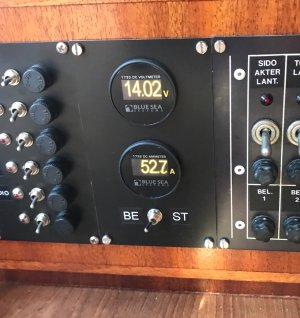
This is a weird one on a new to me LM30. Volvo Penta 2030 with the alternator going to a three way split charge jobbie to house bank, starter and thruster/windlass battery. The house bank is 330amps in total, all new. The starter and windlass batteries were fully charged.

Running the engine the last few days the NASA battery monitor said there was never more than 30amps going into the house bank, even for example after 18 hours of fridge, lights, iPad, Eberspacher heater etc etc. Is it possible that the split charge device is limiting each of the three banks to 30amps and that even if the engine and thruster batteries are full, never more than 30amps of the alternator can go to the house bank? If so that’s bananas and what do I do about it?
 
This is a weird one on a new to me LM30. Volvo Penta 2030 with the alternator going to a three way split charge jobbie to house bank, starter and thruster/windlass battery. The house bank is 330amps in total, all new. The starter and windlass batteries were fully charged.

Running the engine the last few days the NASA battery monitor said there was never more than 30amps going into the house bank, even for example after 18 hours of fridge, lights, iPad, Eberspacher heater etc etc. Is it possible that the split charge device is limiting each of the three banks to 30amps and that even if the engine and thruster batteries are full, never more than 30amps of the alternator can go to the house bank? If so that’s bananas and what do I do about it?
The amount of amps is determined by what the battery can absorb NOT what it is capable of producing. You don't say what size your bank is but 30A is high unless the bank is large or the SOC is low. You will get higher absorption with low SOC but once you get over 80% it tails of. AGMs generally have higher absorption rates than LA - 35-40% maximum compared with 20-25% for FLA. These are however maximum for flat batteries so when you are only "topping up" absorption will maybe half that. I don't think I have ever seen a charge as high as 30% on a 270Ah bank. After an initial 25A when first starting the engine it typically falls to 12-15A and once at absorption cycle down to 1-2 A.

So nothing weird at all. Lithium will take much higher charge rates but even then unless you have a large bank it is normally limited to 30A as any higher means you have to run the engine at high revs and risk overheating the alternator. Clearly if you change to a 100A alternator as on the later D1 engines you can up the charge rate for lithium, but even then 50A is normally the limit. Fitting a larger alternator to your existing set up won't help and anyway you would need to change the pulleys and belts to deal with the higher outputs. One sensible move would be to fit some solar which reduces the net usage and ensures the batteries are always fully charged when you are not there. Plugging into shorepower achieves similar but does not help when at anchor and consuming.
 
Yes at least - should put 50+ Amps into a moderately depleted bank?
I would not hold your breath on that!

So many things can affect theoretical output under ideal conditions to what happens in real life.

We had a 110Amp Balmar with the Balmar 'Smart Regulator', fitted as OE by Island Packet.

44O AH AGM house bank, two fridges running 24/7 when we were aboard, often a Dometic 40 litre freezer box too.

Never saw more than 35 amps going into the house bank. As we were never short of battery power, even pre our modest Solar install, never considered it an issue. It was enough to keep everything up to scratch.

If it aint broke, dont fix it!
 
The amount of amps is determined by what the battery can absorb NOT what it is capable of producing. You don't say what size your bank is but 30A is high unless the bank is large or the SOC is low. You will get higher absorption with low SOC but once you get over 80% it tails of. AGMs generally have higher absorption rates than LA - 35-40% maximum compared with 20-25% for FLA. These are however maximum for flat batteries so when you are only "topping up" absorption will maybe half that. I don't think I have ever seen a charge as high as 30% on a 270Ah bank. After an initial 25A when first starting the engine it typically falls to 12-15A and once at absorption cycle down to 1-2 A.

So nothing weird at all. Lithium will take much higher charge rates but even then unless you have a large bank it is normally limited to 30A as any higher means you have to run the engine at high revs and risk overheating the alternator. Clearly if you change to a 100A alternator as on the later D1 engines you can up the charge rate for lithium, but even then 50A is normally the limit. Fitting a larger alternator to your existing set up won't help and anyway you would need to change the pulleys and belts to deal with the higher outputs. One sensible move would be to fit some solar which reduces the net usage and ensures the batteries are always fully charged when you are not there. Plugging into shorepower achieves similar but does not help when at anchor and consuming.
Original post says 330amp domestic bank. I would have guessed it had used about 110amps by the time we started charging.

What caused the confusion is that each of the four times we charged it only ever showed 30amps max.
 
I would not hold your breath on that!

So many things can affect theoretical output under ideal conditions to what happens in real life.

We had a 110Amp Balmar with the Balmar 'Smart Regulator', fitted as OE by Island Packet.

44O AH AGM house bank, two fridges running 24/7 when we were aboard, often a Dometic 40 litre freezer box too.

Never saw more than 35 amps going into the house bank. As we were never short of battery power, even pre our modest Solar install, never considered it an issue. It was enough to keep everything up to scratch.

If it aint broke, dont fix it!
Thank you that’s very reassuring to know 👍👍
 
Original post says 330amp domestic bank. I would have guessed it had used about 110amps by the time we started charging.

What caused the confusion is that each of the four times we charged it only ever showed 30amps max.
Sorry I saw that but the 270 was my boat with 115A alternator. I used that to show that a larger alternator does not make any difference.

110A out means SOC is well above 50% so acceptance rate will be much lower than the maximum. 30A is 10% roughly and quire normal.
 
Sorry I saw that but the 270 was my boat with 115A alternator. I used that to show that a larger alternator does not make any difference.

110A out means SOC is well above 50% so acceptance rate will be much lower than the maximum. 30A is 10% roughly and quire normal.
Thank you 👍👍👍👍👍
 
I would have guessed it had used about 110amps by the time we started charging.
As already mentioned, the relatively high state of charge explains the charging current seen.
For comparison, below is over 50 A going into my well depleated AGM house bank of 270 Ah. 70 A alternator and the engine running at about 2 000 rpm. Battery voltage just before charging began was 12,27 V with all loads turned off, so probably a SOC of around 30 percent or so.
As can be seen from the low voltage reading, the charging is clearly in bulk phase.
charging current.jpg
 
So many factors will limit the charge from an alternator in to LA batteries. To get a large charge in to batteries will usually require 14 .5 volts or so. Your alternator may not be able to maintain 14.5 volts at the high current you hope for. (alternator claimed rating)
Alternator output is determined by alternator RPM (engine speed and pulley ratios) and may be temperature limited. Then there is the wiring and the splitter which may limit current flow. I would not imagine your splitter will deliberately limit current flow but may provide some restriction. (all assuming it is a no volt drop splitter)
So your 30 amps actual delivery might be good. ol'will
 
This is a weird one on a new to me LM30. Volvo Penta 2030 with the alternator going to a three way split charge jobbie to house bank, starter and thruster/windlass battery. The house bank is 330amps in total, all new. The starter and windlass batteries were fully charged.

Running the engine the last few days the NASA battery monitor said there was never more than 30amps going into the house bank, even for example after 18 hours of fridge, lights, iPad, Eberspacher heater etc etc. Is it possible that the split charge device is limiting each of the three banks to 30amps and that even if the engine and thruster batteries are full, never more than 30amps of the alternator can go to the house bank? If so that’s bananas and what do I do about it?
What is this three way split charge jobbie ?

If it's a diode splitter is the alternator battery sensed ( and sensing the house bank). If not then perhaps it should be ,

Or do you in fact have a modern low loss device such s a Victron Argodiode or Argofet
 
Larger alternators really only help when using a windlass or bow-thruster .... at least that's when mine produces the most output.

When depleted and bulk charging, the charge current for LA "leisure" batteries needs to be between 0.1C to 0.2C, start going to 0.3C and above and there is a risk of overheating and damage.

For the best compromise between long life and reasonably fast charging, 0.1C is a good place to be. On a 330Ah bank, that's 33A .... so I wouldn't worry.

My current boat has 520Ah LA bank for electric winches, electric furling, windlass, bow thruster plus 2 fridges and the rest of the electrical system, and a 100Ah starter battery. It is factory fitted with a 50A charger to cover all the 12V batteries - which is around 0.1C for the house bank.
 
Thank you for these helpful replies; much appreciated; reassuring and I know a lot more than I did before I asked.
 
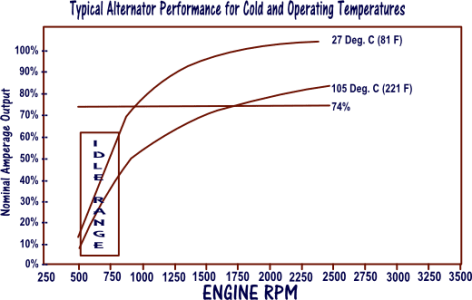
Nobody has mentioned engine rpm, you generally have to run the engine at 1500rpm or more to get decent power out of the alternator. Idle rpm isn't going to get your high charge output.

Although baggy talks of high consumers (the motors in thruster and windlass), it's likely the engine rpm will be idle when you're using them.

Try checking depleted battery charge current flow with a range of rpm, idle, 1,000, 1,250 and 1,500 rpm and see how that works.

Several old posts on the same subject on the forum inc ...

 
Nobody has mentioned engine rpm, you generally have to run the engine at 1500rpm or more to get decent power out of the alternator. Idle rpm isn't going to get your high charge output.

Although baggy talks of high consumers (the motors in thruster and windlass), it's likely the engine rpm will be idle when you're using them.

Try checking depleted battery charge current flow with a range of rpm, idle, 1,000, 1,250 and 1,500 rpm and see how that works.

Several old posts on the same subject on the forum inc ...

That's a very good point, I sit in neutral at around 1200rpm when pulling the anchor up ... which means the 12V alternator (115A) is spinning at around 2500 rpm.

Lithium batteries can charge at much higher currents (my Li batteries specify 1C as the max safe charge current, so 100A on a 48V battery) - attaching Lithium directly to standard alternators without a B2B Charger to limit the load leads to this ...


This following graph is generic max values (fully loaded) in %age of alternator rating, but as already stated above, it depends entirely on the applied load. All a standard alternator does is regulate to a voltage by pumping out more current as the load increases, up to the maximum it can produce before it overheats. In use these values are never seen.

1775725064308.png

The link below is a good article on alternator upgrades.

Alternator upgrade
 
Top