Why do tides get later quicker at neaps than at springs?

Midnight Drifter

Active Member
Joined
7 Mar 2017
Messages
54
Visit site
On average, tides get later every day by about 50 minutes. This is because the moon goes round the earth every 28 days, so after the earth has rotated once it takes an additional 1/28th of a day, or 24/28ths of an hour, to catch up and get back to the same position relative to the moon.

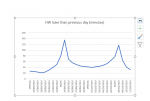
But the tide gets later much more around neaps than at other times. For example, at Dover:
- on 23 September (neaps) HW was at 0533, and the next day it was at 0748, 2 hours 15 minutes later
- today, 30 September (springs) HW was at 1253 and tomorrow it is at 1333, just 40 minutes later.

Can anyone explain why?
 
Full moon, the moon is going the same way as the earth, therefore the sun/moon/earth stay in alignment for longer than at new moon, when the moon is going the opposite way?
Neap tides are in between?
 
Full moon, the moon is going the same way as the earth, therefore the sun/moon/earth stay in alignment for longer than at new moon, when the moon is going the opposite way?
Neap tides are in between?

I am sorry but I don't understand that. Could you explain in more detail?
 
https://en.wikipedia.org/wiki/Orbit_of_the_Moon#/media/File:Moon_trajectory1.svg

Full moon, the moon is outside the earth's orbit, travelling in the same direction but slightly faster than the earth
New moon, it's inside the earth's orbit, same direction but slower, the earth is overtaking it.

It's easy to see that relative to the earth, it won't be orbiting steadily, it's less obvious exactly how it must vary.
 
https://en.wikipedia.org/wiki/Orbit_of_the_Moon#/media/File:Moon_trajectory1.svg

Full moon, the moon is outside the earth's orbit, travelling in the same direction but slightly faster than the earth
New moon, it's inside the earth's orbit, same direction but slower, the earth is overtaking it.

It's easy to see that relative to the earth, it won't be orbiting steadily, it's less obvious exactly how it must vary.

Springs happen at both full moon and new moon, and at both of them the time of HW advances more slowly than at neaps. Neaps occur half way between full moon and new moon,
 
Daily high tides are due to the moon (yeah, I know you know but...)
Springs/ neaps are due to the sun (lining up with the moon or not)

In a simple model both lunar and solar tides are sine waves. If you mix 2 sine waves you get the beating effect (neaps/springs) but also some phase angle funkiness, as shown by your observation.

For a less mathsy version:
Right on springs the sun and moon are doing the same thing. Just after springs the moon is falling behind. The moon high tide is advanced by the sun's high tide.
As you get to neaps the effect of the sun switches from advancing the moon's high tide to retarding it in order to line up at the next spring.
 
If it is due to the eccentric (elliptical?) orbit of the moon, then the moon must be at its closest approach to the earth, and therefore travelling faster, at neaps at the moent. This must be a coincidence, and should change during the year as the earth goes round the sun. I will check the tide times at other times of the year, and perhaps in other years.
 
Dover is at the junction of 2 tidal streams from the North Sea and the Channel, so only minor changes in the stream timings can make a bigger difference in the actual impact at Dover. The tidal atlas by Reeve Fowkes therefore used Cherbourg as its basis, where I think the difference are much smaller. Up on the Clyde, where again the tidal impact is not totally simple, the difference in day to day timings at neaps and springs are much smaller.
 
Dover is at the junction of 2 tidal streams from the North Sea and the Channel, so only minor changes in the stream timings can make a bigger difference in the actual impact at Dover. The tidal atlas by Reeve Fowkes therefore used Cherbourg as its basis, where I think the difference are much smaller. Up on the Clyde, where again the tidal impact is not totally simple, the difference in day to day timings at neaps and springs are much smaller.

I agree that the effect is not as marked at some places other than Dover, but it is still significant. For example, at both Greenock and Aberdeen HW is about an hour and a half later tomorrow than today (neaps) but last week at springs it only advanced about 45 minutes.
 
Daily high tides are due to the moon (yeah, I know you know but...)
Springs/ neaps are due to the sun (lining up with the moon or not)

In a simple model both lunar and solar tides are sine waves. If you mix 2 sine waves you get the beating effect (neaps/springs) but also some phase angle funkiness, as shown by your observation.

For a less mathsy version:
Right on springs the sun and moon are doing the same thing. Just after springs the moon is falling behind. The moon high tide is advanced by the sun's high tide.
As you get to neaps the effect of the sun switches from advancing the moon's high tide to retarding it in order to line up at the next spring.

So, my simplistic understanding from what you say is this. At full moon (springs) the moon and sun are in line and the tidal 'bulge' is moving around the earth at the same speed as the moon. Over the next few days, as the moon moves ahead of the sun, the sun holds back the bulge so that it lags behind the moon. Close to neaps, as the moon passes through 90 degrees from the sun, the bulge catches up with the moon and then goes ahead of it, thus moving fast. As the moon approaches alignment with the sun again at new moon (springs again), the bulge slows down and the moon catches up with it.

Does that make sense?
 
I think what you describe is what used in old days to be called the ‘priming and lagging of the tides’ - for a description see ‘Priming and Lagging’ by Henri Bencker at https://journals.lib.unb.ca/index.php/ihr/article/view/27018/1882519773.

Also, on definitions: ‘Priming and Lagging’ from E. E. Mann, followed by a comment from the Dr A T Doodson (a pioneer of tidal prediction) at https://www.cambridge.org/core/services/aop-cambridge-core/content/view/S0373463300036249

‘The Priming and Lagging of the Tides’ by J A Hardcastle at http://adsabs.harvard.edu/full/1905JBAA...15..312H has I think a diagram at the bottom of its first page which is the equivalent (for London Bridge for January to March 1904!) of yours for Dover at #14 - but the axes are not very clearly labelled.

For a more modern but very brief description in terms of the luni-tidal interval see: Section 2.1.2.1 'Time of Tide' at https://www.iho.int/iho_pubs/CB/C-13/english/C-13_Chapter_5.pdf
 
Additionally the earth orbit around the sun is elliptical. The sun also makes a significant contribution to tides so if we move nearer or further it will change the effect.

Another factor is that the high tide in the UK lags full moon by about two and a half days as it takes time to build up the resonance.
 
Additionally the earth orbit around the sun is elliptical. The sun also makes a significant contribution to tides so if we move nearer or further it will change the effect.

Another factor is that the high tide in the UK lags full moon by about two and a half days as it takes time to build up the resonance.

I can understand how these factors could affect tide times, but not why they could be a reason for the time of the tide advancing quicker at neaps than at springs.
 
At neaps, the driving force behind the tides is increasing, so it's reasonable that the tide time is more locked to that day's driving force, with left-over effects of previous days being at a minimum.

It's not trivial to unscramble the behaviour of the ocean tides from what we observe on our coast, which is very 'messed up' by our coastline.

The tide we observe on the south coast is a big wave which is about 6 hours reaching Dover from Plymouth.
 
Top