Why do so few cruising sail boats have a protected helm?

........
So why don't cruising sail boats have any models with protected a helm?


Many sailors come from a background of small sailing boats without engines and one of the attractions is getting out in the fresh air. You are coming from the opposite direction so it may seem strange to be in an open cockpit as a matter of course.
It you had a chance to try it, you might find the standard sprayhood offers a good level of shelter in most conditions. On passage the autopilot would be on and inshore you could be steering with a tiller in some comfort.
A lot of people like to do a bit a racing which more or less rules out a fixed shed but there is no doubt you could put one on any boat if you had a mind, steering via the autopilot.

If you really can't bear the thought, a 35ft ish Southerly (already mentioned) would be perfect, no draught problems for the ex mob'er to worry about and loads of sailing possibilities.
 
The Southerlies had (mostly) the benefit of size to carry the superstructure. However, they were prime examples of such features resulting in a very expensive boat so limited market.

They had models in the mid-30ft size for years, which I don't consider particularly large for a cruising boat. Their largest model for years was 42ft, it was only in the 00's that the bigger versions appeared.

They were built on a semi-custom production basis, which had far more to do with their cost than the fact they had a deck saloon with an inside helming position.
 
In the past I regularly sailed on a Moody Eclipse 43 with an internal steering position. The only time I can remember using the internal position was at night crossing the southern North Sea on a very cold calm night. This allowed us to watch all the shipping on the radar, but this was not perfect as a trawler did a sudden change of course a short distance in front of us. The loss of the feel of the conditions by being inside made it the unprefered steering position, especially when healed.

As an observation I have seen most of the dual position sailing boats changed during production runs from an internal wheel to an autopilot steering position and dropping the wheel completely.
 
Last edited:
There's a lot to be said for using an umbrella occasionally. I'm sure it is frowned upon but it is very convenient in showery weather. It can certainly save having to get fully dressed in oilies.
 
I have always thought of sailing as an "outdoor sport" your using the elements to drive the boat, so you need to be in them. I sail on the scottish west coast most weekends from april to october. A 2 week summer cruise where possible. We also sail one of those terribly unsuitable med-style french boats that seem so popular up here, strangely never yet had a wave in the cockpit. I have never felt the need for a wheelhouse. Good kit - yes, and a decent boat heater is sometimes a help, but we always sleep with hatches open. I am not a tough-nut, and I am not accusing people of being softies, but it really isn't that wet, or cold outside most of the time in the above months.
 
The simple answer is demand. They are not what the majority of people want, so they are not made in any large numbers. That means that what is made is expensive.

There have been enough examples over the years of boats with sheltered helming positions to be satisfied that if the market was there then they would be made in large numbers.
 
The simple answer is demand. They are not what the majority of people want, so they are not made in any large numbers. That means that what is made is expensive.

There have been enough examples over the years of boats with sheltered helming positions to be satisfied that if the market was there then they would be made in large numbers.

760 of these were produced - although not all with the hard top. I think the latter is a very attractive looking boat - but tastes are personal.

http://www.hallberg-rassy.com/yachts/previous-models/hallberg-rassy-rasmus-35/
 
They had models in the mid-30ft size for years, which I don't consider particularly large for a cruising boat. Their largest model for years was 42ft, it was only in the 00's that the bigger versions appeared.


i know, but they had high freeboard (needing a step in the topsides for boarding) and superstructure that looked like it came off a 60s block of flats.

Two helm positions plus of course the expensive keel added costs even before the inefficiencies of the build process. Demand would always be limited, partly because they were not attractive to many buyers.

As I suggested, worthy though they are, they illustrate perfectly why such boats are not big sellers.
 
Some interesting comments and discussion.. I hadn't considered the autopilot aspect and that you can shelter behind the spray hood and make slight course corrections using the autopilot.. Still I know what a huge difference moving from a canvas covered open boat to a pilothouse made for us on the motorboat so don't really get the reason they have never been more accepted and more popular in the sailing world when there have been attempts to create them.. I guess that's just the way it is.. :)
 
760 of these were produced - although not all with the hard top. I think the latter is a very attractive looking boat - but tastes are personal.

http://www.hallberg-rassy.com/yachts/previous-models/hallberg-rassy-rasmus-35/

That was a boat of its time (and a very long time ago). You have to look at it in the context of what was available at the time, and the hull design was pretty mainstream based on earlier wooden boat design. It was made in two countries for many years, but the majority of sales were in Scandinavia where it suited the style of sailing.

However, sales eventually dried up as much greater choice of boats became available and buyers' expectations changed. Notable that HR did not replace it with a similar concept boat - its time had passed.

Of course there are still people who like than sort of boat - just are not prepared to spend the £300k a new one might cost when you can get a usable example for a tenth of that!
 
Because the mass-market models are designed for the Med and Carribean, especially for charter fleets. Economies of scale make these so much cheaper that boats properly designed for northern-european weather have struggled to sell well.

Except that very few of the expensive Scandinavian sailing yachts have wheelhouses either - but instead tend to have large sprayhoods plus glass windscreens (eg HR, X-Yachts, Malo and Najad as they were.
One key factor in my view is the fact that sailing boats being used as sailing boats tend to heel - and it is typically more comfortable when steering to be sitting on the cockpit coaming at an angle. Sitting inside trying to steer at an angle of heel would be very uncomfortable.
Under autopilot, whether motoring or longer passages under sail, watch keeping can easily be done in many boats sitting on the companionway steps, sheltered by the sprayhood and ideally looking through an HR/X-Yachts/Malo windscreen :-)
Been sailing every month this winter on the Clyde and not needed oilskins on yet. Most days seen a Fisher out as well, with crew inside wheelhouse - but equally never seen their sails hoisted (which is fine, each to their own, but suggesting not so conducive to winter sailing)
 
It may be worthwhile me adding that I reckon a sailing boat with an inside helm instead of an outside helm, is only a small improvement in my view; the big step forward is to have both, allowing as much masochism or hedonism as the owner feels he deserves, hour by hour. :

Absolutely correct in my opinion!
 
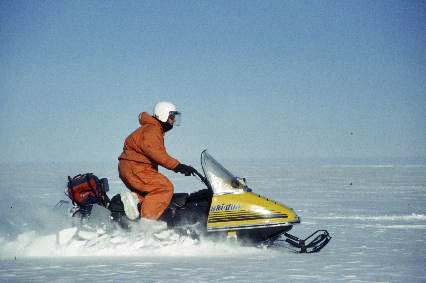
I've always thought it odd that, in temperate climates we travel in heated / air conditioned boxes but in polar regions they seem to prefer to perch on open Ski Doos.
 
I've always thought it odd that, in temperate climates we travel in heated / air conditioned boxes but in polar regions they seem to prefer to perch on open Ski Doos.

7-types-main-5.png
veh_skidoo.jpg


landrover-fd-040_0.jpg
Special-App-003-L.JPG


:)

Pete
 
Yes and no. An inside steering position demands a lot of space and so that will rule out smaller boats because no one will accept the remaining living space as acceptable. As boats gets bigger it becomes possible but the reality is that boat like Discovery for example are driven with an Auto-pilot from inside. It is not necessary to have a wheel.

As I said in my earlier post the question is about a protected helm and I believe that you need a ketch to do that properly and that does add cost and again does not work well with smaller boats.
 
Top