
Who was right? (or wrong?)

Zen Zero

Well-Known Member
Joined
11 Mar 2011
Messages
1,591
Location
Boat:Syvota, Epirus, Greece. Me:Rome, Italy
Visit site
We had a fantastic Sunday regatta at our club on the Tyrrhenian coast, plenty of wind, big long waves and sunshine. It was only slightly marred by one unpleasant incident.
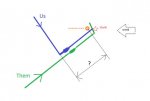

clonk.jpg


We asked for room at the buoy, they did not reply but bore away across our bow and we clonked them. Damage was very slight. We also touched the buoy and did a pirouette to avoid disqualification.

I am certain we were in the right because:

we were the leeward boat
their action (tacking) caused the collision,
we hailed for "room"
we were overlapped in the zone

We usually carry at least 1 lawyer in the boat, sometimes two, but no red flag, and our club races do not usually involve protests. The other boat hoisted a length of red electrical tape but subsequently removed it and in the end no protest was made.

There was confusion in our crew because we were not sure how many boat-lengths there were between us and the buoy when we tacked onto a track parallel to the other boat's. I'm certain it was more than 50m and we are a 14m boat. Another crew member thinks less. But I'm not even sure how relevant this is given the other details.

Discuss ... :-)
 
Last edited:
Were you overlapped as you came into the zone? In essence, it doesn't matter what happened before or after, if you had the overlap you had rights. If the overlap was broken at that moment, you didn't. But if you were still on port within the zone before you tacked, naughty naughty.

However, even if you didn't have rights, the other boat should not have gybed if it caused an unavoidable collision.

Some racers might pick me up on some of my language, and there are other technicalities too, however in essence that's about the size of it...
 
Last edited:
I am confused! At the buoy you had to jibe, not tacked. So, you asked for room instead of them? Room for what?
Anyhow, they jibed in front of you without asking for room. They were wrong.
 
Their fault. You were the leeward boat. Even if they had asked you for room you could still keep them on your startboard site for ever (theoretically of course) until they tack away or slow down and jibe behind your stern. Unless there was a danger in front of them.
 
We had a fantastic Sunday regatta at our club on the Tyrrhenian coast, plenty of wind, big long waves and sunshine. It was only slightly marred by one unpleasant incident.


View attachment 39831


We asked for room at the buoy, they did not reply but tacked across our bow and we clonked them. Damage was very slight. We also touched the buoy and did a pirouette to avoid disqualification.

I am certain we were in the right because:

we were the leeward boat
their action (tacking) caused the collision,
we hailed for "room"
we were overlapped in the zone

We usually carry at least 1 lawyer in the boat, sometimes two, but no red flag, and our club races do not usually involve protests. The other boat hoisted a length of red electrical tape but subsequently removed it and in the end no protest was made.

There was confusion in our crew because we were not sure how many boat-lengths there were between us and the buoy when we tacked onto a track parallel to the other boat's. I'm certain it was more than 50m and we are a 14m boat. Another crew member thinks less. But I'm not even sure how relevant this is given the other details.

Discuss ... :-)

Can't make your description match the diagram - as it looks like a bear away at the mark, but you say them tacking caused the collision?

Anyway, if I assume the diagram to be correct then it all hinges on when YOU tacked.

Rule 18 is the rule here - so let's have a look at 18.1.

18.1 When Rule 18 Applies
Rule 18 applies between boats when they are required to leave a
mark on the same side and at least one of them is in the zone.
However, it does not apply
(a) between boats on opposite tacks on a beat to windward,
(b) between boats on opposite tacks when the proper course at the
mark for one but not both of them is to tack,
(c) between a boat approaching a mark and one leaving it, or
(d) if the mark is a continuing obstruction, in which case rule 19
applies.

As you approach the mark you're overlapped on the same tack, and neither has to tack, so it looks like the definition of when 18 applies is satisfied.

18.2 Giving Mark-Room
(a) When boats are overlapped the outside boat shall give the
inside boat mark-room, unless rule 18.2(b) applies.
(b) If boats are overlapped when the first of them reaches the zone,
the outside boat at that moment shall thereafter give the inside
boat mark-room. If a boat is clear ahead when she reaches the
zone, the boat clear astern at that moment shall thereafter give
her mark-room.

So you were inside and entitled to mark room.

BUT You tacked, so that's not the end of the story and we need to look at 18.3

18.3 Tacking in the Zone
If a boat in the zone passes head to wind and is then on the same tack
as a boat that is fetching the mark, rule 18.2 does not thereafter apply
between them. The boat that changed tack
(a) shall not cause the other boat to sail above close-hauled to
avoid contact or prevent the other boat from passing the mark
on the required side, and
(b) shall give mark-room if the other boat becomes overlapped
inside her.

So when did you tack? Was it within 3 boat lengths of the mark? If it was, then you don't get mark room. This does not make them ROW boat, and may not actually prevent you from rounding the mark - as you are still leeward boat - but if you take them above close hauled then you've fouled them.

In short - you can only tack under someone in the zone if you're 100% certain that they are overstood and coming in with sheets eased.

If your tack was outside of the zone, and you were overlapped when you entered the zone - then you would have mark room, and as long as you satisfy rules 15 and 16, then you're going to be pretty safe in the room.
 
Even if they had asked you for room you could still keep them on your startboard site for ever (theoretically of course)

No, I was wrong

18.4 Gybing
When an inside overlapped right-of-way boat must gybe at a mark or obstruction
to sail her proper course, until she gybes she shall sail no farther from the mark or
obstruction than needed to sail that course.
 
Can't make your description match the diagram - as it looks like a bear away at the mark, but you say them tacking caused the collision?

Anyway, if I assume the diagram to be correct then it all hinges on when YOU tacked.

Rule 18 is the rule here - so let's have a look at 18.1.


As you approach the mark you're overlapped on the same tack, and neither has to tack, so it looks like the definition of when 18 applies is satisfied.


So you were inside and entitled to mark room.

BUT You tacked, so that's not the end of the story and we need to look at 18.3


So when did you tack? Was it within 3 boat lengths of the mark? If it was, then you don't get mark room. This does not make them ROW boat, and may not actually prevent you from rounding the mark - as you are still leeward boat - but if you take them above close hauled then you've fouled them.

In short - you can only tack under someone in the zone if you're 100% certain that they are overstood and coming in with sheets eased.

If your tack was outside of the zone, and you were overlapped when you entered the zone - then you would have mark room, and as long as you satisfy rules 15 and 16, then you're going to be pretty safe in the room.


We may have tacked in the zone - I think we didn't, another crew member thinks we might have; the fact is we were not paying attention and can not say for certain one way or the other; and neither can anyone else!

However we did not force them above close hauled and they were clear of the buoy when they bore away.

So I think we are innocent of infringing Rule 18.3.
 
If you were within 3 boatlengths then this applies:
18.3 Tacking in the Zone
If a boat in the zone passes head to wind and is then on the same tack as a boat that is fetching the mark, rule 18.2 does not thereafter apply between them.
The boat that changed tack
(a) shall not cause the other boat to sail above close-hauled to avoid contact or prevent the other boat from passing the mark on the required side, and
(b) shall give mark-room if the other boat becomes overlapped inside her.

If you were outside the zone and the overlap was established and maintained when the nearest boat reached the 3 boatlength zone then you had all the rights.

It is the length of the nearest boat to the mark which is used for the 3 length decision so if it was 7m the zone is 21m.

Not protesting is just too easy, and I am as guilty as anyone, and it does nought to solve anything. It may keep you out the bar for a moment or two but it does encourage learning and sailing to the rules.
 
We may have tacked in the zone - I think we didn't, another crew member thinks we might have;

Learning point. ALWAYS know this! Talk about it on the way in, decide between you if you're going to be tacking in the zone, and if you are, will that be an issue? If you're not sure, assume that it is in the zone, and plan accordingly.

Without putting too fine a point on it, if I was the other boat and you turned up in the room saying "I don't know if we tacked in the Zone, we might have done" I'm going to win that protest every time.

That said, it's perfectly possible to tack into an inside overlapped position in the zone and not foul, but it's a seriously risky move. If it's a high end regatta expect to see the starboard tack boats going bow down on you before you get there to ensure that there's no room for you to scrape in without taking them past close hauled. It's very rarely worth it unless the other boat is either very green, or very accommodating.

Picking up on something else from your OP - you said

I am certain we were in the right because:

.....
we hailed for "room"
....

This is irrelevant. There is only one hail in the rule book that means ANYTHING. And that is rule 20 - hailing for room to tack at an obstruction. All other hails "Starboard", "Room", "Water", "Get out of the way.." etc have absolutely no bearing on anything, all they do is help the people around you know what you're thinking.

You do not have to hail in order to be given room, it's the relative positions of the boats ONLY that invoke the rules.
 
I am rusty on racing rules but from the diagram, presumably the collision was eventually caused by the other boat bearing away at a point when you could not do so yourself. I understood that all boats are obliged to avoid collision, even when racing, so his correct action should have been to carry on past the mark and make a protest. Failure to make a protest is, I believe, an infringement of the rules in itself, so another competitor could have protested against him anyway. You were at liberty to make a risky tack and take your chance that a protest might go against you, at least, I think so.
 
Flaming has pretty much described the relevant rules. Minor points to add:

1) although the hail officially means nothing, it is worth hailing to claim the overlap as you approach the zone. You never know it might be acknowledged and you have a nice civilised rounding. In any event if the overlap is subsequently claimed to have been broken you have something to take into the protest room.

2) You didn't need to do a turn for hitting the mark as you were fouled - of course you have to be certain you were fouled.

3) Always protest. Make sure you can easily deploy the red flag. Even if you don't go to the protest room, you've laid down a line in the sand (water) and can discuss it with the other boat in the bar. No joy there, then protest room the next time. A minority will take the mick if they can get away with it and that ruins the racing for the others, so you're helping no one but the bad guys by not protesting.
 
It was in my time. Mind you, we didn't bother much about rules in those days, which is one reason most of us didn't get any better.
 
Been a while since I raced - did it used to be a single boats length clear to establish an overlap to become entitled to water at the mark ?

These days you need to complete the tack at least three boat lengths from the mark. That is come onto a close-hauled course, it doesn't matter when you get the sails trimmed in (at least not for rules purposes). Otherwise, as Flaming describes, if you tack within three boat lengths you can't force the windward boat above close hauled (note that doesn't mean you can't force them up to close hauled, but in practice it is one of these guilty until proven innocent situations)
 
Without putting too fine a point on it, if I was the other boat and you turned up in the room saying "I don't know if we tacked in the Zone, we might have done" I'm going to win that protest every time.

Without putting too fine a point on it, this is worth repeating. Your original diagram was good, but other details like 'they tacked' when clearly they didn't, will just get you thrown out of court. You might not always be right, but you should at least be able to describe what happened in an unambiguous way, even if it is only 'as you saw it'. As has been said, keeping a running commentary going on the boat as situations develop will help all the crew share their awareness of what's going on at any particular point in the race.
 
Rules in Oz and I am certain in ISAF now advocate mediation in a protest. So first step is to raise the red flag and hail the other boat "protest" . He can then decide if you are wrong and bluffing or if he is in the wrong. Often it is safer to do a720 degree penalty turn than risk disqualification. (especially after a contact.) I don't think you taking a penalty has to mean you are not protesting the other boat. If you stick to your guns and he does also then a protest is lodged. In our club a wise member will then discuss the situation with each skipper individually. He may be able to convince either protester to withdraw the protest or the protestee to retire from the race. This is a purely friendly assessment of the situation based on rules and precedents. If there is disagreement on facts or if both parties want to persue the protest then a formal hearing is set up. Often precedent will indicate which party is accepted as right in argument about facts. ie with port and starboard conflict it is enough for the stbd boat to have concerns rather than argue about whether a collision would have ocurred.
All very interesting but mostly I imagine a subject shunned by the cruisers of this forum. olewill
 

Other threads that may be of interest

Top