Who does machining for a mast hinge?

convey

N/A
Joined
26 Jun 2020
Messages
1,232
Visit site
Hi.

Does anyone know who does, or rather who has done, machining for a mast hinge?

Not a tabernacle, nor a hinged mast-step. but a hinge for a keel stepped, unstayed, alloy mast.

Any experience with difference designs welcome. About a 5" diameter mast.

I remember seeing a hinge and sleeve design, and another using a sort of ball socket device.

Thanks.
 
I have designed and made several different types of structural hinges for various round tubular devices.

My stainless steel dive boarding ladder has a sleeve and hinge arrangement but are all in stainless steel.

Before a sensible design the loads need to be specified.

I also made a clamp on hinge attachment for my deck 15 meter high stepped mast an lowering A frame so it could lower my mast short handed.

I am a long way from the UK where are you.

There are some pics on the web site link in my sig
 
Am I alone in struggling to understand where something described as a 'hinge' would fit with a keel stepped, unstayed mast?

There will be a socket, or other type of bracket, locating the bottom of the mast. There will be a ring (forgotten correct term), likely fitted with wedges or other adjustable grips, where the mast passes through the deck/coachroof and is supported by it.
 
Am I alone in struggling to understand where something described as a 'hinge' would fit with a keel stepped, unstayed mast?

I also struggle with a hinge on a keel stepped , unstayed mast.

My interpretation is the the OP wishes to be able to lower the mast without lifting the mast through the deck.

To put a hinge in the mast just above the deck would need a very strong locking hinge to take all the bending load where the mast goes through the deck.

That point is where the maximum bending moment and thus maximum load/stress in the mast that would all be taken by the hinge arrangement.

I would not consider that as it makes the mast more vulnerable to being lost in a big blow.
 
Am I alone in struggling to understand where something described as a 'hinge' would fit with a keel stepped, unstayed mast?

There will be a socket, or other type of bracket, locating the bottom of the mast. There will be a ring (forgotten correct term), likely fitted with wedges or other adjustable grips, where the mast passes through the deck/coachroof and is supported by it.
we have a Tee bar
 
My interpretation is the the OP wishes to be able to lower the mast without lifting the mast through the deck.
To put a hinge in the mast just above the deck...
That's also my interpretation. The OP made reference to a sleeve - I've certainly known of small boats with such an arrangement (Robin Blaine's boat, for one). A slightly larger tube that drops over the hinge, effectively disabling it, and making for a strong straight tube. So the hinge needs to be internal to the mast. (hmmm.... a different solution might be possible with the hige part of the sleeve)

I suspect this is for a small boat, possibly a trailer sailer (or even a dinghy). The loads, even for a freestanding mast, would be small enough to be contained with a good sleeve. And should be a very good and appropriate solution to the problem.

But back to the OP, I can't help with a manufacturer. But I'm sure the Junk Rig Association must have some designs in their archives
 
That's also my interpretation. The OP made reference to a sleeve - I've certainly known of small boats with such an arrangement (Robin Blaine's boat, for one). A slightly larger tube that drops over the hinge, effectively disabling it, and making for a strong straight tube. So the hinge needs to be internal to the mast. (hmmm.... a different solution might be possible with the hige part of the sleeve)

That's how I made the hinge on my dive/boarding ladder. My hinge 180 degrees so has 2 hinge pins but a single pin allowing the mast to hinge 90 degrees would be possible. The hinge bit is relative the attachment to the mast also needs a lot of strength particularly the wall thickness to take the loading tending to split the tube open with an internal attachment. With an outside attachment the tube could tend to buckle at the top or bottom of the hinge attachment.

But back to the OP, I can't help with a manufacturer. But I'm sure the Junk Rig Association must have some designs in their archives

Junk rigs are unstayed but could have a tabernacle which the OP says he has looked at but still have something that suits the OP
 
I also struggle with a hinge on a keel stepped , unstayed mast.

My interpretation is the the OP wishes to be able to lower the mast without lifting the mast through the deck.

Yes, the hinge above the deck, so the mast can be lowered without being lifted out. Not my boat, but in Essex. No tabernacle as a first choice, as the desire is for it to be clean looking. It's for a gunkholer extending their range up rivers and canals. Mast is about 8m total, although the idea is to raise that slightly with an extension holding the hinge below.

Seems Mr Blane is now dead, unfortunately, but someone must have machined them up for him. Saw mention of a Newbridge Ventura junk with one but they and their successors are now long shut down. Have seen a more tidy take on a tabernacle on a Herreshoff cat boat but it didn't look very strong, in essence, only half a pipe holding the mast.

I'm sure I saw a couple of options once that looked like two inserts into each half, one male & one female, the male having a, erm, proboscis that stuck itself into the lady part. One looking if it dropped into the hole, which left me wondering how you did the straight lift up, before folding back. The other just hinged back, i.e. was only held on 3 sides, and, hence, I presume was reinforced with a tightly fitting sleeve like the Newbridges have.

It's not clear to me how they lift up either.

Another had a welded flat plate, presumably with inserts again, that hinged and locked like on a Dawes Kingpin or Brompton bike.

Ta.
 
Last edited:
Your first question was about machining or making a fitting.
Any small local engineering shop could probably do that, if you can give them reasonably clear working drawings..
For design, look at the mast step on an MG-C 27 (there may be others similar), it has a plug fixed into the mast foot which has two lateral bolts holding it between the flanges on a step plate. Remove the forard bolt and swing it back down using the after bolt as the hinge pin. You'll need a pole to give purchase on whatever rope you'll use for lowering the heavy mast and standing rigging as it reaches deck level, and a way to keep the mast from swaying about or you'll damage something.
If you can find it, 'New Skipper's Sketchbook' in Practical Boat Owner mag #349 January 1996 page 107 shows several good ideas.
Lowering a mast is not as simple as you'd apparently like it to be ; me too !
By the way, the bit where the mast goes through the deck and any wedges which hold it there are called 'the partners'.
Best of luck with helping your friends,
Rob.
 
For design, look at the mast step on an MG-C 27 ... any wedges which hold it there are called 'the partners'.
I would have called the partners the reinforcing to the coachroof, and the wedges wedges. Don't know if it will translate as the MGC, Contessa is stayed.

Really, the idea is to find the shop that's already done a few sets. I've never sailed a boat with a working tabernacle. Obviously they work to a degree. No idea where the 'in extremis' point of their limitations is. It does not seem a bad solution to use what would basically be a keel stepped tabernacle. I can imagine problem arise from having a sleeve, like it corroding into place and being difficult to lift. Would have to be closely machined to match the reducing diameter of the mast.
 
Yes, thanks 'Convey'. The partners and their wedges are usually regarded as one entity, but of course the wedges if referred to separately would be referred to as 'wedges'.
My mention of that referred to an earlier post in which the respondent said he couldn't remember the word. I was just trying to be helpful.
I made no connection between that and the mast step on an MG-C 27.
I suppose by 'stayed' you mean that it is 'deck-stepped' ? Which it is.
Apart from Freedom and other such rigs, all masts are 'stayed', are they not ?
Rob
 
Is is a two-piece unstayed mast, keel-stepped, but hinged at (or above) the deck/coachroof and held in column while in action by a sleeve over the outside of the mast?
Yes, known in the trade as a TPUMKSBHATDAHICIABSOTOTM for short. Whew.


Junk rigs are unstayed but could have a tabernacle which the OP says he has looked at but still have something that suits the OP
Actually, not my boat in this case. I find it keeps me young to exercise what's left of my brain on new problems. Usually making them on the way.

That some junks have been built with tabernacles suggests that the forces involved aren't huge. A friend has a wooden boat. A typical flat bottomed, Thames-type, clinker built boat therefore, on one hand, it's not going to face seas of wrath and, on the other, bits of wood would not look entirely out of place. But, apart from sails and rigging fouling on it, don't they just come down to a couple of bolt and may be some tie downs around it?

How does their strength compare, pro or con, to a one piece mast?

I think the pay off would be how high does it need to be to be strong enough, and how would that affect how high the sail has to sit?

I did come up with this from a Marshall Marine cat boat. They do have a narrowly angled headstay though. Boat is about 18'. I'd want to belt and brace it with a sleeve at least. It has a handgrip hole in the front and you use your leg muscles to lift it. Yes, you would just be moving the failure point to above the sleeve and I don't know how long the insert is. I suppose you could use a really short stay to hold it down and in place.

The joint below it, I have no idea what it is.

I did see one clever idea for increasing the strength, someone used a long, tapered, cross-shaped section going up inside the mast several feet, so instead of having a specific fold point, the mast's flex was limited gradually.


84bff66f9f464a95ee13a29a11706920.jpgac3b73ea2028e7797bb0ee8e11883a8f.jpg
 
Last edited:
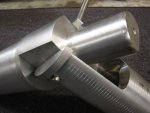
Here's someone's solution, making-the-mast-hinge 1, mast-hinge-design 2.

Also, courtesy of the reference to Blaine above, a boat of his that was sold. Not sure how it works, but it looks as neat as one could hope for.

Mast%20Hinge%20-%20Gigi.JPG


4%20Deck%20-%20Gigi.JPG
 
Excuse me while I think aloud and talk to myself.

I did find something out that address other concerns raised. Examining an old Needlespar mast, and checking with their site, they actually use "bonded" segments in the construction of their masts, allowing for different wall thickness etc at different parts of them.

I expected these to be welded, but they appear to be glued. Perhaps something they use in aviation construction? (question). Hence a machine insert could presumably be bonded too?

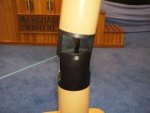
Probably the most boring photo ever uploaded but it looks like this. Off a 31' mast. Could not see how long an inner sleeve there was.

DSC00019 copy.jpg
 
Top